
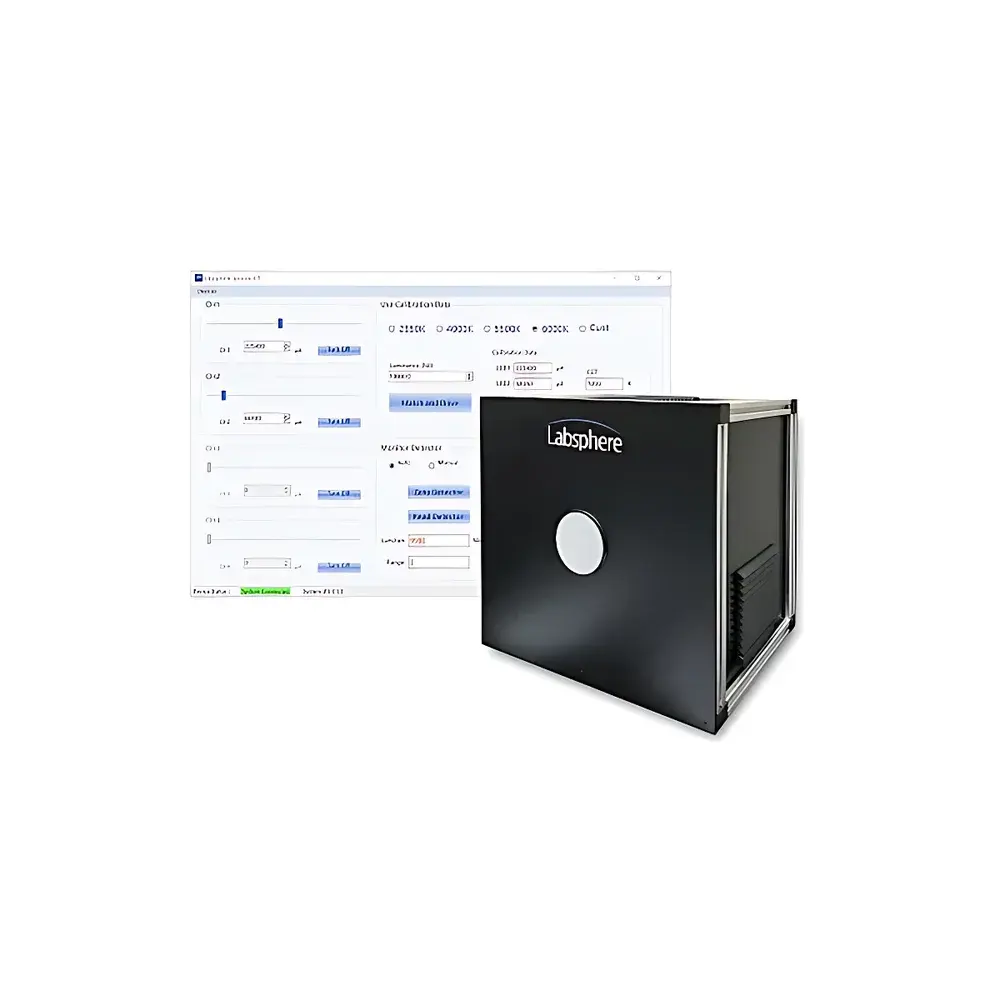
Labsphere Spectra-CT LED Integrating Sphere Uniform Light Source
| Brand | Labsphere |
|---|---|
| Origin | Shanghai, China |
| Manufacturer Type | Authorized Distributor |
| Product Origin | Domestic (China) |
| Model | SPECTRA-CT |
| Light Source Type | Tunable Broadband LED-Based Integrating Sphere Source |
| Illumination Method | Internal Illumination |
| Key Dimensions (CT-1000-S / M / L) | 20/30/50 cm sphere diameter |
| Output Aperture | 5/10/20 cm |
| Spectral Range | UV-Vis-NIR (250–1700 nm) |
| Luminance Range | 0.1–500,000 cd/m² (model-dependent) |
| Uniformity | >99% (per EMVA 1288 Annex A) |
| Color Temperature Range | 2800–7500 K |
| CCT Uniformity | ±15 K |
| Short-Term Stability | ±0.1% over 10 min |
| Warm-up Time | ≤30 s |
| Monitoring Sensor | Integrated Silicon Photodiode |
| Control Interface | USB + Ethernet |
| Software SDK | Yes (C/C++, Python, LabVIEW compatible) |
| Compliance | Fully supports EMVA 1288:2016 for camera characterization |
Overview
The Labsphere Spectra-CT LED Integrating Sphere Uniform Light Source is an engineered optical calibration standard designed specifically for high-fidelity radiometric and photometric characterization of imaging sensors and cameras. Operating on the principle of diffuse multiple-scattering within a precisely dimensioned integrating sphere cavity, the Spectra-CT delivers spatially uniform, temporally stable, and spectrally controllable luminance across its output aperture—enabling traceable, repeatable, and standards-compliant camera testing. Its core architecture leverages Labsphere’s proprietary Spectraflect® coating—a near-Lambertian, ultra-high-reflectance (>99% from 250 nm to 1700 nm) material—combined with optimized baffle geometry and internal LED array placement to minimize hotspot formation and angular dependency. Unlike traditional xenon or mercury arc sources, the Spectra-CT eliminates spectral discontinuities, flicker, and thermal drift while offering continuous tunability in both luminance (spanning six orders of magnitude) and correlated color temperature (CCT), making it uniquely suited for EMVA 1288:2016-compliant evaluation of quantum efficiency, photoresponse nonuniformity (PRNU), dark signal nonuniformity (DSNU), linearity, dynamic range, and temporal noise.
Key Features
- Ultra-high spatial uniformity (>99% across aperture, verified per EMVA 1288 Annex A)
- Continuous, linear luminance control from 0.1 cd/m² to 500,000 cd/m² (model-dependent)
- Dynamic CCT adjustment from 2800 K to 7500 K with ±15 K uniformity across field
- Integrated silicon photodiode with real-time feedback loop for luminance stabilization (±0.1% short-term stability)
- Active thermal management ensuring <0.2% luminance drift over 10-minute intervals
- Three scalable configurations (CT-1000-S/M/L) supporting apertures from 5 cm to 20 cm and sphere diameters from 20 cm to 50 cm
- Full software SDK (C/C++, Python, LabVIEW) enabling OEM integration and automated test sequencing
- Compliance-ready design: supports audit trails, parameter logging, and metadata tagging aligned with GLP/GMP documentation requirements
Sample Compatibility & Compliance
The Spectra-CT is compatible with all CMOS and CCD-based imaging devices requiring flat-field, linearity, and noise characterization—including area-scan and line-scan cameras, fisheye and 360° panoramic sensors, automotive ADAS cameras (AEC-Q200 ambient operating envelope), NIR/SWIR imaging modules, and imaging photometers and colorimeters. It satisfies the illumination requirements defined in EMVA 1288:2016 for measurement of absolute responsivity, PRNU, DSNU, saturation capacity, and temporal noise. The system’s spectral continuity and lack of emission lines ensure compatibility with spectral radiance calibrations referenced to NIST-traceable standards. While not a primary calibration artifact itself, the Spectra-CT is routinely deployed as a transfer standard in ISO/IEC 17025-accredited labs performing camera performance validation under controlled environmental conditions (23 ± 2 °C, <60% RH). Optional add-ons—including calibrated reference detectors, fiber-coupled spectroradiometers, and UV/NIR-enhanced coatings—enable extension into specialized regulatory workflows governed by IEC 62471 (photobiological safety) or MIL-STD-810H (environmental testing).
Software & Data Management
The Spectra-CT ships with Labsphere’s SpectraControl™ software—a Windows-based GUI supporting real-time luminance/CCT setpoint definition, live sensor readout, stability trending, and export of time-stamped CSV datasets. All user-defined parameters (luminance level, CCT, ramp rate, dwell time) are stored with ISO 17025-compliant metadata including timestamp, operator ID, and system serial number. The included SDK provides low-level API access for integration into custom vision test platforms (e.g., National Instruments TestStand, Keysight PathWave), robotic calibration cells, or Industry 4.0 MES environments. Audit trail functionality records all parameter changes, software version updates, and hardware status events—meeting FDA 21 CFR Part 11 requirements for electronic records and signatures when deployed in regulated manufacturing settings. Firmware updates are delivered via signed binary packages with SHA-256 checksum verification.
Applications
- EMVA 1288-compliant camera characterization: flat-field correction, linearity mapping, dark current analysis, dynamic range profiling
- Flat-panel display (FPD) inspection system calibration—especially for OLED, microLED, and Mini-LED panel metrology
- Automotive vision system validation: surround-view, rearview, and driver-monitoring camera calibration under variable CCT conditions
- Consumer electronics: smartphone, tablet, and AR/VR camera module qualification across production batches
- Scientific imaging: calibration of astronomical CCDs, fluorescence microscopy cameras, and hyperspectral line-scan systems
- Imaging photometry: reference source for luminance/illuminance meter verification per CIE Publication 122 and ISO/CIE 19476
- OEM R&D: development of next-generation global shutter sensors, stacked CIS architectures, and event-based neuromorphic imagers
FAQ
Does the Spectra-CT meet EMVA 1288 illumination requirements?
Yes—the Spectra-CT is explicitly designed and validated to satisfy all spatial uniformity, temporal stability, and spectral irradiance criteria specified in EMVA 1288:2016 Annex A for camera characterization.
Can the system be integrated into an automated production test station?
Yes—via the full-featured SDK, programmable USB/Ethernet interface, and deterministic command-response protocol, the Spectra-CT supports unattended operation in high-throughput AOI and functional test environments.
Is NIST-traceable calibration provided with the system?
Labsphere offers optional factory calibration services using NIST-traceable reference detectors; calibration certificates include uncertainty budgets compliant with ISO/IEC 17025.
What maintenance is required?
No routine optical recalibration is needed—the Spectraflect® coating exhibits negligible aging under normal operating conditions; annual verification of photodiode linearity and thermal stabilization performance is recommended.
Can the output spectrum be customized for narrowband applications?
Yes—custom configurations with monochromatic LED arrays (255 nm to 1650 nm), bandpass-filtered modules, or fiber-optic coupling to external spectroradiometers are available upon request.




