
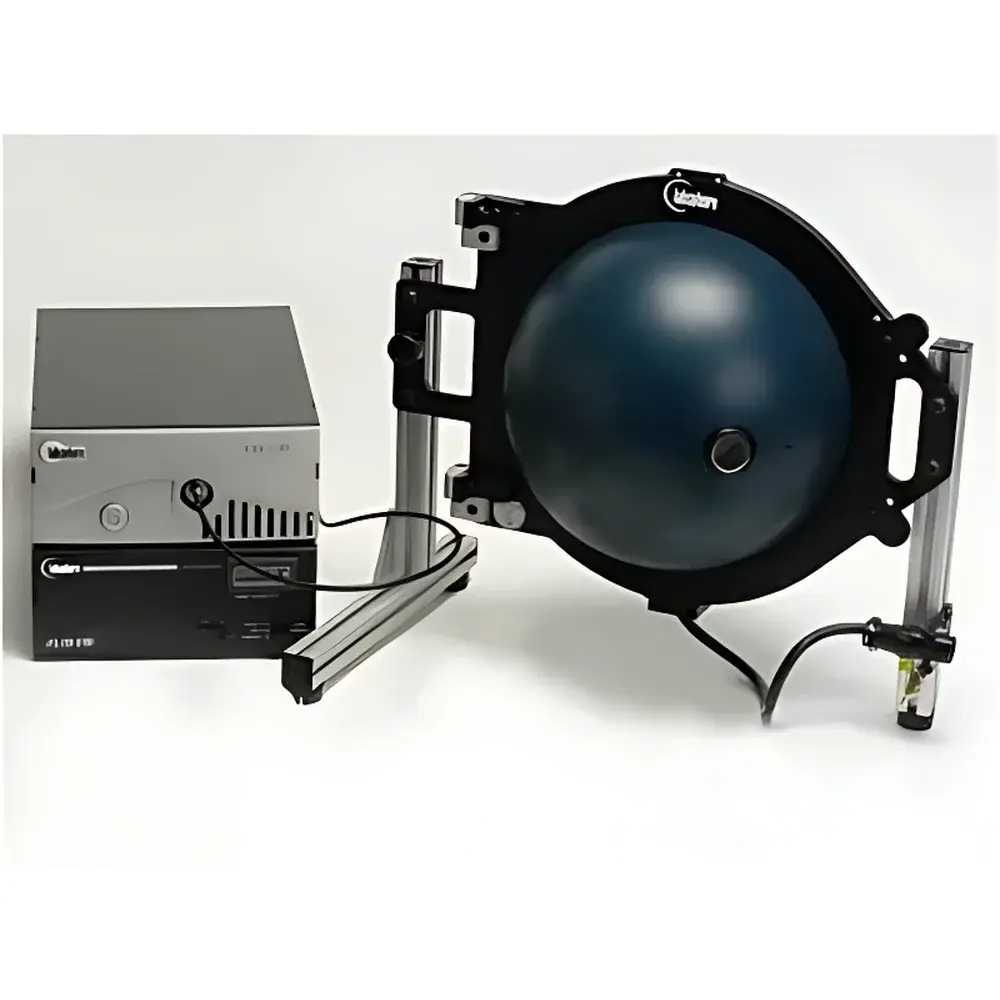
Labsphere Illumia Photometric, Radiometric & Electrometric Testing System
| Brand | Labsphere |
|---|---|
| Origin | USA |
| Manufacturer Type | Authorized Distributor |
| Origin Category | Imported |
| Model | Illumia |
| Pricing | Available Upon Request |
Overview
The Labsphere Illumia Photometric, Radiometric & Electrometric Testing System is a fully integrated, NIST-traceable optical measurement platform engineered for high-accuracy characterization of light sources across photometry, radiometry, colorimetry, and electrical domains. Built upon the foundational principles of integrating sphere photometry—specifically utilizing Lambertian-diffusing Spectraflect® coating—the system enables precise total flux (4π steradian) and hemispherical (2π steradian) measurements by controlling geometry-dependent collection efficiency and minimizing spatial non-uniformity errors. The Illumia architecture supports both source-in-center (for 4π full-flux integration) and source-on-wall (for 2π directional emission analysis) configurations, with optional correction algorithms for angular distribution bias per IES LM-79, CIE 127, and ISO/CIE 19902 standards. Its modular design accommodates interchangeable integrating spheres—from 2-inch diameter for chip-scale LEDs to 60-inch spheres for roadway luminaires—ensuring scalability without compromising measurement fidelity.
Key Features
- NIST-traceable calibration using primary standard lamps certified to NIST SRM 2030 and SRM 2032, enabling direct metrological traceability for spectral irradiance, luminous flux, and radiant power
- Dual-mode sphere geometry: configurable for 4π (source centered) or 2π (source mounted on sphere wall) measurement modes with built-in correction for self-absorption and angular response deviation
- Optional thermoelectrically cooled CCD spectroradiometers (e.g., Ocean Insight QE Pro or StellarNet Black-Comet series) delivering <0.1 nm wavelength repeatability and <1% photometric linearity over 350–1050 nm
- Labsphere’s proprietary auxiliary lamp compensation method mitigates systematic underestimation caused by sample absorption of internal sphere wall radiation
- Integrated electrical measurement module supporting DC/AC voltage, current, power factor, and forward voltage sweep up to 10 A / 100 V with 0.1% basic accuracy
- Real-time spectral acquisition at ≥10 Hz frame rate with simultaneous display of SPD, CIE 1931 chromaticity coordinates, CCT, CRI (Ra), R9, Duv, peak wavelength, dominant wavelength, purity, and FWHM
Sample Compatibility & Compliance
The Illumia system accommodates diverse light-emitting devices—including discrete LEDs, COB modules, OLED panels, fluorescent tubes, HID lamps, and streetlight assemblies—without requiring mechanical reconfiguration beyond sphere selection. All hardware and software comply with international photometric standards including IES LM-79-19 (Electrical and Photometric Measurements of Solid-State Lighting Products), CIE S 025/E:2015 (Test Method for LED Lamps, LED Luminaires and LED Modules), and ISO/CIE 19902:2017 (Integrating Sphere Systems for Measurement of Optical Radiation). Data integrity meets GLP/GMP documentation requirements, with audit trails, user access controls, and electronic signature support aligned with FDA 21 CFR Part 11 when configured with validated software packages.
Software & Data Management
Illumia Control Software provides a unified interface for instrument orchestration, real-time visualization, automated report generation (PDF/CSV/XLSX), and batch processing. Calibration files are stored in encrypted, version-controlled archives with checksum verification. Raw spectral data retain native resolution (≥3648 pixels) and support post-acquisition reprocessing with selectable smoothing, interpolation, and CIE observer functions (2° or 10°). Exported datasets include metadata compliant with ASTM E308-22 (Computing Tristimulus Values) and ISO 11664-1:2019 (Colorimetry – Part 1: CIE Standard Colorimetric Observers). Optional IQ/OQ documentation kits facilitate installation and operational qualification per ISO/IEC 17025 laboratory accreditation requirements.
Applications
- LED package and module development: spectral binning, efficacy mapping, thermal roll-off analysis under pulsed/DC drive conditions
- Lighting product certification: LM-79-compliant photometric reports for ENERGY STAR®, DLC, and CE marking submissions
- Display backlight characterization: narrow-band blue/green/red LED arrays used in Mini-LED and Micro-LED backlights
- R&D validation of phosphor-converted white LEDs: quantification of Stokes shift losses, quantum efficiency estimation via absolute quantum yield mode (with optional integrating sphere + excitation source)
- UV-C germicidal lamp validation: radiant exposure (J/m²) calculation, spectral hazard analysis per IEC 62471, and lifetime degradation trending
- Automotive lighting compliance testing: headlamp beam pattern correlation with near-field goniophotometer data using calibrated reference sources
FAQ
Is the Illumia system suitable for measuring UV and IR emitting devices?
Yes—when equipped with broadband spectroradiometers covering 200–1100 nm (e.g., with UV-enhanced optics and InGaAs detectors), the system supports radiometric quantification across UV-A/B/C and NIR bands.
Can users perform in-house recalibration without sending hardware to Labsphere?
Yes—the system includes dual-calibration lamp sockets and software-guided procedures for user-executed radiometric and photometric recalibration using NIST-traceable standard lamps.
Does the software support automated pass/fail evaluation against industry thresholds?
Yes—customizable limit templates allow rule-based flagging of CCT deviation (>±100 K), CRI Ra < 80, or efficacy below target thresholds, with exportable compliance summary dashboards.
What sphere sizes are available, and how are they selected?
Standard options range from 2″, 4″, 10″, 30″, to 60″ diameters; selection follows CIE 127:2007 recommendations based on source maximum dimension (D) and required d/D ratio ≥10 for minimal self-absorption error.
Is remote operation and data sharing supported?
Yes—via secure HTTPS-enabled web interface and RESTful API integration for lab information management systems (LIMS) and enterprise quality databases.





