
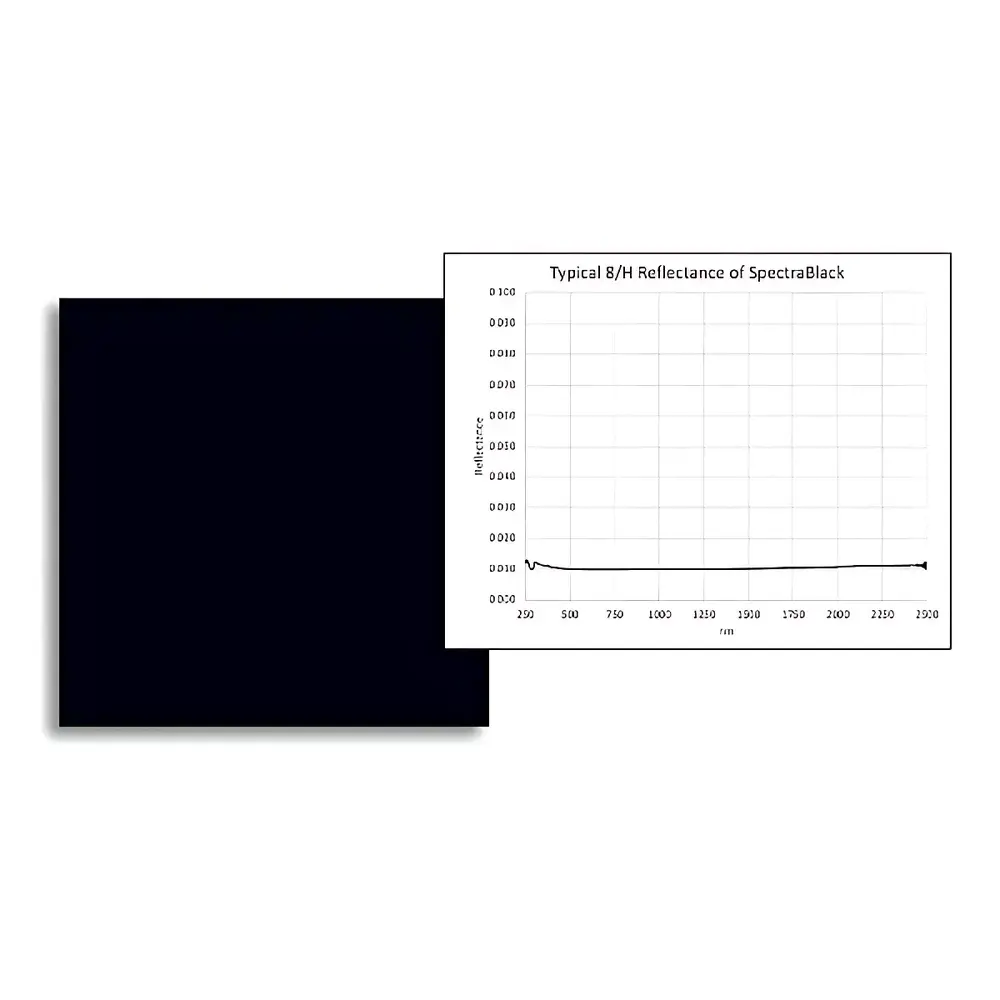
Labsphere SpectraBlack Low-Reflectance Diffuse Target Board
| Brand | Labsphere |
|---|---|
| Origin | USA |
| Model | SpectraBlack |
| Reflectance Range | <5% (250–2500 nm) |
| Surface Type | Micro-porous engineered matte black |
| Compliance | ISO 13694, ASTM E275, NIST-traceable calibration available |
| Material Composition | Carbon-loaded polymer composite with controlled pore structure |
| Operating Temperature | –40°C to +85°C |
| Durability | Abrasion-resistant, non-outgassing, low particulate shedding |
Overview
The Labsphere SpectraBlack Low-Reflectance Diffuse Target Board is a precision-engineered optical reference standard designed specifically for quantitative characterization of time-of-flight (ToF) sensors, LiDAR receivers, and other photodetector-based systems operating under ultra-low-reflectance conditions. Unlike conventional black paints or anodized metals—whose spectral reflectance varies significantly across UV-VIS-NIR bands and degrades with environmental exposure—SpectraBlack employs a proprietary micro-porous carbon-loaded polymer matrix that delivers spectrally flat, Lambertian-diffuse reflectance below 5% from 250 nm to 2500 nm. This uniformity enables traceable, repeatable measurement of system sensitivity, dynamic range compression, and noise floor performance in real-world sensor validation workflows. Its engineered surface geometry ensures minimal angular dependence (<±0.3% BRDF variation over ±45° incidence), making it suitable for both collimated and divergent beam geometries typical in automotive LiDAR test benches and industrial ToF camera calibration rigs.
Key Features
- Spectrally flat diffuse reflectance <5% across 250–2500 nm, validated per ISO 13694 and ASTM E275 methodologies
- Lambertian scattering profile with BRDF stability <±0.3% over ±45° viewing angles
- Mechanically robust micro-porous surface resistant to abrasion, cleaning solvents, and thermal cycling (–40°C to +85°C)
- Low outgassing and minimal particulate generation—certified compatible with cleanroom environments (ISO Class 5 compliant handling)
- Available in standardized formats (e.g., 100 × 100 mm, 200 × 200 mm) with optional mounting flanges and NIST-traceable reflectance certificates
- No fluorescence or phosphorescence emission under UV or NIR excitation—critical for low-signal photodetection validation
Sample Compatibility & Compliance
SpectraBlack targets are routinely deployed in ISO/IEC 17025-accredited metrology labs for calibrating radiometric and photometric instruments including integrating spheres, goniophotometers, and spectral radiometers. The material meets the optical stability requirements of IEC 60825-1 (laser safety testing), ISO 16508 (automotive LiDAR performance verification), and ASTM E308 (colorimetric measurement standards). Its non-hygroscopic composition eliminates reflectance drift due to ambient humidity—a known limitation of carbon-black coatings—and its thermal expansion coefficient (12 ppm/°C) matches common optical breadboard substrates, minimizing mechanical stress-induced measurement artifacts during long-duration tests.
Software & Data Management
While SpectraBlack itself is a passive optical standard, its integration into automated test systems is supported via Labsphere’s SpectraSuite™ software ecosystem. When paired with calibrated spectroradiometers (e.g., USB4000, QE Pro), SpectraSuite enables automated BRDF mapping, spectral deviation trending, and uncertainty propagation analysis per GUM (Guide to the Expression of Uncertainty in Measurement). Reflectance certificate data—including wavelength-resolved values, expanded uncertainty (k=2), and measurement geometry—is delivered in XML and CSV formats compatible with LabVIEW, Python (NumPy/Pandas), and MATLAB for statistical process control (SPC) and MSA (Measurement Systems Analysis) compliance reporting. All calibration records adhere to FDA 21 CFR Part 11 audit trail requirements when deployed in regulated OEM validation environments.
Applications
- LiDAR receiver sensitivity mapping across 905 nm and 1550 nm wavelengths using pulsed laser sources
- Time-of-flight camera linearity and depth accuracy validation at sub-5% target reflectance
- Stray light suppression in high-dynamic-range spectrophotometers and FTIR systems
- Optical cavity baffling and internal light trapping in satellite-borne Earth observation sensors
- Reference standard for ISO 14823-compliant automotive ADAS sensor testing protocols
- Calibration anchor for absolute irradiance measurements in UV curing and phototherapy device validation
FAQ
Is SpectraBlack suitable for outdoor exposure or only indoor laboratory use?
SpectraBlack is engineered for controlled indoor environments; prolonged UV exposure and moisture ingress may affect long-term reflectance stability. For field-deployable applications, Labsphere offers weatherized variants with protective quartz overcoats.
Can SpectraBlack be cleaned without altering its optical properties?
Yes—gentle wiping with lint-free wipes dampened with reagent-grade isopropyl alcohol (IPA) is recommended. Avoid abrasive cleaners, ultrasonic baths, or compressed air above 30 psi.
Does the reflectance value change with incident angle in collimated beam setups?
No—its micro-porous architecture maintains Lambertian behavior with BRDF variation <±0.3% over ±45° incidence, verified via goniometric measurement per CIE 110.
Are NIST-traceable calibration certificates included by default?
Certificates are optional but strongly recommended for ISO/IEC 17025 compliance; they include full spectral data, uncertainty budgets, and metrologist sign-off.
How does SpectraBlack compare to commercial black anodized aluminum in terms of stray light reduction?
Anodized aluminum exhibits strong specular components and wavelength-dependent reflectance peaks >15% in NIR—SpectraBlack reduces integrated stray light by >90% in typical optical enclosures due to its near-zero specular lobe and broadband absorption.





