
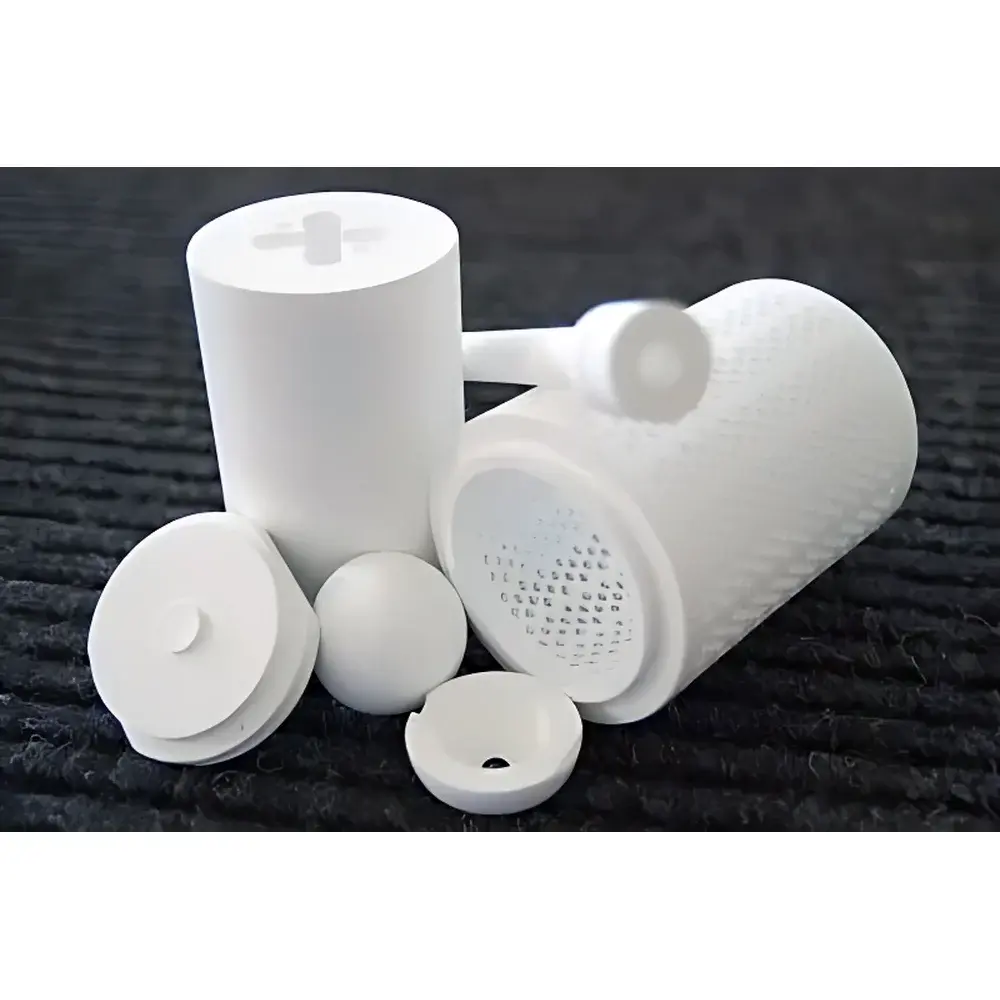
Labsphere Spectralon Diffuse Reflectance Standard
| Brand | Labsphere |
|---|---|
| Origin | USA |
| Model | Spectralon |
| Reflectance | >99% (400–1500 nm), >95% (250–2500 nm) |
| Lambertian Character | Excellent |
| Chemical Stability | Inert |
| Thermal Stability | High |
| UV Resistance | Certified for Space-Grade Exposure |
| Compliance | NASA/JPL, GSFC, TRW, CSEM Qualified |
| Form Factor | Custom-Machinable Solid PTFE-Based Material |
Overview
Labsphere Spectralon is a rigorously engineered diffuse reflectance standard manufactured from highly sintered polytetrafluoroethylene (PTFE) and optimized for spectral calibration, radiometric validation, and bidirectional reflectance distribution function (BRDF) characterization across ultraviolet, visible, and near-infrared (UV-VIS-NIR) spectral regions. Unlike painted or coated standards, Spectralon achieves its exceptional performance through intrinsic bulk scattering—its microstructure consists of isotropically distributed voids and crystallites that produce near-perfect Lambertian reflectance via volume scattering rather than surface reflection. This physical mechanism ensures minimal angular dependence, high spatial uniformity, and long-term photostability under repeated irradiation. Its certified reflectance exceeds 99% between 400–1500 nm and remains above 95% from 250–2500 nm, making it the reference material of choice for hyperspectral imaging systems, field-deployable spectroradiometers, and laboratory-grade integrating sphere coatings.
Key Features
- Ultra-High Diffuse Reflectance: >99% absolute reflectance in the 400–1500 nm range; >95% from 250–2500 nm—traceably calibrated against NIST-traceable standards.
- Exceptional Lambertian Behavior: Bidirectional reflectance deviates <±0.5% from ideal cosine law across incidence angles up to 60°, critical for BRDF modeling and radiometric intercomparison.
- Space-Qualified Durability: Validated per NASA JPL, GSFC, TRW, and CSEM protocols—including vacuum UV exposure (115–200 nm), proton fluence (>1 × 10¹⁵ p/cm²), atomic oxygen erosion resistance, Lyman-α radiation stability, and outgassing compliance (ECSS-Q-ST-70-02C).
- Thermal & Environmental Robustness: Stable performance from –40°C to +100°C; unaffected by humidity, ozone, or ambient atmospheric contaminants; no measurable degradation after >10,000 hours of continuous solar-simulated illumination.
- Chemically Inert Bulk Structure: Non-porous, non-hygroscopic, and resistant to acids, bases, solvents, and halogens—enabling use in cleanroom, semiconductor metrology, and aerospace environmental test chambers.
- Custom Fabrication Capability: Machinable into precision discs, cones, baffles, sphere liners, and apertured targets with tolerances down to ±5 µm; compatible with CNC, laser cutting, and diamond turning.
Sample Compatibility & Compliance
Spectralon is intrinsically compatible with optical systems requiring stable, spectrally neutral references—including Fourier-transform spectrometers (FTIR), UV-VIS-NIR spectrophotometers, drone-mounted multispectral sensors, and satellite-based Earth observation payloads. It conforms to ASTM E275, ISO 13406-2, and USP for reflectance standardization. For regulated environments, Spectralon supports full audit trails when integrated with GLP/GMP-compliant software platforms and meets data integrity requirements under FDA 21 CFR Part 11 when used with validated instrument control systems. Its low total mass loss (<0.05%) and collected volatile condensable materials (<0.01%) satisfy ECSS-Q-ST-70-02C for spacecraft hardware qualification.
Software & Data Management
While Spectralon itself is a passive standard, its spectral reflectance data are provided in standardized ASCII format (.csv and .spc) compliant with ASTM E275 Annex A1. Labsphere delivers NIST-traceable calibration certificates including uncertainty budgets (k=2) across full operational wavelength ranges. These datasets integrate seamlessly with industry-standard analysis tools such as MATLAB’s Optical Toolbox, Ocean Insight’s OceanView, and Thermo Fisher’s OMNIC. When deployed in automated calibration workflows—e.g., robotic spectroradiometer validation rigs—the material enables repeatable, operator-independent measurement chains with reproducibility better than ±0.15% reflectance unit (RU) over 12 months under controlled storage (ISO 17025-accredited conditions).
Applications
- Radiometric calibration of airborne and spaceborne imaging spectrometers (e.g., AVIRIS-NG, PRISMA, EnMAP)
- Reference target for UAV-based precision agriculture and forest canopy reflectance modeling
- Primary standard for integrating sphere coating verification in LED and laser diode characterization labs
- Benchmark material for validating BRDF models in climate radiative forcing studies
- Stable diffuser for stray light suppression in high-dynamic-range optical benches
- Traceable reflectance reference in pharmaceutical tablet coating uniformity analysis (USP )
FAQ
Is Spectralon suitable for UV-C (100–280 nm) applications?
Yes—space-grade Spectralon variants undergo accelerated UV-C irradiation testing and maintain >90% reflectance at 254 nm after 1,000 kJ/m² exposure; however, routine use below 250 nm requires custom lot certification.
Can Spectralon be cleaned without compromising reflectance?
Yes—gentle rinsing with deionized water followed by nitrogen blow-drying is sufficient; isopropyl alcohol may be used sparingly for organic residue; abrasive cleaning or ultrasonication is strictly prohibited.
How often does Spectralon require recalibration?
Under ISO/IEC 17025-controlled storage (dark, dry, <30°C), annual verification is recommended; in field-deployed or high-irradiance environments, quarterly checks against a master reference are advised.
Does Spectralon exhibit polarization sensitivity?
No—its volumetric scattering mechanism results in polarization insensitivity across all incidence angles and wavelengths within its specified range.
What dimensional tolerances can be achieved in custom-machined parts?
Standard machining yields ±10 µm flatness and ±0.02 mm diameter tolerance; precision-ground optics-grade variants achieve ±5 µm flatness and surface roughness <0.1 µm Ra.





