
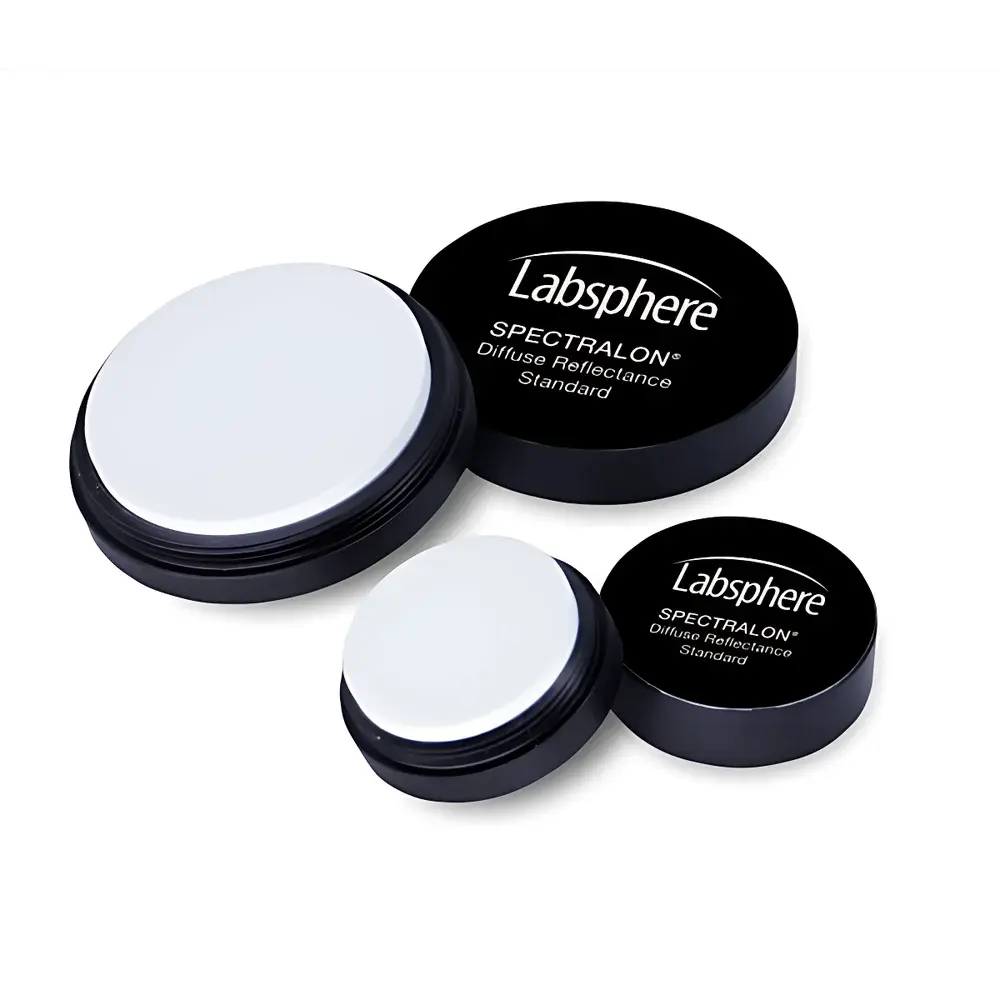
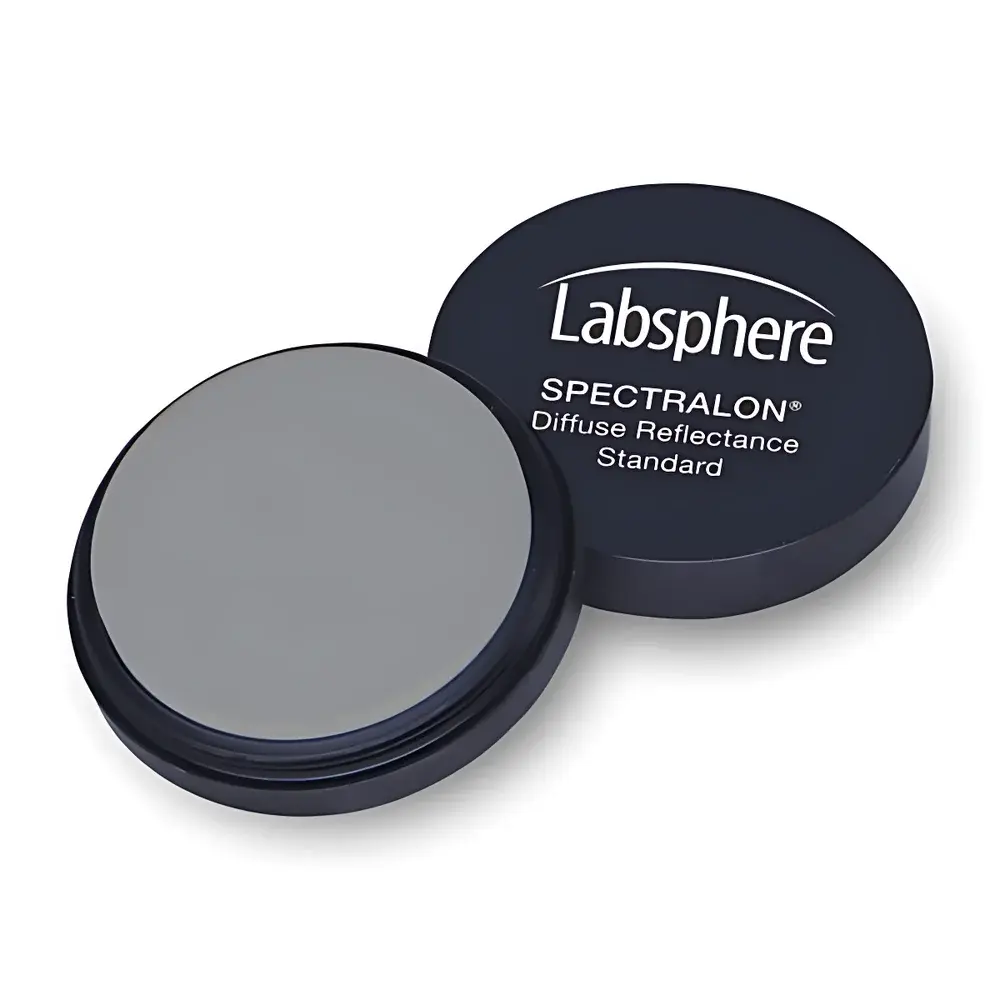
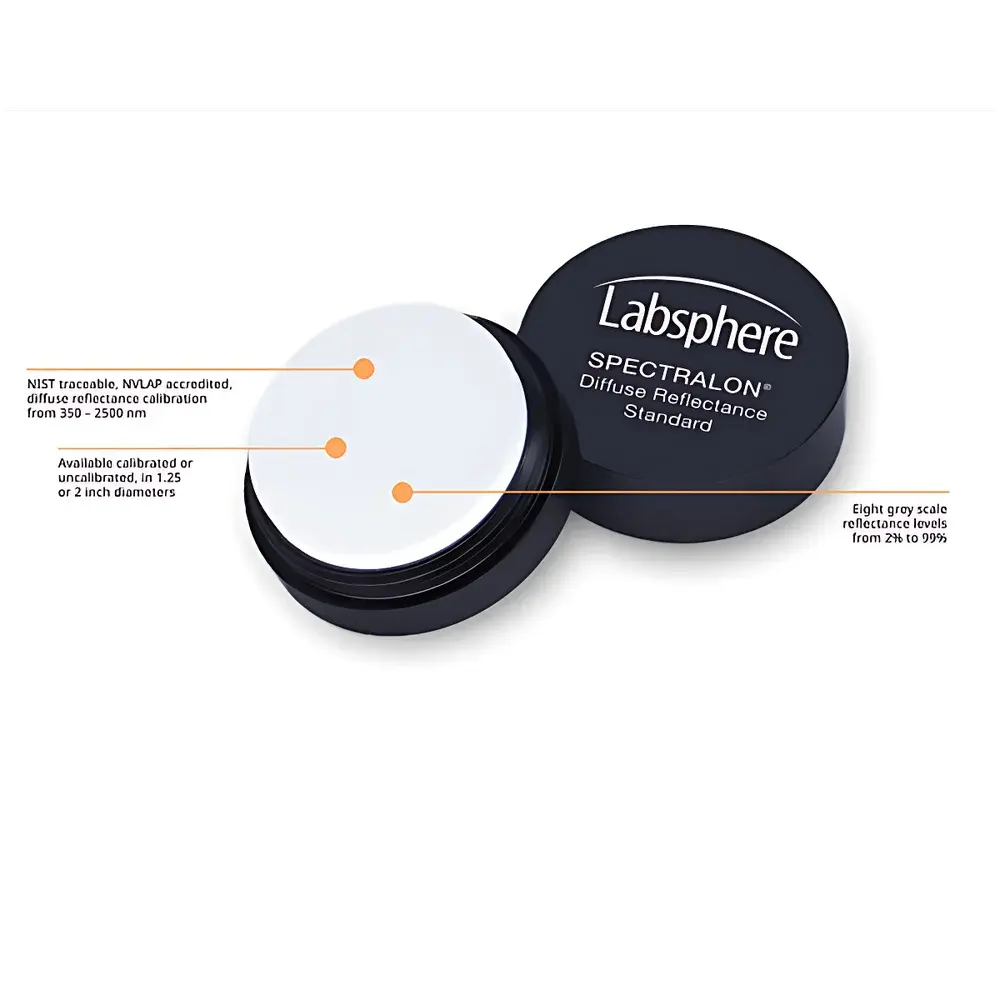
Labsphere Spectralon® Diffuse Reflectance Standard Target Plate
| Brand | Labsphere |
|---|---|
| Origin | USA |
| Model | Spectralon® |
| Material | PTFE-based sintered polymer |
| Spectral Range | 250–2500 nm |
| Reflectance Options | 2%, 5%, 10%, 20%, 25%, 40%, 50%, 60%, 75%, 80%, 99% |
| Spectral Flatness | ±1% (400–1500 nm), ±4% (250–2500 nm) |
| Lambertian Character | >99.9% |
| Calibration Traceability | NIST-traceable |
| Physical Form | Circular disk (1.25″ or 2.00″ diameter) |
| Packaging | Polyoxymethylene (POM) protective case with lid |
| Compliance | ASTM E259, ISO 13468-2, USP <857> |
Overview
Labsphere Spectralon® Diffuse Reflectance Standard Target Plates are high-precision, NIST-traceable calibration references engineered for radiometric and photometric measurement systems requiring stable, spectrally flat, and highly Lambertian reflectance properties. Fabricated from proprietary sintered polytetrafluoroethylene (PTFE), Spectralon® material exhibits exceptional diffuse reflectance uniformity across the ultraviolet–visible–near-infrared (UV-VIS-NIR) spectrum (250–2500 nm). Its near-perfect Lambertian behavior—characterized by angular independence of reflected radiance—ensures consistent response under varied illumination geometries, making it indispensable for instrument validation, system linearity verification, and inter-laboratory data harmonization. Unlike painted or ceramic standards, Spectralon® is chemically inert, non-hygroscopic, and resistant to UV degradation, enabling long-term stability without recalibration drift under routine laboratory handling and environmental exposure.
Key Features
- NIST-traceable absolute reflectance calibration performed in Labsphere’s ISO/IEC 17025-accredited reflectance spectroscopy laboratory
- Spectrally flat response: ±1% deviation over 400–1500 nm; ±4% over full 250–2500 nm range
- High Lambertian character (>99.9% cosine response) validated per ASTM E259 and ISO 13468-2
- Chemically inert, non-porous surface resistant to solvents, acids, bases, and UV-induced aging
- Available in discrete reflectance values: 2%, 5%, 10%, 20%, 25%, 40%, 50%, 60%, 75%, 80%, and 99%
- Standard diameters: 1.25″ (31.75 mm) and 2.00″ (50.8 mm); custom sizes and shapes available upon request
- Supplied in precision-machined polyoxymethylene (POM) protective cases with optically sealed lids to prevent contamination and mechanical damage
- Each plate includes a full spectral reflectance dataset (every 50 nm from 250–2500 nm) certified with uncertainty budgets
Sample Compatibility & Compliance
Spectralon® standards are compatible with a broad range of optical instrumentation, including integrating sphere systems (e.g., for total reflectance/transmittance measurement), spectrophotometers, hyperspectral imagers, remote sensing radiometers, reflectometers, densitometers, and camera-based colorimetry setups. Their robust physical and optical properties meet stringent requirements for GLP and GMP environments. Calibration protocols align with ASTM E259 (Standard Practice for Describing and Measuring Performance of Integrating Spheres), ISO 13468-2 (Plastics — Determination of Total Luminous Transmittance), and USP (Spectrophotometry and Light-Scattering). For regulated applications—including pharmaceutical analytical method validation and FDA 21 CFR Part 11-compliant workflows—Spectralon® plates support audit-ready documentation with full traceability to NIST Standard Reference Materials (SRMs).
Software & Data Management
Each Spectralon® standard is delivered with a digital certificate containing reflectance spectra in CSV and XML formats, fully compatible with industry-standard data analysis platforms (e.g., MATLAB, Python SciPy, OceanView, Labsphere’s own Spectralon Manager software). The dataset includes wavelength-stamped values at 50 nm intervals from 250–2500 nm, accompanied by expanded measurement uncertainties (k=2) and environmental condition metadata (temperature, humidity, integration time). Optional firmware-integrated calibration modules enable direct loading into OEM instrument control software for automated reference correction and real-time baseline normalization. All spectral files adhere to the ASTM E131-22 spectral data exchange convention, ensuring interoperability across multi-vendor optical metrology ecosystems.
Applications
- Calibration and performance verification of UV-VIS-NIR spectrophotometers and array detectors
- Baseline correction and stray-light characterization in integrating sphere-based reflectance measurements
- Validation of hyperspectral imaging systems used in agriculture, mineralogy, and biomedical diagnostics
- Reference target deployment in airborne and satellite-based remote sensing platforms (e.g., NASA AVIRIS, ESA PRISMA)
- Traceable reflectance transfer between primary standards laboratories and end-user facilities
- Development and testing of BRDF/BTDF models in optical simulation software (e.g., LightTools, FRED, ASAP)
- Quality assurance of optical coatings, pigments, and diffuse reflectors in R&D and production environments
FAQ
What is the recommended cleaning procedure for Spectralon® standards?
Gently wipe with lint-free optical tissue dampened with reagent-grade isopropyl alcohol; avoid abrasive contact or ultrasonic cleaning.
Can Spectralon® plates be used under vacuum or elevated temperature conditions?
Spectralon® is stable under ambient vacuum (≤10⁻³ Torr) and continuous operation up to 100°C; prolonged exposure above 120°C may induce microstructural changes affecting reflectance uniformity.
How often should a Spectralon® standard be recertified?
Under controlled lab conditions with proper handling and storage, recalibration is recommended every 24 months—or after any event involving mechanical impact, solvent immersion, or visible surface contamination.
Are custom reflectance curves or non-circular geometries available?
Yes; Labsphere offers bespoke fabrication including user-defined spectral profiles (e.g., band-limited reflectance), rectangular or annular forms, and mounting-integrated substrates with kinematic alignment features.
Does the 99% reflectance value represent peak or average reflectance across the spectrum?
The stated value (e.g., “99%”) denotes the nominal average reflectance across the 400–1500 nm region; the certified spectral file provides exact point-by-point values with associated uncertainties.




