
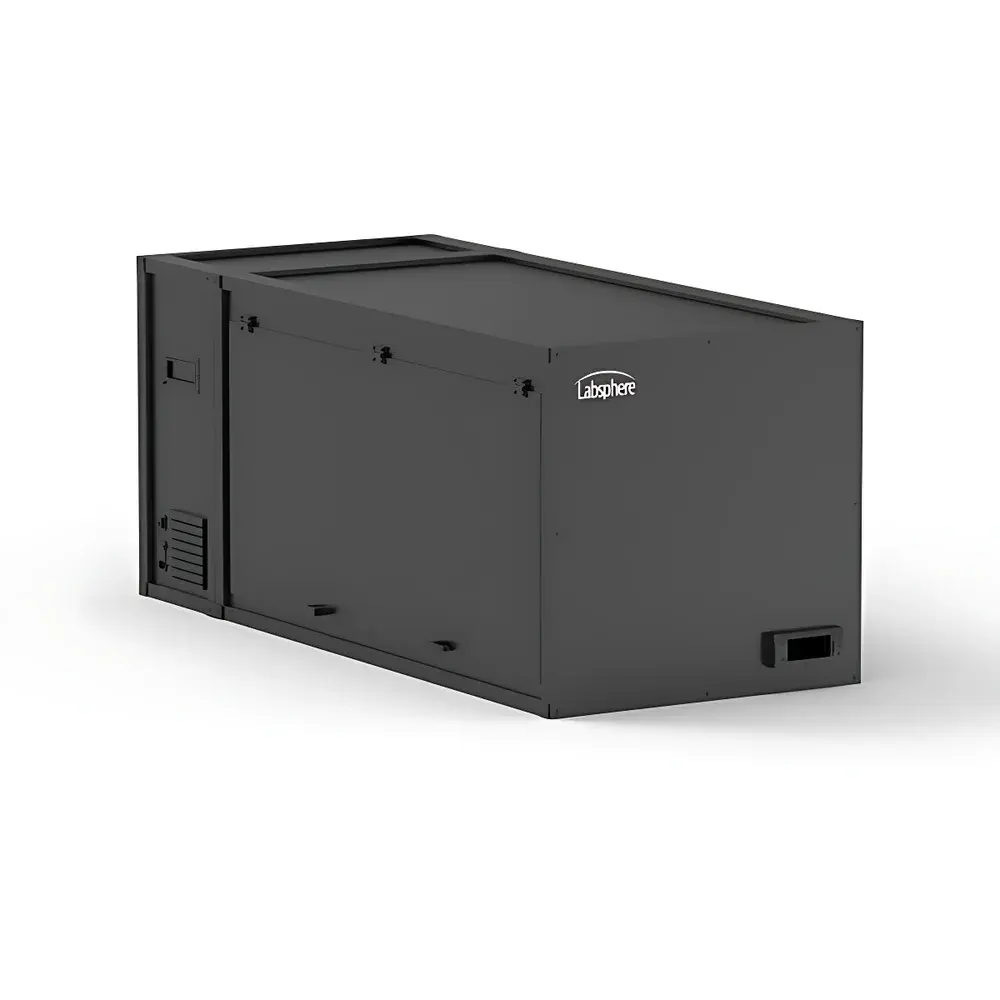
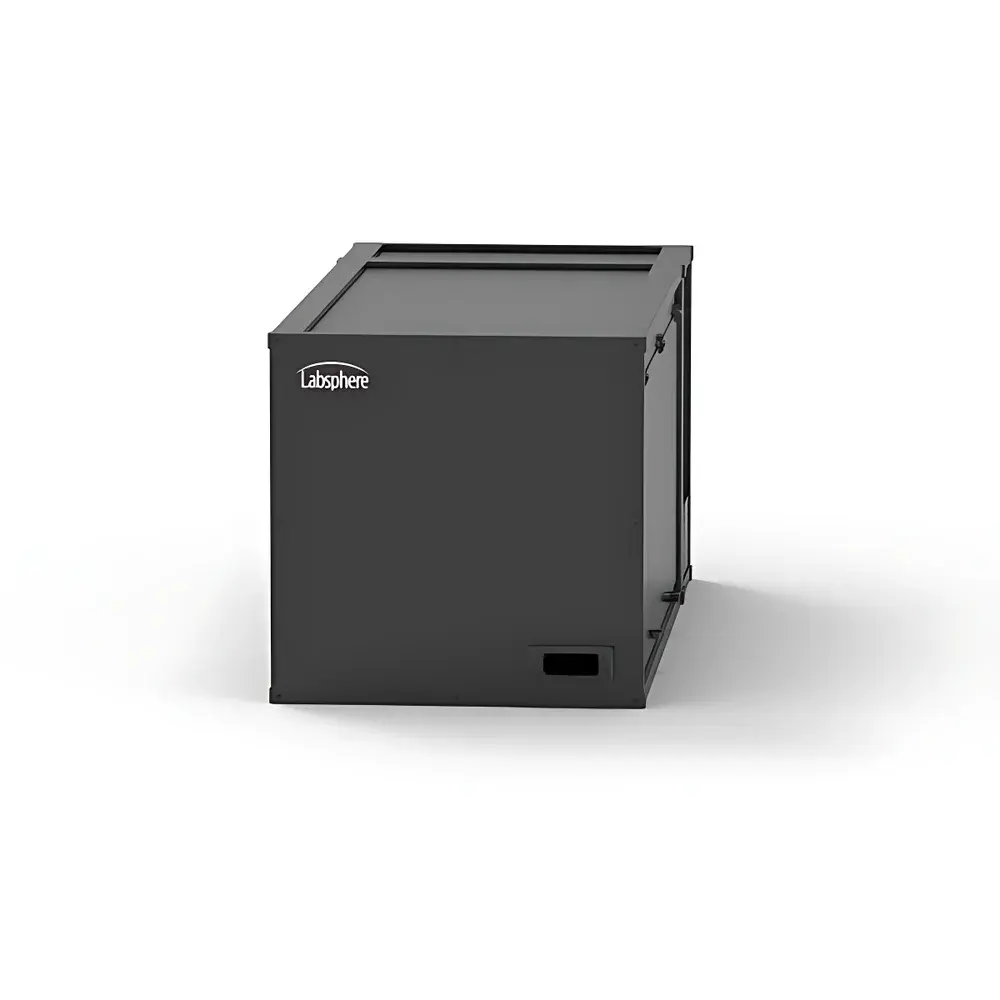
LabSphere LF Human Eye Safety Testing System
| Brand | LabSphere |
|---|---|
| Origin | Shanghai, China |
| Manufacturer Type | Authorized Distributor |
| Product Origin | Domestic (China) |
| Model | LF Human Eye Safety Testing Solution |
| Pricing | Available Upon Request |
| Spectralon Transmittance | 25% or 50% |
| Spectralon Target Size | 30 cm × 50 cm (customizable) |
| Spectralon Spectral Flatness | ±1.5% |
| Wavelength Range | 400–1000 nm |
| DUT-to-Target Distance | 5–30 cm |
| Maximum DUT Divergence Angle | 80° (customizable up to 120°) |
| Eye Safety Aperture | 7 mm |
| Measurement Modes | Total Radiant Power, Per-Spot Radiant Power, Spatial Distribution, Angular Emission Profile, MPE (Maximum Permissible Exposure) Compliance Assessment |
| Data Output Formats | .txt, .csv |
| Software Features | Pixel-level spot detection & centroid localization, intensity calibration with NIST-traceable reference, real-time MPE calculation per IEC 62471 and ANSI Z136.1 |
Overview
The LabSphere LF Human Eye Safety Testing System is a purpose-built optical measurement platform engineered for quantitative radiometric characterization of infrared (IR) laser dot projectors used in facial recognition systems—particularly those based on structured light (SL) and time-of-flight (ToF) architectures. It operates on the fundamental principle of calibrated spatial irradiance mapping: collimated or divergent VCSEL (Vertical-Cavity Surface-Emitting Laser) emissions are projected onto a NIST-traceable, spectrally neutral Spectralon® diffuse transmissive target; the resulting spatial intensity distribution is captured by a scientifically calibrated CMOS camera system. Using geometric optics modeling—including precise knowledge of source-to-target distance, camera focal length, pixel pitch, and solid angle subtense—the system computes absolute radiant power per spot, total radiant flux, angular divergence, and critically, the retinal irradiance that would result from direct ocular exposure at defined working distances (5–30 cm). This enables rigorous evaluation against international photobiological safety standards, including IEC 62471 (Photobiological Safety of Lamps and Lamp Systems) and ANSI Z136.1 (American National Standard for Safe Use of Lasers), specifically addressing Class 1 and Class 1M laser product classification requirements under nominal ocular hazard conditions.
Key Features
- Proprietary Spectralon® transmissive diffuser targets with certified Lambertian behavior (±1.5% spectral flatness from 400–1000 nm) and selectable transmittance (25% or 50%), eliminating spatial non-uniformity artifacts induced by off-axis illumination.
- High-fidelity, pixel-level spot detection algorithm optimized for dense IR dot arrays (e.g., ~30,000 points), delivering sub-pixel centroid accuracy and calibrated radiant power per spot with traceable uncertainty budgets.
- Integrated geometric modeling engine that computes divergence angle, beam profile ellipticity, and effective source size directly from image data—no external goniometer required.
- Real-time MPE (Maximum Permissible Exposure) assessment using the 7-mm pupil diameter model per IEC 62471 Annex A, with automatic comparison against exposure limits for both single-pulse and repetitive-pulse regimes.
- Modular mechanical design accommodating DUTs with divergence angles up to 120°, configurable standoff distances (5–30 cm), and optional motorized XYZ stage integration for automated multi-position scanning.
- Comprehensive software suite supporting GLP-compliant audit trails, user-defined pass/fail thresholds, batch measurement scripting, and full metadata embedding (wavelength, integration time, lens ID, calibration date).
Sample Compatibility & Compliance
The system is validated for near-infrared VCSEL-based emitters operating between 400 nm and 1000 nm—covering common wavelengths such as 850 nm and 940 nm used in mobile biometric modules. It supports both free-space and fiber-coupled DUT configurations. All optical components—including the Spectralon® target, lens assembly, and sensor—are characterized per ISO/IEC 17025-accredited calibration protocols. Measurement reports include full uncertainty statements aligned with GUM (Guide to the Expression of Uncertainty in Measurement) principles. The platform satisfies technical documentation requirements for FDA 21 CFR Part 11 compliance when deployed in regulated environments (e.g., medical device OEM validation labs), and supports IQ/OQ/PQ protocol execution for GMP-aligned qualification.
Software & Data Management
The LF Safety Analysis Software provides a deterministic, scriptable interface built on Python 3.9+ with NumPy, SciPy, and OpenCV backends. Core functions include non-uniformity correction (NUC) using reference frame subtraction, dynamic range optimization via adaptive histogram equalization, and radiometric calibration using factory-provided responsivity maps. All raw images are stored in TIFF format with embedded EXIF metadata; processed results export to .csv (tabular metrics) and .txt (summary logs) with timestamp, operator ID, and instrument serial number. An open API (RESTful HTTP endpoints + Python SDK) enables integration into MES, LIMS, or automated test benches. Audit logs record every parameter change, file save, and calibration event with digital signature and UTC timestamp—fully compliant with ALCOA+ data integrity principles.
Applications
- Pre-certification validation of smartphone and tablet facial authentication modules prior to IEC/EN 62471 testing.
- R&D troubleshooting of VCSEL array uniformity, DOE (Diffractive Optical Element) alignment drift, and thermal-induced beam shift.
- Supplier qualification for Tier-1 optical component vendors supplying dot projectors to consumer electronics OEMs.
- Failure analysis of field returns linked to perceived eye discomfort or inconsistent unlock performance at varying distances.
- Supporting ISO/IEC 17025 accredited laboratories in issuing technically defensible test reports for regulatory submissions (e.g., CE marking, FCC ID, KC certification).
- Academic research on near-field laser safety thresholds for emerging AR/VR wearable displays incorporating eye-tracking VCSEL illuminators.
FAQ
Does this system comply with IEC 62471 for LED and laser-based facial recognition modules?
Yes. The system implements the photobiological exposure assessment methodology specified in IEC 62471:2006+A1:2009, including spectral weighting functions for actinic UV, blue light, and IR radiation hazards, and applies the 7-mm pupil model for near-field exposure scenarios.
Can it measure VCSEL arrays emitting at 940 nm with sufficient signal-to-noise ratio?
Yes. The calibrated CMOS sensor exhibits peak quantum efficiency >65% at 940 nm, and the Spectralon® target maintains >98% diffuse transmittance across the NIR band, enabling robust SNR even at low-duty-cycle pulsed operation.
Is third-party calibration documentation provided with the system?
Each delivery includes a full calibration certificate issued by LabSphere’s ISO/IEC 17025-accredited metrology lab, covering spectral responsivity, spatial uniformity, and geometric scaling factors—with traceability to NIST SRM 2241 and NPL standards.
Can the software generate reports compliant with FDA 21 CFR Part 11?
Yes. When deployed on validated Windows Server environments with domain authentication, the software supports electronic signatures, role-based access control, and immutable audit trails meeting all Part 11 requirements for electronic records and signatures.
What is the minimum resolvable spot separation at 30 cm working distance?
At 30 cm standoff with the standard 50-mm focal length lens, the system achieves <125 µm spatial resolution (FWHM), sufficient to resolve individual spots in commercial 30k-dot projector arrays with ≥150 µm inter-spot pitch.



