
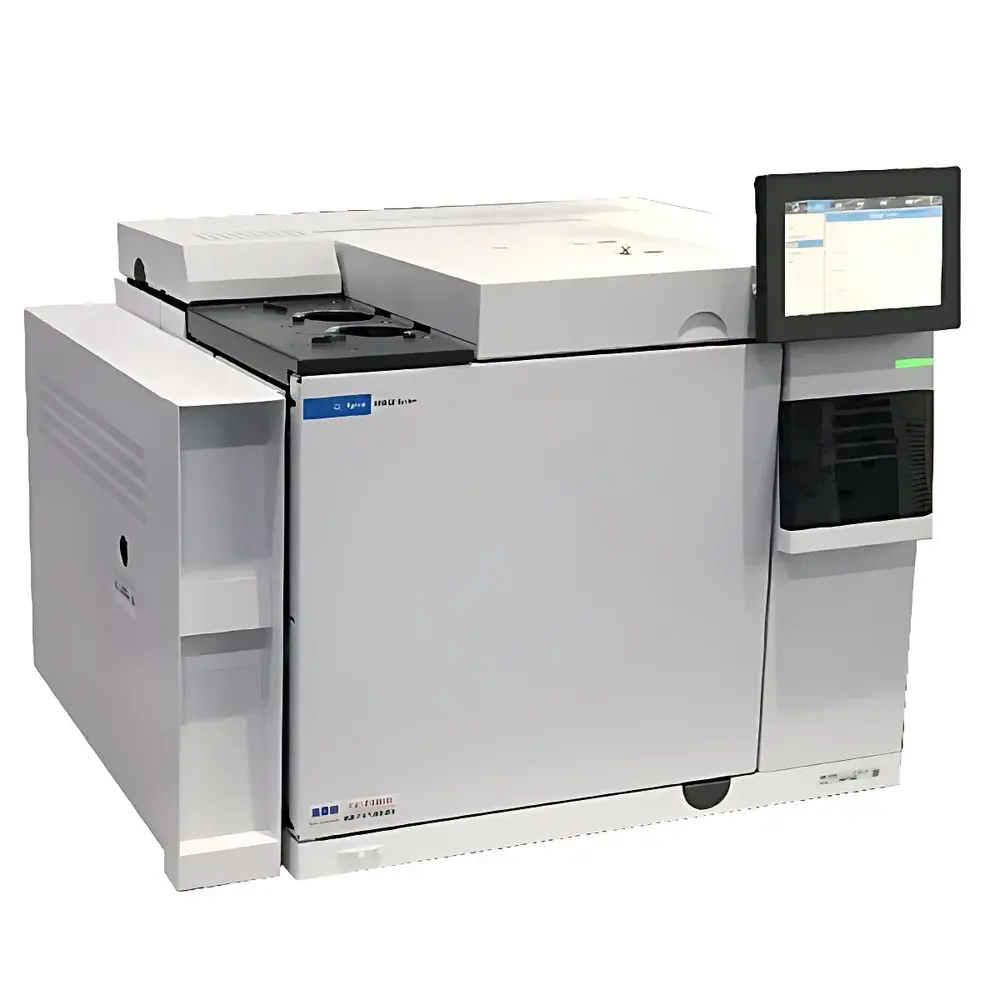
Agilent 8890 Pulsed Discharge Helium Ionization Detector (PDHID) Gas Chromatograph for Ultra-High-Purity Electronic Specialty Gases
| Brand | Agilent Technologies |
|---|---|
| Origin | Zhejiang, China |
| Manufacturer Type | Authorized Distributor |
| Product Origin | Domestic (China) |
| Model | Agilent 8890 |
| Pricing | Upon Request |
Overview
The Agilent 8890 Pulsed Discharge Helium Ionization Detector (PDHID) Gas Chromatograph is a purpose-engineered analytical platform designed for trace-level impurity profiling in ultra-high-purity (UHP) and electronic-grade specialty gases—particularly fluorinated compounds such as CH3F, CF3I, and C4F6. Operating on the principle of pulsed discharge helium ionization, this system achieves sub-ppb detection sensitivity across permanent gases (H2, O2/Ar, N2, CO, CO2) and hydrocarbon/fluorocarbon species (C1–C4, CmHnFy, CmClnFy). Unlike conventional TCD or FID detectors, the PDHID delivers universal, non-destructive response with exceptional signal-to-noise ratio and long-term baseline stability—critical for meeting stringent semiconductor manufacturing gas specifications. The instrument complies with GB/T 28726–2012 (“Gas Analysis — Helium Ionization Gas Chromatography”) and JJG 700–2016 (“Verification Regulation for Gas Chromatographs”), and supports method validation under ISO/IEC 17025 and GLP-aligned laboratory practices.
Key Features
- Temperature-controlled oven with 20-stage, 21-platform programmable ramping; operating range: 40 °C above ambient to 450 °C; temperature setpoint resolution: 0.1 °C; ramp rate: 0.1–120 °C/min
- Thermal stability: <0.01 °C deviation per 1 °C ambient fluctuation; cooling from 450 °C to 50 °C in ≤6 minutes (at 22 °C ambient)
- Pulsed discharge helium ionization detector (PDHID) with optimized discharge pulse timing and helium purity management for consistent electron generation and minimal background drift
- Detection limits: 5–10 ppb for H2, O2/Ar, N2, CH4, CO, CO2; 10–15 ppb for C1–C3 hydrocarbons and fluorocarbons including CHF3, CH2F2, C2F5I, C4F8, and C5F8
- Robust column compartment design accommodating multiple packed and capillary columns for multi-gas method flexibility
- Integrated early maintenance feedback (EMF) system tracking consumable usage (e.g., PDHID discharge cell, helium purifier, liner life) with configurable alerts
Sample Compatibility & Compliance
The system is validated for analysis of high-purity fluorinated electronic gases—including monofluoromethane (CH3F), trifluoroiodomethane (CF3I), and hexafluorobutadiene (C4F6)—with certified purity ≥99.99%. It quantifies up to 12 co-eluting impurities per sample matrix, covering permanent gases, light hydrocarbons, chlorinated species (e.g., CH3Cl), unsaturated fluorocarbons (e.g., C4F6 polymer), and polar contaminants such as isopropanol (IPA). Method development aligns with enterprise-specific standards for CH3F, CF3I, and C4F6, and supports audit readiness for ISO 9001, ISO 14644 cleanroom gas monitoring, and IATF 16949 traceability requirements. All hardware interfaces and gas pathways utilize electropolished stainless-steel tubing, rigorously cleaned to ASTM F51–22 specifications to prevent adsorption or memory effects.
Software & Data Management
The fully localized Chinese-language chromatography data system (CDS) provides comprehensive instrument control, acquisition, and reporting capabilities. It supports automated system suitability testing (SST), peak purity assessment, and spectral library searching (where applicable). Users may define custom report templates compliant with internal QA/QC workflows or external regulatory submissions. The software implements full electronic audit trail functionality—including user login history, parameter change logs, injection records, and calibration event timestamps—in accordance with FDA 21 CFR Part 11 principles. Built-in diagnostics include self-tests for detector voltage stability, oven temperature accuracy, and carrier gas flow consistency. Over 30 interactive training modules guide users through method setup, troubleshooting, and preventive maintenance protocols.
Applications
This GC-PDHID platform serves critical quality control functions across semiconductor fabrication, flat-panel display manufacturing, and photovoltaic gas supply chains. Typical use cases include:
- Release testing of bulk and cylinder-delivered electronic gases against SEMI F63, SEMI F21, and JIS K0123 specifications
- Monitoring degradation byproducts (e.g., C4F6 oligomers, HF traces) during gas cylinder aging and delivery system validation
- Supporting root-cause analysis of particle excursions in etch and deposition tools via correlating gas impurity profiles with chamber performance metrics
- Verifying purge efficiency and residual moisture/hydrocarbon content in nitrogen or argon blanketing systems
- Method transfer between R&D labs and production QC environments with retention time locking (RTL) and retention index referencing
FAQ
What gases can be analyzed using this PDHID configuration?
It is optimized for permanent gases (H2, O2/Ar, N2, CO, CO2), saturated and unsaturated hydrocarbons (C1–C4), fluorocarbons (CHF3, CH2F2, C2F5I, C4F6, C4F8), chlorinated compounds (CH3Cl), and select polar impurities (e.g., IPA).
Is helium purity critical for PDHID operation?
Yes—helium carrier gas must meet Grade 5.7 (99.9997% pure) with total hydrocarbon content <0.1 ppmv and moisture <0.5 ppmv to ensure stable discharge plasma and minimize baseline noise.
Can this system interface with process sampling manifolds?
Yes—the instrument supports direct integration with engineered online sampling loops, pressure-regulated gas introduction modules, and automated valve sequencing for unattended multi-stream analysis.
What are the environmental requirements for stable operation?
Ambient temperature: 5–35 °C; relative humidity: 0–85% non-condensing; installation site must be free of corrosive vapors, excessive dust, and electromagnetic interference from arc welders or RF sources.
Does the software support 21 CFR Part 11 compliance?
The CDS includes role-based access control, electronic signatures, immutable audit trails, and configurable retention policies—enabling alignment with FDA 21 CFR Part 11, EU Annex 11, and PIC/S GMP Annex 11 expectations when deployed in regulated environments.



