
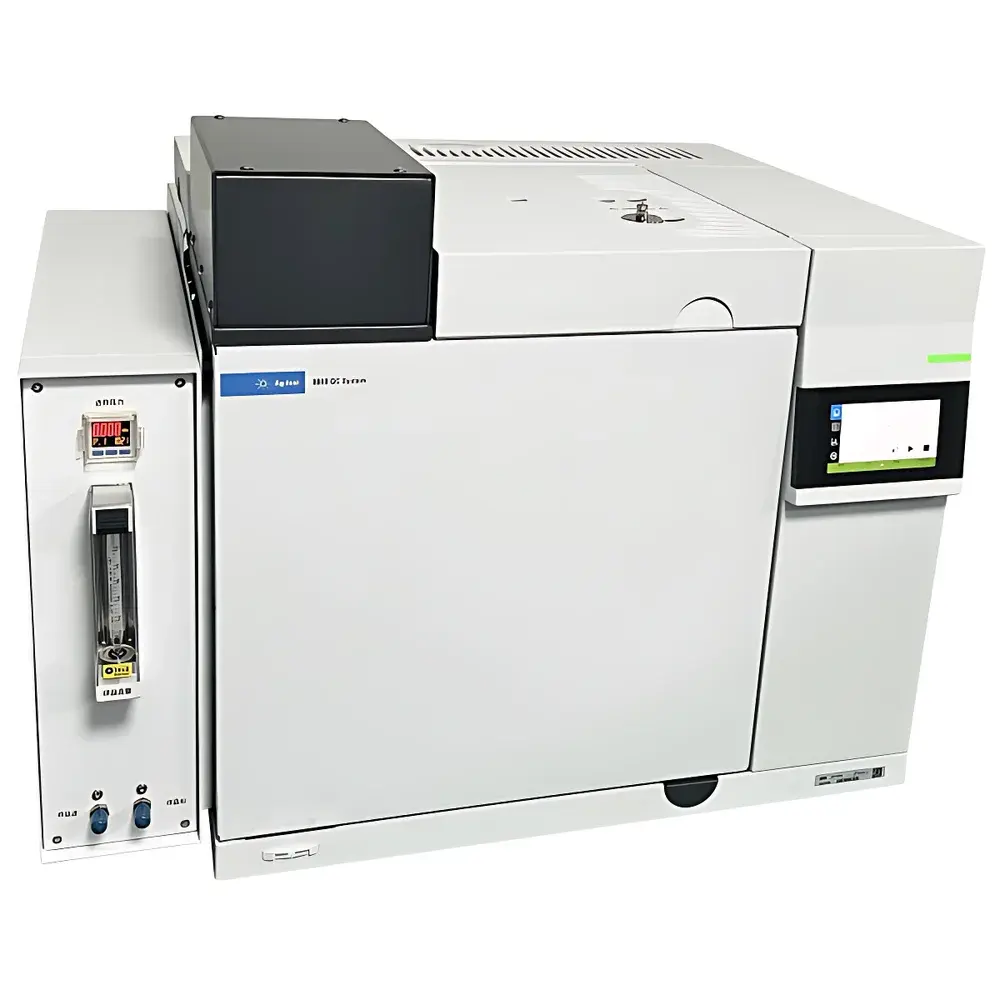
Agilent 8860 PDD Helium Ionization Gas Chromatograph for High-Purity Air Separation Gas Analysis
| Brand | Agilent Technologies |
|---|---|
| Origin | Zhejiang, China |
| Model | Agilent 8860 |
| Detector Type | Pulsed Discharge Helium Ionization Detector (PDHID) |
| Column Oven Temp Range | 8 °C above ambient to 425 °C |
| Max Ramp Rate | 75 °C/min |
| Cooling Rate | 300 °C → 50 °C in ≤5.7 min (at 25 °C ambient) |
| Temperature Resolution | 0.1 °C |
| Max Run Time | 999.99 min |
| PDHID Detection Limit | ≤10 ppb (as CH₄) |
| Linear Dynamic Range | 10⁵ |
| Measurable Impurities | H₂, O₂/Ar, N₂, CH₄, CO, CO₂, C₂H₆ |
| Compliance | GB/T 28726–2012, JJG 700–2016, GB/T 8979–2008, GB/T 4842–2006, GB/T 4844.3–2005, GB/T 3634.2–2011, GB/T 6052–2011 |
Overview
The Agilent 8860 PDD Helium Ionization Gas Chromatograph is a purpose-engineered analytical platform designed for trace-level impurity profiling in high-purity industrial gases produced via air separation units (ASUs). It employs pulsed discharge helium ionization detection (PDHID), a universal, non-destructive detection principle that leverages metastable helium atoms (He*) to ionize analytes with ionization potentials below ~24.6 eV — enabling sensitive, quantitative detection of permanent gases (H₂, O₂, N₂, CH₄, CO, CO₂) and light hydrocarbons (C₂H₆) without chemical derivatization or catalytic conversion. Unlike thermal conductivity detectors (TCD) or flame ionization detectors (FID), PDHID delivers sub-ppb detection limits across diverse compound classes while maintaining exceptional baseline stability and long-term reproducibility—critical for compliance-driven environments such as semiconductor-grade gas certification, cryogenic plant QA/QC, and ISO 8573-1 Class 1 compressed air verification.
Key Features
- Optimized column oven architecture with precise temperature control (0.1 °C resolution), programmable ramps (up to 75 °C/min), and rapid cooling (<5.7 min from 300 °C to 50 °C), ensuring method robustness and high-throughput analysis of multi-component gas matrices.
- Integrated Pulsed Discharge Helium Ionization Detector (PDHID-8860) with documented ≤10 ppb detection limit (as methane), linear dynamic range exceeding 10⁵, and immunity to detector poisoning from oxygen or moisture—enabling direct injection of high-purity He, Ar, N₂, H₂, and CO₂ streams without pre-purification.
- Dual analog output channels (1 V and 10 V configurable), LAN connectivity, remote start/stop capability, and binary-coded decimal (BCD) valve control support automated integration into centralized process monitoring systems and LIMS environments.
- Compliance-ready hardware design aligned with metrological traceability requirements per JJG 700–2016 and application-specific standards including GB/T 28726–2012 (gas analysis by helium ionization GC), GB/T 8979–2008 (high-purity nitrogen), and GB/T 4844.3–2005 (high-purity helium).
- Thermally stable mechanical construction with environmental operating range of 15–35 °C and 5–90% RH (non-condensing); validated altitude operation up to 4600 m ASL; storage tolerance from –40 °C to +70 °C.
Sample Compatibility & Compliance
The system is validated for direct analysis of ultra-high-purity (UHP) gases meeting ≥99.999% purity specifications, including helium, hydrogen, nitrogen, argon, carbon dioxide, and methane. It quantifies trace impurities at certified detection limits: H₂ (≤10 ppb), O₂/Ar (≤10 ppb), N₂ (≤10 ppb), CH₄ (≤10 ppb), CO (≤25 ppb), CO₂ (≤10 ppb), and C₂H₆ (≤10 ppb). Method performance satisfies regulatory expectations for GMP-aligned gas release testing, adhering to principles outlined in ISO/IEC 17025 for analytical validation. While not inherently 21 CFR Part 11–compliant out-of-the-box, the instrument’s data acquisition architecture supports integration with audit-trail-enabled chromatography data systems (CDS) compliant with FDA, EMA, and PIC/S GLP/GMP guidelines when deployed in regulated manufacturing settings.
Software & Data Management
Data acquisition and reporting are executed via Agilent OpenLab CDS or compatible third-party GC control software supporting ASTM E1947-compliant data exchange protocols. Raw signal files (.D format) retain full detector voltage-time profiles, retention time metadata, and sequence log entries—including column oven setpoints, ramp histories, and PDHID pulse parameters. All calibration curves, integration events, and report templates are stored with version-controlled access rights. Audit trail functionality (user login, parameter changes, result reprocessing) is enforced through role-based permissions when paired with validated CDS installations. Export options include CSV, PDF, and XML formats compatible with enterprise quality management systems (QMS) and electronic batch records (EBR).
Applications
- Trace impurity verification in ASU output streams prior to distribution to semiconductor fabs, pharmaceutical inerting lines, and fiber optic preform synthesis facilities.
- Periodic monitoring of cryogenic distillation column off-gas for early detection of equipment degradation (e.g., heat exchanger micro-leaks introducing air ingress).
- Validation of purifier bed efficiency in on-site gas generation systems (e.g., PSA nitrogen generators, membrane helium concentrators).
- Reference method implementation for internal laboratory proficiency testing under ISO/IEC 17043 schemes.
- Supporting technical documentation for ISO 8573-1 Class 1 compressed air certification where hydrocarbon and CO/CO₂ content must be verified at sub-ppm levels.
FAQ
What gases can be analyzed with this system?
The Agilent 8860 PDD GC is validated for high-purity He, H₂, N₂, Ar, CO₂, and CH₄ matrices, detecting H₂, O₂/Ar, N₂, CH₄, CO, CO₂, and C₂H₆ at sub-ppb levels.
Is helium carrier gas required for PDHID operation?
Yes—ultra-high-purity helium (≥99.999%) serves both as the carrier gas and the ionization source; no supplemental gases or make-up flows are needed.
Does the system require special installation infrastructure?
It operates within standard laboratory environmental conditions (15–35 °C, 5–90% RH, non-corrosive atmosphere); no dedicated exhaust hoods or grounding enhancements beyond typical lab electrical codes are mandated.
Can it be integrated into an automated plant-wide monitoring network?
Yes—via built-in LAN port, BCD valve interface, and dual analog outputs, enabling seamless connection to DCS/SCADA systems using Modbus TCP or OPC UA protocols.
How is detector performance verified over time?
Routine verification uses certified gas standards traceable to NIM (China National Institute of Metrology); daily system suitability tests assess retention time stability, peak symmetry, and signal-to-noise ratio against established acceptance criteria per GB/T 28726–2012 Annex B.





