
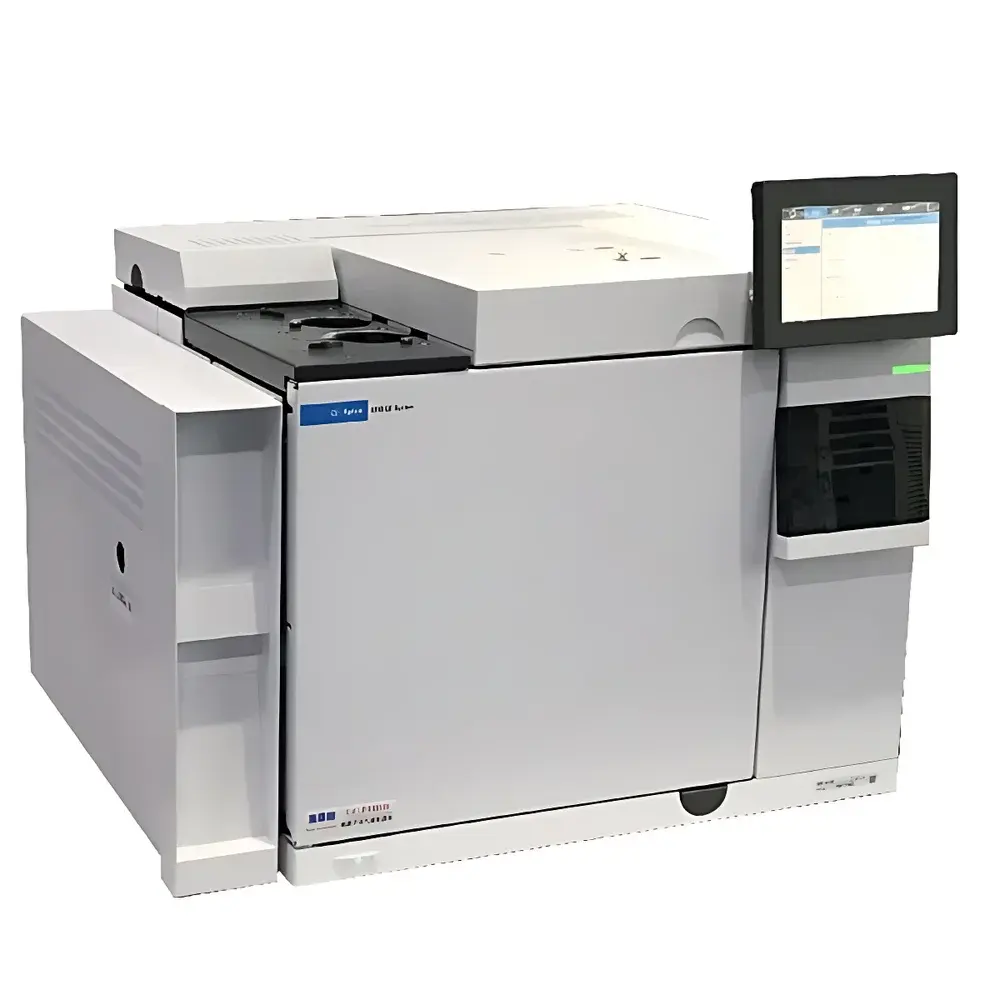
Agilent 8890 PDHID Helium Ionization Gas Chromatograph for Electronic Specialty Gases Analysis
| Brand | Agilent Technologies |
|---|---|
| Origin | Zhejiang, China |
| Manufacturer Type | Authorized Distributor |
| Regional Classification | Domestic (China) |
| Model | Agilent 8890 |
| Quotation | Upon Request |
| Detector | Dual-Pulse Helium Ionization Detector (PDHID) |
| Column Oven Temp Range | 40 °C above ambient to 450 °C |
| Temp Setpoint Resolution | 1 °C |
| Ramp Rate | 0.1–120 °C/min |
| Temp Stability | <0.01 °C per 1 °C ambient fluctuation |
| Programmable Temperature Steps | 20 ramps / 21 platforms |
| Max Run Time | 999.99 min |
| Cool-down | ≤6 min (450 °C → 50 °C at 22 °C ambient) |
| Detection Limits | 5–10 ppb for H₂, O₂/Ar, N₂, CH₄, CO, CO₂, C₂–C₄ hydrocarbons, SiH₃Cl, Si₂H₆, and other silicon-containing impurities in electronic-grade silane (≥99.9995% purity) |
| Compliance | GB/T 28726–2012, JJG 700–2016, GB/T 15909–2017 |
Overview
The Agilent 8890 PDHID Helium Ionization Gas Chromatograph is a purpose-engineered analytical platform designed for ultra-trace impurity profiling in high-purity electronic specialty gases—particularly electronic-grade silane (SiH₄ ≥ 99.9995%). Unlike conventional flame ionization (FID) or thermal conductivity (TCD) detectors, the dual-pulse helium ionization detector (PDHID) operates on the principle of metastable helium atom-induced ionization under low-energy electron impact. This enables universal, near-equimolar response across permanent gases (H₂, O₂, N₂, Ar), hydrocarbons (CH₄, C₂H₆, C₃H₈), carbon oxides (CO, CO₂), and critical silicon-hydride and chlorosilane species (SiH₃Cl, Si₂H₆, SinHn, SiHnCln) without chemical derivatization or catalytic conversion. The system delivers sub-10 ppb detection limits across >15 target analytes in a single run—meeting stringent purity verification requirements defined by SEMI F57, ASTM D7607, and IEC 62320-2 for semiconductor process gas qualification.
Key Features
- Column oven with precise temperature control: operating range from 40 °C above ambient to 450 °C, 0.1 °C/min ramp resolution, and thermal stability better than ±0.01 °C per 1 °C ambient variation—ensuring retention time reproducibility <0.05% RSD over 100 injections.
- Dual-pulse PDHID configuration with independent pulse timing and bias voltage optimization—minimizing baseline drift and maximizing signal-to-noise ratio for low-concentration impurities in He or Ar carrier streams.
- 20-stage, 21-platform programmable temperature programming supports complex multi-step elution profiles required for co-elution resolution of structurally similar silanes and chlorosilanes.
- Integrated early maintenance feedback (EMF) system tracks consumable usage—including detector filaments, septa, and liner life—and triggers configurable alerts prior to performance degradation.
- Real-time electronic log records all user actions, method changes, calibration events, and hardware status transitions—fully compliant with GLP/GMP audit trail requirements per FDA 21 CFR Part 11.
- Rapid cool-down capability (≤6 minutes from 450 °C to 50 °C at 22 °C ambient) enables high-throughput batch analysis in QC laboratories handling >50 samples/day.
Sample Compatibility & Compliance
The Agilent 8890 PDHID system is validated for direct injection and online coupling with standardized sampling manifolds for silane, arsine, phosphine, ammonia, and NF₃—using stainless-steel, electropolished, passivated gas pathways to prevent adsorption or surface-catalyzed decomposition. It complies with national and industry standards governing electronic gas purity assessment: GB/T 28726–2012 (Gas Analysis—Helium Ionization GC Method), JJG 700–2016 (Verification Regulation for Gas Chromatographs), and GB/T 15909–2017 (Electronic Industrial Gases—Silane). All methods are developed and verified per ISO/IEC 17025:2017 general requirements for competence of testing and calibration laboratories. System suitability testing (SST) parameters—including resolution (Rs ≥ 2.0), tailing factor (Tf ≤ 1.5), and repeatability (RSD ≤ 3% for area and retention time)—are automatically calculated and reported within the software framework.
Software & Data Management
Controlled via Agilent OpenLab CDS (ChemStation Edition), the workstation provides full method development, sequence management, peak integration, and compliance-ready reporting. Built-in templates generate system suitability reports, peak purity assessments (via spectral deconvolution where coupled with GC/MS), and customizable audit trails. All data files are stored in secure, timestamped, non-erasable format with digital signature support. The software includes >30 context-sensitive training modules accessible directly from each dialog box, plus automated diagnostic routines for detector baseline validation, oven temperature profile verification, and valve timing synchronization. Remote monitoring and instrument health dashboards are supported via optional OpenLab Enterprise edition—enabling centralized fleet management across multi-site semiconductor fabrication facilities.
Applications
- Quantitative analysis of trace impurities (H₂, O₂/Ar, N₂, CH₄, CO, CO₂, C₂–C₄ alkanes) in electronic-grade silane for CVD and epitaxy processes.
- Monitoring chlorosilane contaminants (SiH₃Cl, Si₂H₆, SiH₂Cl₂) that cause particle generation and film non-uniformity in silicon nitride deposition.
- Verification of cylinder lot certification per SEMI standard C35 for bulk electronic gas suppliers.
- In-line quality assurance during gas delivery to fab tools—integrated with PLC-controlled sample switching and auto-calibration sequences.
- Failure root-cause analysis of chamber contamination events linked to upstream gas purity excursions.
FAQ
What carrier gases are compatible with the PDHID detector?
Helium is the primary carrier and ionization gas; argon may be used as an alternative carrier when analyzing helium-rich matrices—but requires recalibration and exhibits slightly reduced sensitivity for H₂ and He itself.
Can this system analyze corrosive gases such as HCl or Cl₂?
No—PDHID is not suitable for strongly oxidizing or halogenated corrosives. For Cl₂, HCl, or HF analysis, a dedicated sulfur chemiluminescence detector (SCD) or pulsed discharge helium ionization (PDHID) with specialized passivated flow paths is required.
Is the column oven rated for operation in Class 1 Division 1 hazardous locations?
The standard Agilent 8890 column oven is not intrinsically safe certified. For installation in explosive atmospheres, third-party explosion-proof enclosures meeting NEC Article 500 or ATEX Directive 2014/34/EU must be deployed.
Does the system support unattended overnight operation?
Yes—full sequence automation, automatic shutdown after final run, and real-time EMF-based preventive maintenance scheduling enable reliable 24/7 operation with minimal operator intervention.
How is detector sensitivity verified between calibrations?
A built-in reference gas check (RGC) routine injects a certified 10 ppb H₂-in-He standard at user-defined intervals; integrated software compares response drift against baseline and flags deviations exceeding ±5% for review.
Related Products





