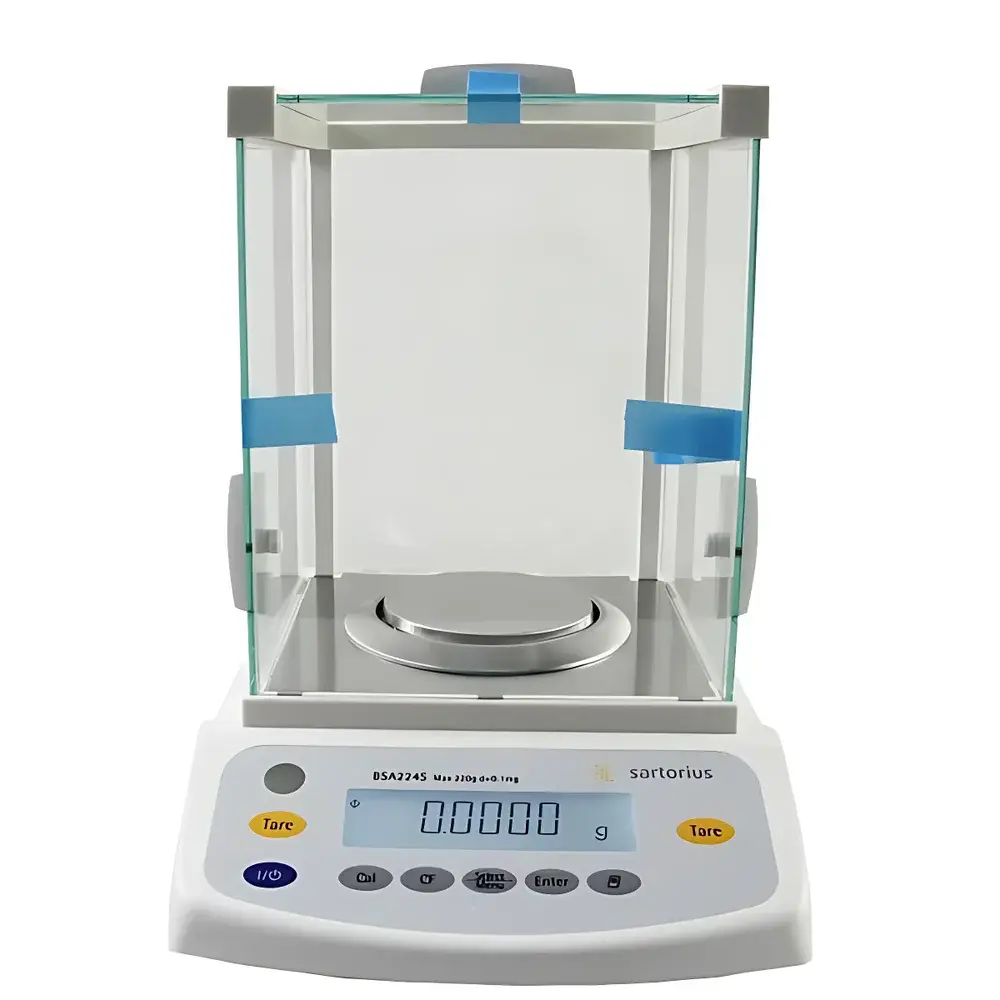
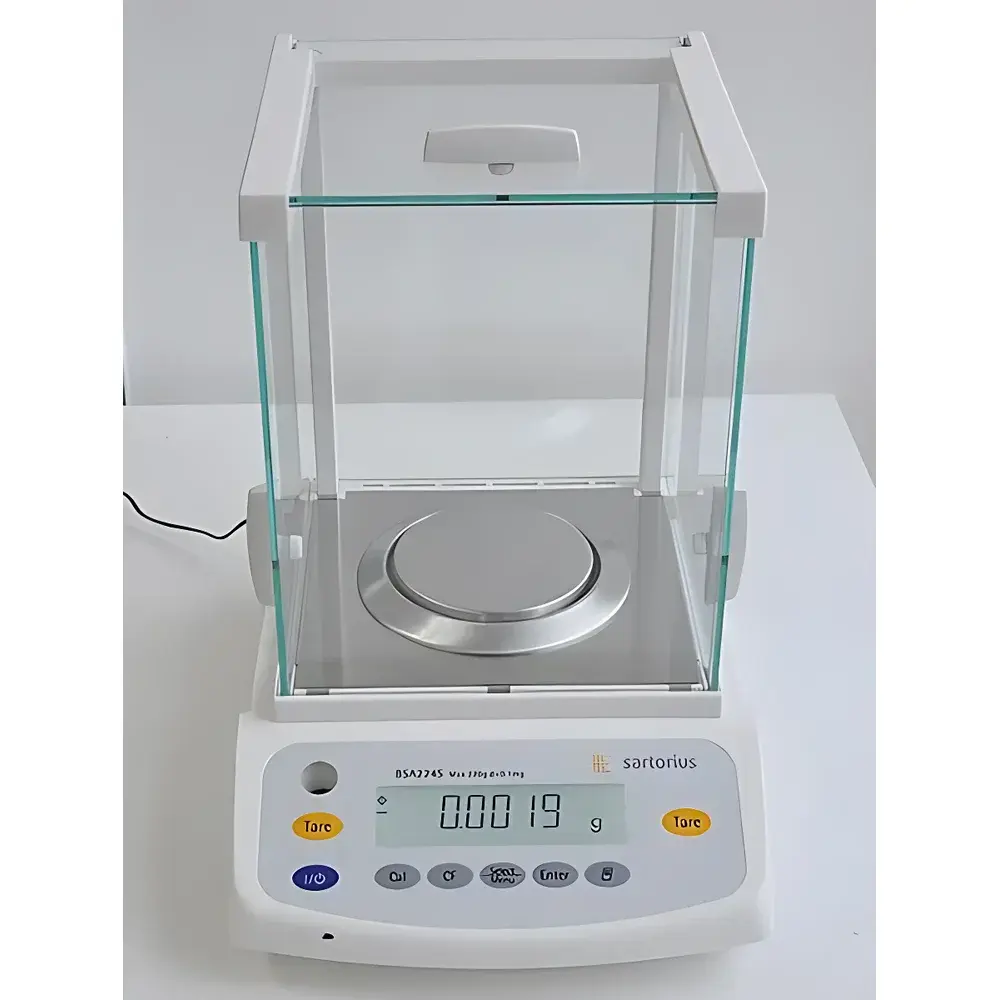
Sartorius BSA124S Analytical Balance
| Brand | Sartorius |
|---|---|
| Origin | Germany |
| Model | BSA124S |
| Type | Analytical Balance |
| Capacity | 120 g |
| Readability | 0.0001 g |
| Repeatability | ≤ ±0.0001 g |
| Linearity | ≤ ±0.0002 g |
| Pan Size | 90 mm diameter |
| Stabilization Time | 2.5 s |
| Calibration | External (BSA124S) or Internal (BSA124S-CW) |
| Compliance | GLP, ISO/IEC 17025-supporting operation |
| Interface | RS232 |
| Draft Shield | Five-sided glass with anti-static coating |
| Sensor | Monolithic dual-lever electromagnetic force compensation sensor |
| Processor | 40 MHz microcontroller (MC1) |
| Additional Features | Automatic fault diagnosis, overload protection, dynamic temperature compensation, bottom hook for density/specific gravity measurement, front-mounted level indicator, left/right tare keys, integrated applications (counting, percentage weighing, animal weighing, summation, net weight calculation, multiplication/division) |
Overview
The Sartorius BSA124S Analytical Balance is a high-precision mass measurement instrument engineered for laboratories requiring traceable, reproducible results in compliance with international quality standards. Operating on the principle of electromagnetic force compensation (EMFC), the balance achieves stable and drift-free measurements by balancing the gravitational force of the sample against a precisely controlled electromagnetic force—eliminating mechanical wear and enabling long-term stability. With a readability of 0.0001 g (100 µg) and a maximum capacity of 120 g, the BSA124S meets the stringent requirements of analytical chemistry, pharmaceutical QC, materials science, and academic research where sub-milligram accuracy is non-negotiable. Its robust architecture, including a monolithic dual-lever sensor and 40 MHz microprocessor control, ensures rapid stabilization (≤2.5 s) and minimal thermal drift across ambient fluctuations.
Key Features
- Five-sided transparent glass draft shield with anti-static coating—minimizes electrostatic interference and provides unobstructed visibility during critical weighing operations.
- Dynamic temperature compensation system—continuously adjusts internal calibration parameters to maintain accuracy across laboratory temperature variations (15–30 °C).
- Integrated electromagnetic force compensation sensor—monolithic design eliminates hysteresis and guarantees exceptional repeatability (≤±0.0001 g) and linearity (≤±0.0002 g).
- Front-mounted bubble level and adjustable feet—enables rapid, reliable leveling without tools; essential for maintaining metrological integrity.
- Dual-position tare keys (left and right)—accommodates ergonomic preferences for both right- and left-handed users in high-throughput environments.
- Bottom hook assembly—supports density determination of solids and liquids using optional YDK03/YDK04 density kits, fully compliant with ASTM D792 and ISO 1183.
- Automatic fault diagnostics and overload protection—prevents sensor damage and alerts users to operational anomalies before measurement errors occur.
- RS232 serial interface—enables direct data transfer to LIMS, ELN, or statistical software; supports GLP-compliant output formatting including date/time stamp, operator ID, and balance ID.
Sample Compatibility & Compliance
The BSA124S accommodates a wide range of sample types—including powders, granules, viscous liquids (via container taring), and small solid components—within its 90 mm diameter stainless steel weighing pan. Its draft shield configuration satisfies ISO 9001 and ISO/IEC 17025 environmental control requirements for analytical balances. The instrument supports full audit trail generation when connected to compliant data systems and adheres to key regulatory frameworks: USP and for pharmaceutical weighing, ASTM E898 for balance verification, and EU GMP Annex 11 principles for electronic records. While the standard BSA124S requires external calibration with certified weights (e.g., Class E2 or better), the CW variant (BSA124S-CW) integrates a motorized internal calibration mass for automated, time-stamped recalibration—facilitating routine compliance with FDA 21 CFR Part 11 when paired with appropriate software.
Software & Data Management
The BSA124S transmits measurement data via ASCII-formatted RS232 protocol, compatible with industry-standard laboratory software such as LabX (Sartorius), Excel-based macros, and custom LIMS integrations. Each data packet includes timestamp, net weight, tare value, unit, and status flags—enabling full traceability per GLP guidelines. Optional YDP20-0CEV1 thermal printer provides hard-copy documentation with configurable headers (lab name, SOP number, analyst ID). For enhanced data governance, the balance supports user-defined ID entry prior to weighing—a prerequisite for multi-user environments governed by ALCOA+ (Attributable, Legible, Contemporaneous, Original, Accurate) data integrity principles.
Applications
This analytical balance is routinely deployed in: formulation development (active pharmaceutical ingredient dispensing), reference standard preparation (USP/EP monograph compliance), gravimetric titration support, catalyst loading in catalysis research, nanoparticle mass quantification, and calibration of volumetric glassware per ISO 4787. Its counting function—calibrated via sample averaging—is validated for discrete parts (e.g., tablets, microbeads, solder balls) in manufacturing QA. The animal weighing mode compensates for low-frequency motion, making it suitable for live small-animal dosing studies. Density applications—when used with YDK03—cover solid polymers, metal alloys, and liquid solvents across 0.5–3.0 g/cm³ ranges, supporting material specification testing per ASTM D1505.
FAQ
What is the difference between BSA124S and BSA124S-CW?
The BSA124S uses external calibration with manual placement of certified weights, while the BSA124S-CW features a built-in motorized calibration mass for fully automated, time-stamped internal calibration.
Is the BSA124S compliant with FDA 21 CFR Part 11?
The hardware supports Part 11 requirements (audit trail, electronic signatures, data integrity) when integrated with validated software such as LabX; standalone operation does not fulfill all requirements.
Can this balance be used for density determination?
Yes—when equipped with the optional YDK03 or YDK04 density kit and configured with the built-in density application, it calculates density directly in g/cm³ or kg/m³.
What environmental conditions are required for optimal performance?
Operate within 15–30 °C, ≤80% RH non-condensing, on a vibration-isolated, level surface away from air currents, HVAC vents, and electromagnetic sources.
Does the balance support multiple user accounts?
No—the BSA124S does not include onboard user management; identity attribution must be handled externally via connected software or manual logging.