
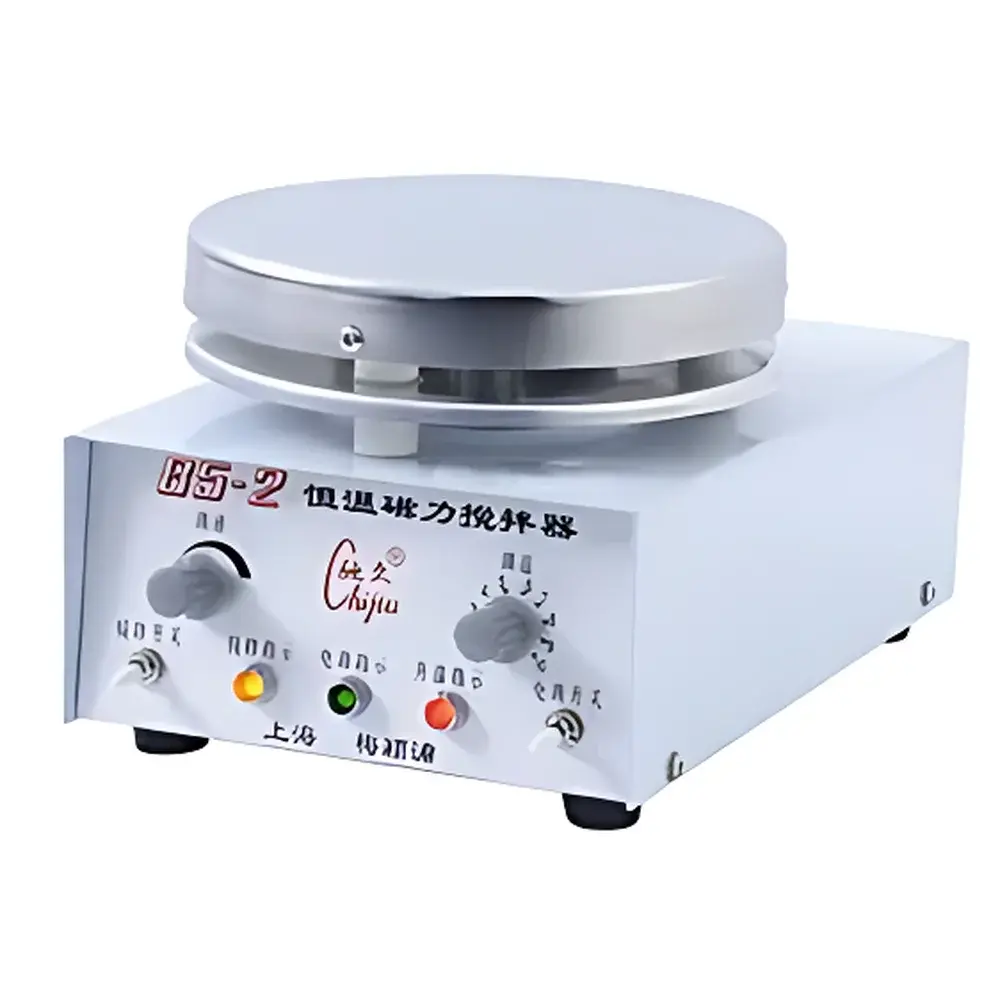
Jiayuan 85-2 Constant-Temperature Magnetic Stirrer
| Brand | Jiayuan |
|---|---|
| Origin | Shanghai, China |
| Model | 85-2 |
| Stirrer Type | Magnetic Stirrer |
| Max. Stirring Volume | 10 L (water) |
| Speed Range | 100–2000 rpm |
| Heating Power | 350 W |
| Temperature Control Range | Ambient to 150 °C (within 1 L volume) |
| Heating Plate Diameter | Φ145 mm |
| Dimensions | 250 × 150 × 130 mm |
| Construction | Stainless Steel Heating Plate |
| Regulatory Status | Domestic Manufacturing |
| Distribution Channel | General Distributor |
Overview
The Jiayuan 85-2 Constant-Temperature Magnetic Stirrer is a robust, field-proven laboratory instrument engineered for reliable simultaneous heating and magnetic stirring of liquid samples in standard benchtop applications. Designed on the principle of electromagnetic induction, it employs a rotating magnetic field generated beneath a non-magnetic ceramic or stainless steel plate to drive a PTFE- or glass-coated stir bar immersed in the sample vessel. Heat is delivered uniformly via resistive heating elements integrated into the stainless steel plate, with temperature feedback controlled by an internal thermistor or external conductive probe (optional). This dual-function architecture enables precise thermal management and homogeneous mixing—critical for applications requiring reproducible reaction kinetics, dissolution testing, buffer equilibration, or reagent preparation under defined thermal conditions.
Key Features
- Stainless steel heating plate (Φ145 mm) offering corrosion resistance, mechanical durability, and consistent thermal distribution across the working surface
- Adjustable speed control from 100 to 2000 rpm with analog or digital interface (model-dependent), enabling optimization for low-viscosity solvents or moderately viscous solutions
- Heating power output of 350 W supports rapid thermal ramping and stable maintenance within the ambient-to-150 °C range—validated for volumes up to 1 L; extended stability at lower temperatures achievable with larger vessels (up to 10 L water-equivalent capacity)
- Compact footprint (250 × 150 × 130 mm) designed for space-constrained fume hoods or shared lab benches without compromising operational safety or accessibility
- Proven mechanical architecture refined over decades of continuous production—prioritizing long-term reliability, minimal maintenance, and operator familiarity
Sample Compatibility & Compliance
The 85-2 accommodates standard laboratory glassware including beakers (50 mL–2000 mL), Erlenmeyer flasks, and cylindrical reaction vessels compatible with magnetic stir bars of appropriate geometry and coating (e.g., PTFE-sheathed, elliptical or cross-shaped bars for enhanced torque transmission). It is suitable for aqueous, organic, and mildly aggressive media—provided chemical compatibility with stainless steel and PTFE components is confirmed. While not certified to ISO/IEC 17025 or GLP-specific validation protocols out-of-the-box, its analog/digital controls support manual calibration traceability. Users implementing this unit in regulated environments (e.g., QC labs under GMP or ISO 9001) are advised to perform periodic verification of temperature accuracy (±2 °C typical) and rotational speed consistency using NIST-traceable reference instruments.
Software & Data Management
The Jiayuan 85-2 operates as a standalone analog or basic digital instrument without embedded microprocessor-based data logging or PC connectivity. Temperature and speed settings are manually adjusted via front-panel dials or push-button interfaces, with visual indicators (LEDs or analog meters) confirming operational status. For laboratories requiring audit trails or electronic records, integration with external data acquisition systems is feasible via optional analog output modules (0–5 V or 4–20 mA signals) when interfaced with third-party DAQ hardware and compliant software platforms adhering to FDA 21 CFR Part 11 requirements. Routine calibration logs, preventive maintenance schedules, and usage records must be maintained manually per institutional SOPs.
Applications
- Buffer and standard solution preparation under controlled thermal conditions
- Chemical synthesis initiation and monitoring where gentle, uniform agitation prevents localized overheating or precipitation
- Dissolution testing of pharmaceutical dosage forms in USP Apparatus I or II simulation setups (when used as auxiliary heating/stirring stage)
- Microbiological media sterilization and equilibration prior to autoclaving or filtration
- Environmental sample homogenization (e.g., wastewater extracts, soil leachates) prior to filtration or instrumental analysis
- Teaching laboratories—ideal for foundational chemistry and biology courses due to intuitive operation and mechanical transparency
FAQ
Is the 85-2 suitable for use with corrosive solvents such as concentrated acids or halogenated organics?
Stainless steel construction provides resistance to mild corrosion, but prolonged exposure to strong oxidizers (e.g., HNO₃, aqua regia) or halogenated solvents (e.g., chloroform, DCM) may degrade surface passivation. Use only with chemically compatible vessels and stir bars; verify material compatibility prior to deployment.
Can the unit maintain ±0.5 °C temperature stability at 100 °C?
At setpoints above 80 °C and within 1 L volume, typical stability is ±2 °C under static ambient conditions. Higher precision requires external PID controllers or dedicated circulatory thermostats.
Does the 85-2 include overload or dry-run protection?
No built-in thermal cutoff or motor stall detection is provided. Always ensure adequate liquid volume and proper stir bar engagement before initiating operation to prevent coil overheating or plate damage.
What stir bar size is recommended for optimal performance at 2000 rpm?
For maximum torque transfer and vortex stability at high speeds, elliptical or cross-shaped PTFE-coated bars (30–40 mm length, 8–10 mm width) are recommended for vessels ≥500 mL.
Is CE or RoHS certification available for export to the EU?
As a domestically distributed instrument, formal CE marking and RoHS documentation are not standard. Export configurations require third-party conformity assessment and technical file compilation prior to shipment.
Related Products



