
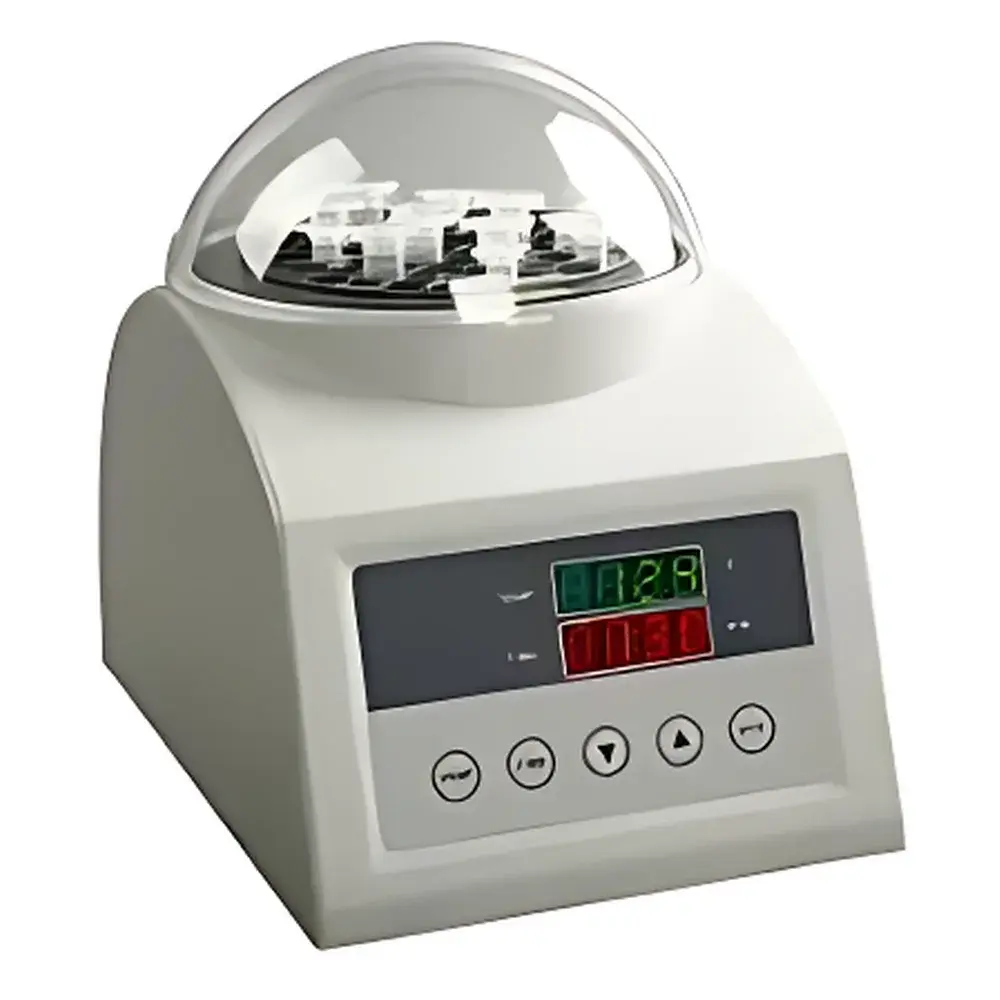
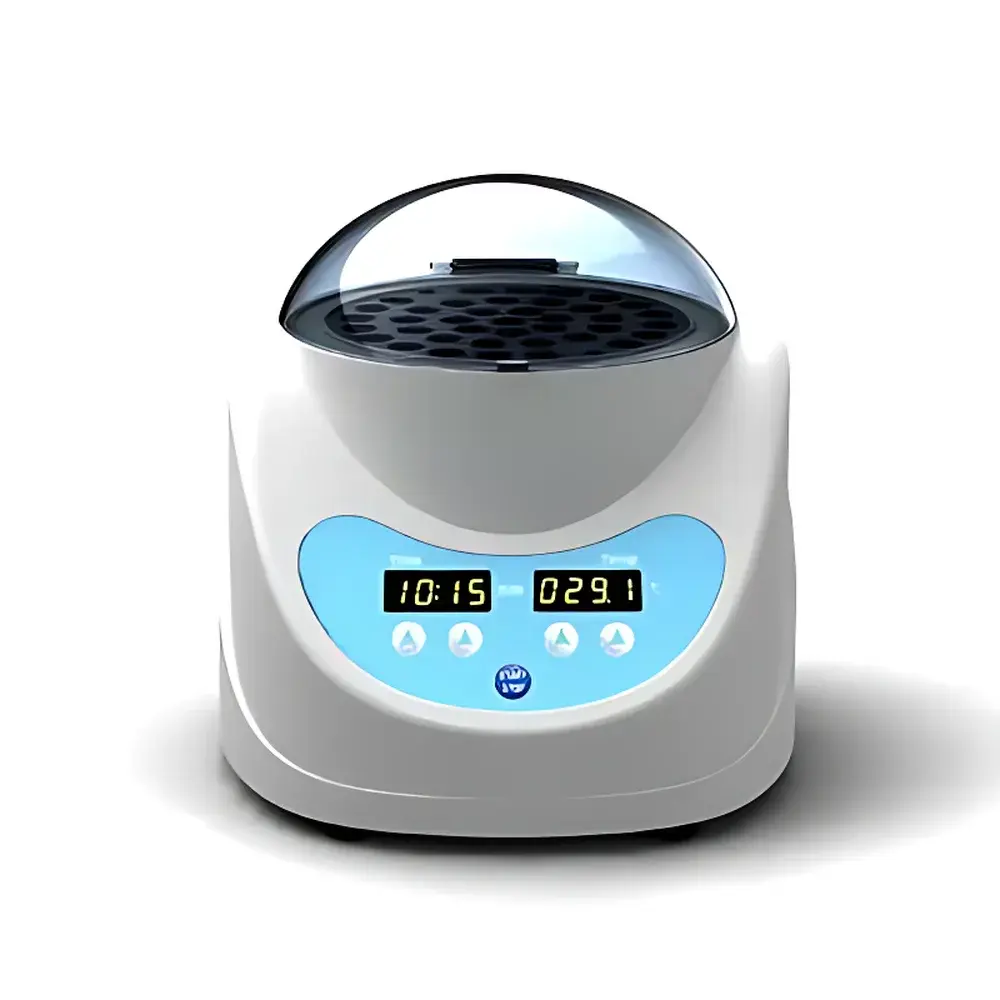
K30 Economic Dry Block Heater
| Origin | Beijing, China |
|---|---|
| Manufacturer Type | Distributor |
| Origin Category | Domestic |
| Model | K30 |
| Price | USD 370 (FOB) |
| Temperature Range | Ambient +5°C to 100°C |
| Heating Time | ≤25 min (20°C → 100°C) |
| Temperature Accuracy | ±0.5°C |
| Display Resolution | 0.1°C |
| Block Uniformity | ±0.5°C |
| Max Power | 150 W |
| Max Setpoint | 105°C |
| Timer Range | 0–99 h 59 min |
| Dimensions (W×D×H) | 225 × 160 × 197 mm |
| Net Weight | 3 kg |
| Interchangeable Blocks | A-30 to N-30 series (Φ6–Φ25 mm, 0.2–2.0 mL tube compatibility) |
Overview
The K30 Economic Dry Block Heater is a microprocessor-controlled, compact thermal incubation system engineered for precise and stable temperature maintenance in laboratory workflows where water baths are impractical or undesirable. Unlike liquid-based heating systems, the K30 employs a solid aluminum heating block—thermally optimized for rapid heat transfer and minimal thermal inertia—to deliver consistent, contact-based heating across sample tubes. Its design follows fundamental principles of conductive heat transfer, eliminating evaporation, contamination risk, and cross-sample mixing inherent in water baths. The unit operates within a controlled range from ambient +5°C up to 100°C (with short-term overshoot capability to 105°C), making it suitable for applications requiring reproducible thermal conditioning without active fluid circulation. Its robust plastic housing, integrated safety features, and modular architecture align with routine benchtop requirements in molecular biology, clinical diagnostics, and quality control laboratories.
Key Features
- LED dual-display interface showing real-time block temperature and countdown timer simultaneously
- Circular, interchangeable aluminum heating blocks (A-30 through N-30 series) supporting standardized tube formats from 0.2 mL PCR strips to 25 mm diameter culture tubes
- High thermal uniformity (±0.5°C across block surface) ensured by precision-machined block geometry and calibrated PID control algorithm
- Integrated overtemperature protection circuitry that automatically cuts power if internal sensor detects deviation beyond safe threshold
- User-accessible temperature offset calibration function to compensate for long-term sensor drift or lab-specific environmental gradients
- Acrylic transparent lid minimizes convective heat loss while enabling visual monitoring without opening—critical for maintaining sterility and thermal stability during sensitive protocols
- Active cooling fan accelerates cooldown after operation, reducing turnaround time between sequential runs
- Built-in audible alarm signals completion of timer cycle—essential for unattended overnight incubations or multi-step thermal protocols
Sample Compatibility & Compliance
The K30 accommodates a broad spectrum of standard laboratory consumables via its drop-in modular block system. Each block is dimensionally standardized (Φ108 mm diameter; 32 mm or 50 mm height) and CNC-machined to ISO-toleranced hole diameters—ensuring secure fit and optimal thermal coupling for tubes complying with IEC 61010-1 (Safety Requirements for Electrical Equipment for Measurement, Control, and Laboratory Use). Supported formats include 0.2 mL PCR tubes (96-well format), 0.5/1.5/2.0 mL microcentrifuge tubes, and round-bottom culture tubes (6–25 mm OD). While the device itself does not carry CE or UL certification out-of-box (as distributed), its electrical architecture meets Class I insulation standards and includes grounded chassis design. When operated under documented SOPs—including routine verification using NIST-traceable thermometers—the K30 supports GLP-compliant temperature validation per ISO/IEC 17025 Annex A.4 and satisfies basic thermal stability requirements referenced in USP and ASTM E2875-13 for incubation equipment qualification.
Software & Data Management
The K30 operates as a standalone analog-digital hybrid instrument with no embedded firmware update capability or USB/Bluetooth connectivity. All operational parameters—including setpoint, timer duration, and calibration offset—are configured directly via front-panel membrane keys. Temperature data is not logged or exportable; however, the display resolution (0.1°C) and repeatability (±0.5°C) enable manual recording compatible with paper-based or LIMS-integrated log sheets. For labs requiring electronic audit trails, integration is achieved externally via optional third-party temperature dataloggers (e.g., Omega OM-EL-USB-TC) placed adjacent to the block surface. The absence of network interfaces ensures immunity to cybersecurity vulnerabilities—a design consideration aligned with FDA 21 CFR Part 11 Annex B guidance for non-networked analytical instrumentation used in regulated environments.
Applications
- DNA denaturation and pre-PCR incubation at 95°C for polymerase activation
- Serum coagulation assays requiring strict 37°C incubation (e.g., PT/aPTT testing)
- Enzyme reaction kinetics studies with defined thermal ramping profiles
- Cell lysis buffer pre-warming prior to extraction protocols
- Standardization of reagent thawing conditions across multiple users
- Stability testing of diagnostic kits under accelerated thermal stress (40–45°C)
- Controlled drying of thin-film samples on glass slides or silicon wafers
FAQ
Does the K30 support programmable ramp-hold cycles?
No—the K30 provides only single-setpoint temperature control with fixed-duration timing. It does not offer multi-step thermal profiling.
Can the heating block be autoclaved?
No—aluminum blocks must not be exposed to steam sterilization. Cleaning is recommended with 70% ethanol and lint-free wipes; dry thoroughly before reuse.
Is the K30 suitable for use inside a biosafety cabinet?
Yes—its low power draw (150 W), absence of moving fluids, and sealed electronics make it compatible with Class II A2 cabinet airflow specifications when positioned away from the front grille.
What is the expected service life of the heating element?
Under normal usage (≤8 h/day, ambient lab conditions), the NiCr alloy heating coil typically exceeds 10,000 operating hours before measurable degradation in thermal response time occurs.
How frequently should temperature calibration be performed?
Per ISO/IEC 17025 recommendations, verify accuracy biannually using a calibrated reference thermometer; more frequent checks are advised if used in GxP-regulated workflows or following mechanical impact.



