
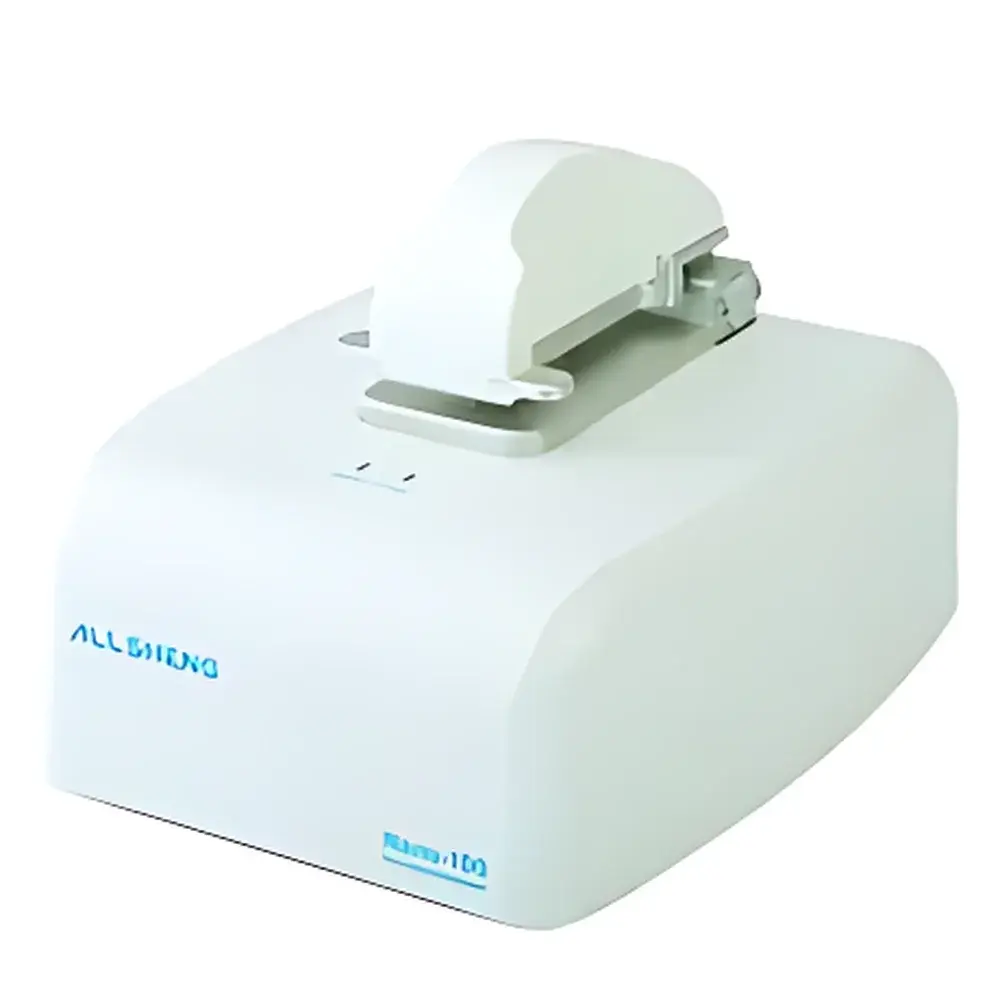
Jiayuan NANO-100 Microvolume UV-Vis Spectrophotometer
| Brand | Jiayuan |
|---|---|
| Origin | Beijing, China |
| Model | NANO-100 |
| Sample Volume | 0.5–2 µL |
| Optical Path Lengths | 0.2 mm (high-concentration mode), 1.0 mm (standard mode) |
| Light Source | Xenon flash lamp (≥10⁹ flashes, ~10-year lifetime) |
| Detector | 3864-element linear CCD array |
| Wavelength Range | 200–850 nm |
| Wavelength Accuracy | ±1 nm |
| Wavelength Resolution | 3 nm (FWHM at Hg 546 nm) |
| Absorbance Accuracy | ±1% (at 7.332 A, 260 nm) |
| Absorbance Precision | ±0.003 A |
| Absorbance Range | 0.02–90 A (equivalent to 10-mm path length) |
| Measurement Time | <5 s |
| Dimensions | 200 × 250 × 166 mm (W×D×H) |
| Weight | 2.6 kg |
| Sample Stage Material | Fused silica optical fiber + hardened aluminum |
| Power Supply | 24 V DC |
| Power Consumption | 20 W |
| Software Platform | Windows XP / Windows 7 (32/64-bit) |
Overview
The Jiayuan NANO-100 Microvolume UV-Vis Spectrophotometer is a benchtop, non-contact microvolume spectrophotometer engineered for rapid, accurate quantification of nucleic acids, proteins, and cell lysates using intrinsic UV-Vis absorbance. It operates on the principle of fixed-pathlength absorbance measurement—eliminating cuvettes, capillaries, or dilution steps—by leveraging surface tension to form a stable liquid column between two optical surfaces (quartz fiber and hardened aluminum). The instrument employs a high-stability xenon flash lamp and a 3864-element linear CCD array detector to capture full-spectrum data (200–850 nm) in a single exposure. With dual optical path lengths (0.2 mm for concentrated samples up to 4500 ng/µL dsDNA; 1.0 mm for standard-range analysis), it delivers high dynamic range without manual pathlength adjustment. Its solid-state optical architecture ensures long-term photometric stability and reproducibility across repeated measurements.
Key Features
- Microvolume operation: Requires only 0.5–2 µL of undiluted sample—ideal for precious, low-yield biological extracts.
- Dual-pathlength capability: Automatically selects optimal path length (0.2 mm or 1.0 mm) based on sample concentration, enabling direct quantification from 2.5 ng/µL to 4500 ng/µL dsDNA without dilution.
- Xenon flash lamp technology: Provides broad-spectrum output with no warm-up time; rated for ≥10⁹ flashes (~10 years under typical lab use), ensuring consistent spectral output and eliminating lamp drift.
- High-speed spectral acquisition: Full 200–850 nm spectrum captured and processed in less than 5 seconds per measurement.
- Intelligent power management: Automatic lamp shutdown after 5 minutes of inactivity; instant reactivation upon user-initiated measurement—no manual intervention required.
- Robust optical stage: Sample interface composed of fused silica optical fiber and aerospace-grade hardened aluminum, resistant to chemical corrosion and mechanical wear.
Sample Compatibility & Compliance
The NANO-100 supports native, unpurified, and buffer-matched samples—including aqueous solutions of dsDNA, ssDNA, RNA, oligonucleotides, BSA, lysozyme, and whole-cell lysates. It accommodates common laboratory buffers (e.g., TE, PBS, Tris-HCl) and tolerates moderate concentrations of salts, detergents, and reducing agents. While not certified for regulatory submission, its photometric performance aligns with key requirements of ISO 8570:2020 (UV-Vis spectrophotometers) and ASTM E275-22 (standard practices for UV-Vis-NIR spectroscopy). Absorbance accuracy (±1% at 260 nm) and precision (±0.003 A) meet internal QC thresholds used in GLP-compliant molecular biology labs. Data integrity is supported via timestamped measurement logs and exportable CSV/PDF reports compatible with LIMS integration.
Software & Data Management
The bundled Windows-based software (compatible with Windows XP SP3 and Windows 7, both 32- and 64-bit) provides an intuitive graphical interface with real-time spectral visualization, automatic peak identification (260/280, 260/230), and preconfigured calculation templates for nucleic acid and protein quantification. All raw spectra and derived values are stored locally with embedded metadata (date/time, operator ID, path length, wavelength calibration status). Export options include CSV (for Excel or statistical packages), PDF (for audit-ready documentation), and image formats (PNG/JPEG). Audit trail functionality—while not Part 11-compliant out-of-the-box—supports manual review of measurement history through chronological log files. Software updates are distributed via secure download portal with version-controlled release notes.
Applications
- Quantitative assessment of DNA/RNA yield post-extraction or enzymatic reaction (e.g., PCR cleanup, in vitro transcription).
- Routine QC of oligonucleotide synthesis products and CRISPR guide RNAs.
- Protein concentration determination in purified fractions or crude lysates using A280 or A205 methods.
- Monitoring cell culture density via A600 (OD600) with minimal sample consumption.
- Verification of dye labeling efficiency (e.g., Cy3/Cy5) by spectral deconvolution.
- Educational use in undergraduate biochemistry and molecular biology laboratories where cost-effective, low-maintenance instrumentation is prioritized.
FAQ
Does the NANO-100 require routine wavelength calibration?
No—factory-calibrated using mercury and holmium oxide reference standards; recalibration is not user-serviceable but may be performed by authorized service centers if traceability documentation is required.
Can the instrument measure turbid or viscous samples?
It is optimized for clear, low-viscosity aqueous solutions; highly turbid or glycerol-rich samples may produce inaccurate readings due to light scattering—centrifugation or dilution is recommended prior to analysis.
Is the sample recoverable after measurement?
Yes—the sample remains intact on the optical stage and can be retrieved with a pipette tip or gently wiped with lint-free lens paper without residue transfer.
What maintenance does the optical stage require?
Daily cleaning with >99% isopropanol and a microfiber cloth is sufficient; avoid abrasive solvents or physical scrubbing to preserve quartz fiber integrity.
How is photometric accuracy verified during daily use?
Users may run a water blank (A280 ≈ 0.000) and a certified dsDNA standard (e.g., 50 ng/µL in TE buffer) to confirm baseline stability and concentration linearity across the operational range.





