
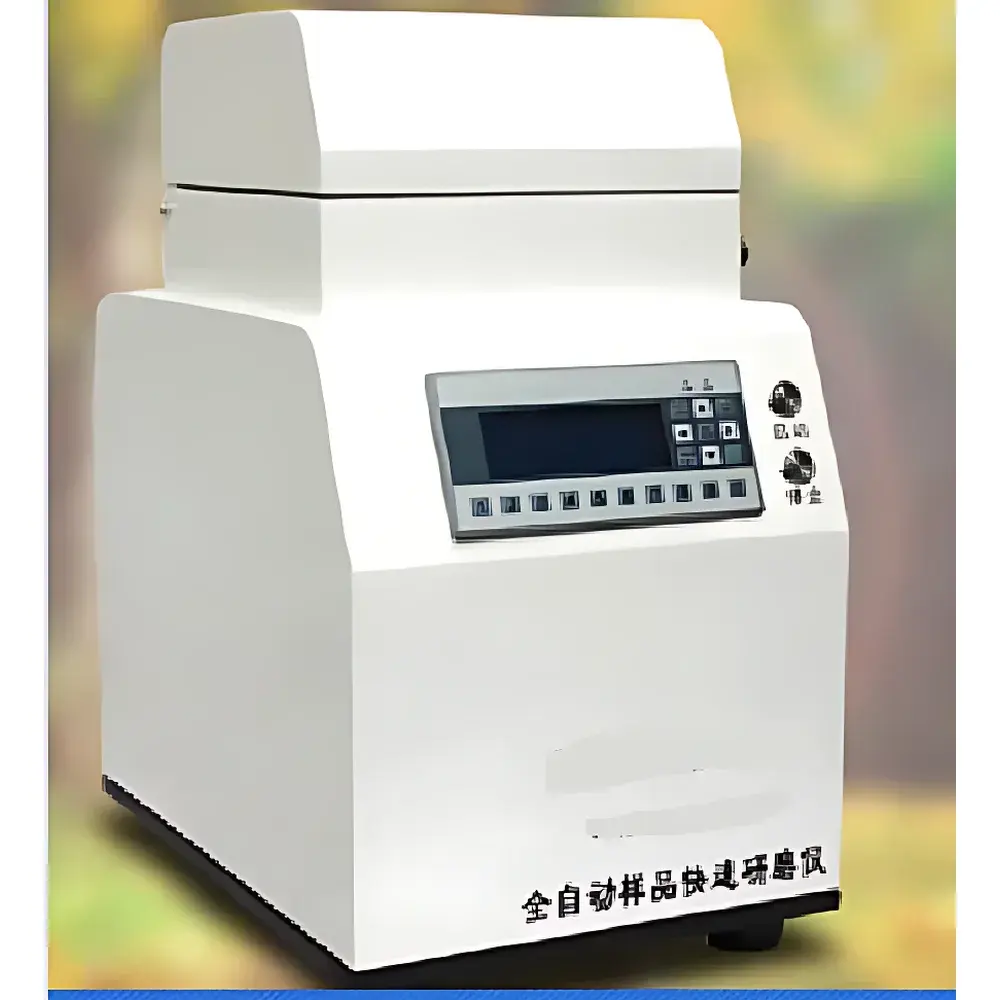
Jiayuan FSTPRP-24 High-Throughput Cryogenic Ball Mill
| Brand | Jiayuan |
|---|---|
| Origin | Beijing, China |
| Model | FSTPRP-24 |
| Instrument Type | Cryogenic Ball Mill |
| Sample Compatibility | Frozen & temperature-sensitive materials |
| Maximum Feed Size | ≤ 8 mm |
| Final Particle Size | 0–5 µm |
| Throughput | 24 × 1.5 mL tubes |
| Operating Temperature Range | −196 °C to −100 °C |
| Frequency Range | 1–70 Hz (30–2100 rpm, equivalent to 100–7000 impacts/min) |
| Grinding Vessel Options | 1.5, 2, 5, 10, 25, 35, 50 mL |
| Vessel Materials | Stainless steel, PTFE |
| Grinding Media | Stainless steel, chrome steel, zirconia, tungsten carbide, quartz |
| Safety Certification | ISO, CE |
| Cooling Method | Liquid nitrogen (LN₂) or optional air-cooling unit |
Overview
The Jiayuan FSTPRP-24 High-Throughput Cryogenic Ball Mill is an engineered solution for rapid, reproducible, and contamination-free sample homogenization under cryogenic conditions. It operates on the principle of high-frequency mechanical impact combined with deep-cryogenic embrittlement—leveraging liquid nitrogen (LN₂) to cool samples to −196 °C, rendering thermolabile, fibrous, elastic, or tough biological and synthetic materials brittle prior to pulverization. This dual-mode mechanism—cryogenic freezing + oscillatory impact grinding—ensures structural integrity of nucleic acids, proteins, and metabolites while achieving sub-5 µm particle size distribution. Designed for laboratories requiring parallel processing of up to 24 samples in standardized microtubes (1.5 mL), the system supports strict thermal management protocols essential for molecular biology, pharmaceutical QA/QC, and materials science applications where ambient-temperature degradation must be eliminated.
Key Features
- Triple-axis oscillatory motion (patented JXFSTPRP-1 vibration architecture) generates 3D “figure-eight” tube movement, ensuring uniform energy transfer and eliminating dead zones during grinding.
- Integrated LN₂ delivery system enables precise, on-demand cryogen injection—fully controllable flow rate and timing—with automatic refilling capability from external dewars (Type II configuration) or optional air-cooling module (Type I, down to 0 °C).
- Full-seal tube containment: All sample vessels remain hermetically sealed throughout the process, preventing cross-contamination, volatilization loss, and operator exposure to hazardous or bioactive substances.
- Intuitive touchscreen interface (optional) allows programmable control of grinding frequency (1–70 Hz), cycle duration, rest intervals, and up to 10 user-defined protocols—supporting audit-ready parameter logging.
- Robust mechanical design featuring a single moving component (impact-driven oscillator), hardened steel housing (no plastic safety covers), and low-stress kinematics—optimized for >10,000 operational cycles with minimal maintenance.
- Rapid thermal stabilization: Samples reach −100 °C within 60 seconds and −196 °C within 4 minutes and 30 seconds—critical for preserving labile biomolecules during tissue lysis or polymer fragmentation.
Sample Compatibility & Compliance
The FSTPRP-24 accommodates diverse sample classes including mammalian/fish/plant tissues, microbial pellets, fibrous botanicals, elastomers (rubber, silicone), thermoplastics (PE, PS), pharmaceutical tablets, coal, shale, ceramics, and composite resins. Its ability to process samples ranging from hard (e.g., bone, seeds) to highly elastic (e.g., cartilage, gels) or moisture-rich (e.g., fresh leaf, adipose) stems from adaptive impact kinetics and real-time cryogen modulation. The system complies with ISO 9001 quality management standards and bears CE marking per Directive 2006/42/EC (Machinery Directive). While not inherently 21 CFR Part 11–compliant, its optional data-logging firmware supports GLP/GMP-aligned workflows when paired with validated LIMS integration and electronic signature modules.
Software & Data Management
The instrument’s embedded controller records timestamped operation logs—including frequency setpoint, actual RPM, LN₂ consumption volume (via calibrated mass-flow sensor), cycle count, and thermal ramp profiles—for each run. Exportable CSV files enable traceability in regulated environments. Optional software packages provide remote monitoring via Ethernet/Wi-Fi, automated report generation (PDF/Excel), and compatibility with laboratory information management systems (LIMS) through standard OPC UA or RESTful API interfaces. All parameter changes are logged with user ID and timestamp, satisfying basic ALCOA+ (Attributable, Legible, Contemporaneous, Original, Accurate) data integrity requirements.
Applications
- Molecular biology: High-yield, low-shear lysis of mammalian cells, yeast, bacteria, and plant tissues for DNA/RNA/protein extraction without enzymatic or chemical bias.
- Pharmaceutical development: Uniform micronization of active pharmaceutical ingredients (APIs) and excipients for dissolution testing and formulation screening (aligned with USP & EP particle size analysis guidelines).
- Food & agriculture: Homogenization of heterogeneous matrices (e.g., meat composites, grain blends, fermented products) for mycotoxin, pesticide residue, or nutritional profiling.
- Materials science: Controlled fragmentation of polymers, composites, and ceramics for SEM/TEM sample preparation, rheological slurry generation, or additive manufacturing feedstock qualification.
- Environmental analysis: Preparation of soil, sediment, and biochar samples for heavy metal speciation, organic contaminant extraction, and isotopic analysis.
FAQ
What cooling methods does the FSTPRP-24 support?
It supports direct liquid nitrogen (LN₂) immersion (Type II) or optional forced-air refrigeration (Type I, down to 0 °C), both fully integrated with real-time temperature feedback and programmable cryogen dosing.
Can the system handle hazardous or regulated samples?
Yes—hermetically sealed tube architecture prevents aerosol release, and stainless-steel/PTFE wetted parts ensure chemical compatibility and decontamination readiness per biosafety Level 2 (BSL-2) and CLIA requirements.
Is method validation documentation available?
Instrument-specific IQ/OQ documentation templates are provided; PQ validation support includes grinding efficiency curves (Dv50 vs. time), temperature stability reports (±0.5 °C at −196 °C), and inter-batch reproducibility data (RSD < 3.2% for RNA yield across 24 replicates).
What maintenance is required?
Annual calibration of frequency transducer and LN₂ flow meter is recommended; no lubrication or bearing replacement is needed due to the single-oscillator mechanical design.
Does it comply with Good Manufacturing Practice (GMP)?
While the base unit meets CE and ISO standards, full GMP compliance requires optional 21 CFR Part 11–enabled software, electronic audit trail activation, and site-specific qualification (IQ/OQ/PQ) performed by certified engineers.



