
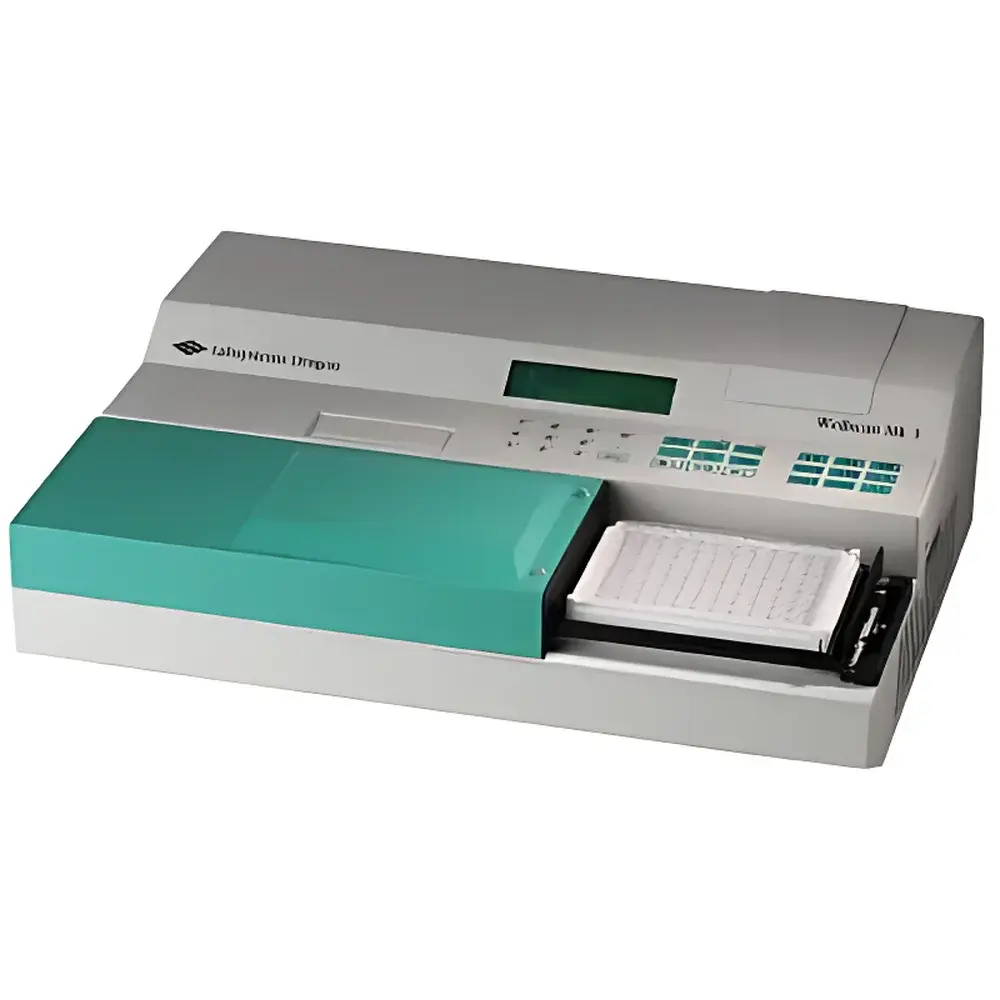
Thermo Scientific Multiskan MK3 Microplate Reader
| Brand | Thermo Fisher Scientific |
|---|---|
| Origin | USA (assembled in Shanghai) |
| Model | MK3 |
| Function Type | Multifunctional |
| Automation Level | Semi-Automatic |
| Measurement Method | Scanning |
| Curve Fitting | Mathematical Functions |
| Detector Type | UV-Vis Photomultiplier Tube (PMT) |
| Wavelength Range | 340–850 nm |
| Absorbance Range | 0–4.0 ABS |
| Linearity Range | 0–2.0 ABS |
| Wavelength Switching Time | 6 s |
| Photometric Accuracy | ±1% (0–2.0 ABS) |
| Precision (CV) | <0.5% (0–1.5 ABS) |
| Resolution | 0.001 ABS |
| Plate Read Time | ≤5 s per 96-well plate |
| Optical System | Multi-channel fiber-optic detection |
| Filter Capacity | Up to 8 positions, motorized filter wheel |
| Built-in Shaker | Linear, 3 adjustable speeds |
| Dimensions | 140 × 420 × 320 mm |
| Weight | 11 kg |
| Power Supply | 220–240 V, 50/60 Hz |
| Light Source | Tungsten-halogen lamp with spare bulb included |
| Interface | RS-232 serial port, parallel printer port |
| Onboard Display | 2 × 20 character LCD |
| Keyboard | 30-key tactile membrane keypad |
| Data Storage | 64 programmable protocols and calibration curves |
| Software | Windows-based MK3 Control & Analysis Suite (included) |
Overview
The Thermo Scientific Multiskan MK3 Microplate Reader is a semi-automatic, multifunctional absorbance microplate reader engineered for precision and reliability in routine and research-grade life science laboratories. Based on dual-beam photometry with a tungsten-halogen light source and multi-channel fiber-optic detection architecture, the MK3 delivers high reproducibility across a broad spectral range (340–850 nm), supporting endpoint, kinetic, and dual-wavelength assays. Its optical design minimizes path-length variability and photometric drift, ensuring compliance with fundamental requirements of quantitative colorimetric analysis in ELISA, protein quantification (e.g., Bradford, BCA), enzyme kinetics, cell viability (MTT, XTT), and microbial growth monitoring. The instrument operates under strict photometric linearity constraints (0–2.0 ABS, ±1% accuracy), with verified coefficient of variation (CV) <0.5% at 0–1.5 ABS — performance aligned with ISO 15197 and CLSI EP10-A3 guidelines for analytical precision in clinical and QC applications.
Key Features
- Semi-automatic operation with intuitive 30-key tactile interface and dual-line LCD display — no PC required for basic assay execution
- Motorized 8-position filter wheel supporting standard wavelengths (405, 450, 492, 630 nm) plus optional filters from 340–700 nm
- Multi-channel fiber-optic detection system enabling full 96-well plate readout in ≤5 seconds
- Integrated linear shaker with three programmable amplitude/speed settings for uniform mixing prior to measurement
- Onboard data handling: stores up to 64 user-defined protocols, calibration curves (linear, 4-parameter logistic, quadratic), and cutoff thresholds
- Automatic self-diagnostic startup sequence including lamp warm-up verification, optical zero calibration, and filter position validation
- Flexible measurement modes: single-, dual-, and multi-wavelength endpoint; kinetic (dual-time point); and agglutination assays
- Comprehensive reporting: printouts mirror microplate layout; include protocol ID, timestamp, operator ID, raw OD values, calculated concentrations, and statistical summaries (mean, SD, CV, Z’-factor)
Sample Compatibility & Compliance
The MK3 supports standard 96-well microplates (flat, U-bottom, V-bottom) and compatible strip wells. It accommodates opaque, clear, and UV-transparent polystyrene and polypropylene plates. All optical calibrations are traceable to NIST-traceable neutral density filters. The instrument meets IEC 61010-1 safety standards and EMC Directive 2014/30/EU. Its photometric performance satisfies key elements of ISO 15197:2013 (in vitro diagnostic devices) and CLSI EP10-A3 (preliminary evaluation of quantitative clinical laboratory methods). While not FDA 21 CFR Part 11–compliant out-of-the-box, audit trail functionality and electronic signature support are available via the optional Windows-based MK3 Software Suite under validated GxP environments.
Software & Data Management
The included MK3 Control & Analysis Software (Windows-compatible) provides full remote control, advanced curve fitting (including 4PL, linear regression, point-to-point), and customizable report templates. Raw absorbance data export is supported in CSV, Excel (.xls), and XML formats — facilitating integration with LIMS or statistical platforms (e.g., GraphPad Prism, R). The software enforces user-level access control (administrator/operator), session logging, and versioned protocol archiving. For regulated environments, optional 21 CFR Part 11 add-ons enable electronic signatures, audit trails, and secure data encryption — supporting GLP and GMP-aligned workflows where instrument qualification (IQ/OQ/PQ) documentation is required.
Applications
- ELISA quantification (IgG, cytokines, hormones) using 450 nm + reference 630 nm
- Enzyme activity assays (e.g., LDH, ALP, β-galactosidase) via kinetic or endpoint measurement
- Cell proliferation and cytotoxicity (MTT, CCK-8, resazurin) at 490–570 nm
- Protein concentration determination (Bradford at 595 nm, BCA at 562 nm)
- Microbial growth monitoring (OD600) in antibiotic susceptibility testing
- Agglutination-based serology (e.g., blood typing, CRP screening)
- Quality control of microplate manufacturing (inter-well uniformity, edge effect analysis)
FAQ
Is the MK3 compatible with 384-well plates?
No — the MK3 is optimized exclusively for 96-well format plates and strips. Its optical path and mechanical stage do not support 384-well geometries.
Can I perform kinetic measurements without a PC connection?
Yes — onboard kinetic mode supports dual-time-point acquisition (e.g., t=0 and t=30 min) with automatic delta calculation and storage.
What is the wavelength accuracy specification?
Peak wavelength accuracy is ±2 nm across the 340–850 nm range, verified using holmium oxide and didymium reference filters per ISO 8578.
Does the MK3 support temperature control?
No — it is a room-temperature-only reader. For incubation-integrated workflows, external plate warmers or stackable incubator modules must be used.
How is photometric linearity validated during routine use?
The MK3 includes built-in neutral density filters for daily linearity verification across 0.0–2.0 ABS; results are logged and exportable for QA review.




