
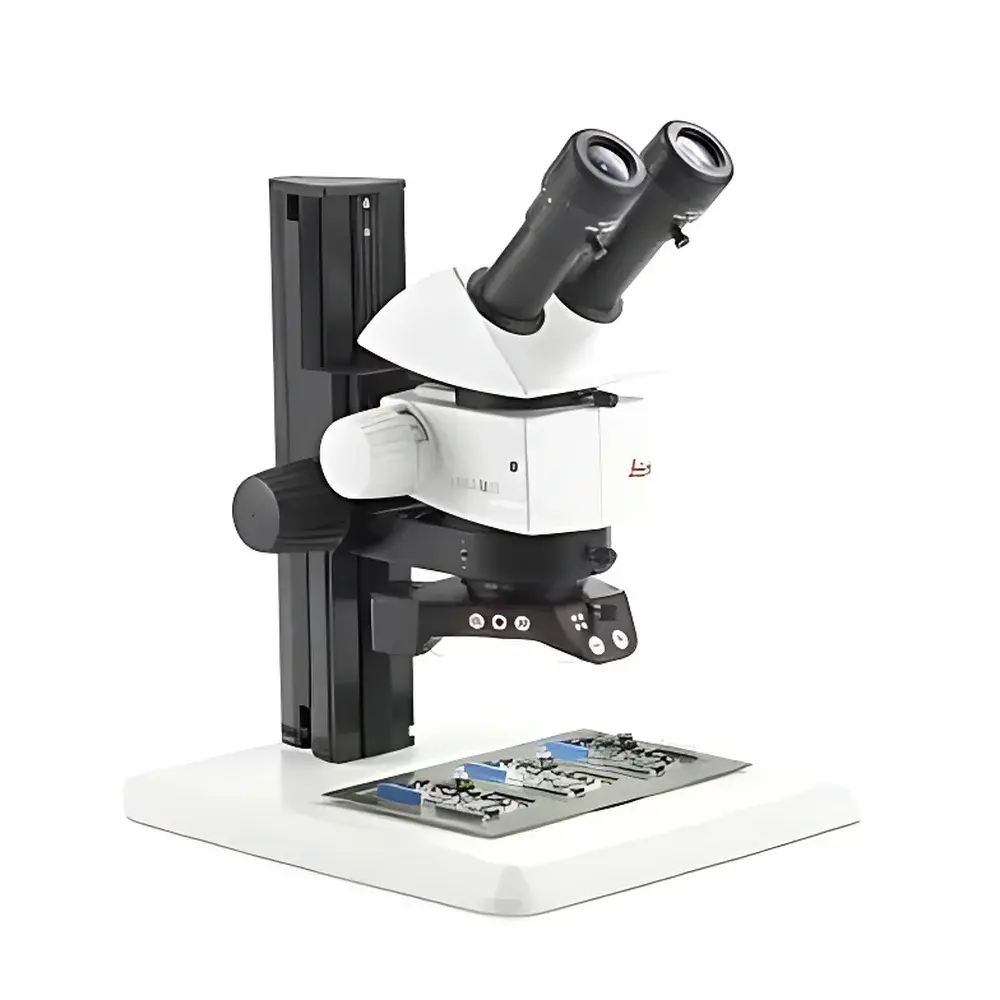
Leica M60 Stereo Microscope
| Brand | Leica |
|---|---|
| Origin | Germany |
| Model | M60 |
| Zoom Ratio | 6.3:1 |
| Working Distance | 27.4 mm (at 2.0×) to 303 mm (at 0.32×) |
| Field of View | Ø5.75 mm – Ø116.8 mm |
| Max Magnification | 320× (with 2.0× objective + 40× eyepieces) |
| Resolution | 225–450 lp/mm (dependent on objective and eyepiece combination) |
| Numerical Aperture | 0.15 (at 1×) |
| Fixed Zoom Stops | 7 positions |
| Ergonomic Viewing Angle | 10°–50° |
| Tube Type | CMO (Common Main Objective) optical design |
| Surface Resistivity | 2×10¹¹ Ω/mm² |
| Discharge Time | <2 s (1000 V → 100 V) |
Overview
The Leica M60 Stereo Microscope is a high-performance, modular CMO (Common Main Objective) stereo imaging system engineered for precision visual inspection, quality control, and routine laboratory analysis in industrial, academic, and life science environments. Utilizing a parallel beam path architecture with a single shared objective lens, the M60 delivers exceptional depth of field, high-resolution stereoscopic imaging, and superior color fidelity across its full 6.3:1 zoom range (0.32×–2.0×). When combined with standard 10× widefield eyepieces and optional auxiliary objectives, total magnifications up to 320× are achievable—enabling detailed morphological assessment of macro- to sub-millimeter specimens without compromising ergonomic usability or optical consistency. Designed and manufactured in Wetzlar, Germany, the M60 adheres to Leica Microsystems’ stringent optical tolerances and mechanical stability standards, ensuring long-term calibration integrity and reproducible measurement outcomes.
Key Features
- CMO optical architecture with dual parallel light paths for true stereoscopic perception and minimal parallax error
- 6.3:1 continuous zoom system with seven tactile, repeatable fixed-stop positions—ideal for standardized inspection workflows and GLP-compliant documentation
- Wide field of view up to Ø116.8 mm (at 0.32×), exceeding industry benchmarks by up to 20% compared to comparable stereo platforms
- Extended working distance range: 27.4 mm (2.0×) to 303 mm (0.32×), accommodating bulky samples, manipulators, and integrated stage accessories
- ErgoTube® and ErgoModule® binocular tube options with adjustable inclination (10°–50°) and interpupillary adjustment for sustained operator comfort
- Multi-coated, lead-free optical components compliant with RoHS and REACH directives; anti-static housing (resistivity 2×10¹¹ Ω/mm²; discharge time <2 s)
- Modular mounting interface supporting Leica LED3000 RL ring light, transmitted base illumination, motorized focus drives, and digital camera adapters
Sample Compatibility & Compliance
The Leica M60 accommodates diverse sample types—including electronic PCBs, metallographic sections, botanical specimens, entomological preparations, and medical device components—without requiring specialized preparation. Its large working distance and variable zoom enable non-contact examination of fragile, reflective, or three-dimensional surfaces. The system supports ISO 10934-1 (stereomicroscopy terminology), ISO 9241-307 (ergonomic requirements for visual display workstations), and ASTM E29-23 (standard practice for using significant digits in test data). When configured with Leica Application Suite (LAS) X software and audit-trail-enabled hardware, the M60 meets FDA 21 CFR Part 11 requirements for electronic records and signatures in regulated QC/QA environments.
Software & Data Management
The M60 integrates seamlessly with Leica LAS X software (v3.7+), enabling image capture, annotation, measurement (length, angle, area, particle count), multi-focus stacking, and report generation in PDF or CSV formats. Optional modules support GxP-compliant workflow templates, user access controls, electronic signature validation, and automatic metadata embedding (objective ID, magnification, illumination settings, timestamp). All image files are stored in open TIFF or JPEG2000 formats with embedded EXIF tags, ensuring long-term archival compatibility and traceability. System logs record user logins, parameter changes, and acquisition events—supporting internal audits and regulatory inspections under GLP and GMP frameworks.
Applications
- Electronics manufacturing: solder joint inspection, component placement verification, and failure analysis of SMT assemblies
- Materials science: fracture surface characterization, coating thickness estimation, and grain structure documentation
- Life sciences: dissection of model organisms, histological slide screening, and embryonic development staging
- Forensics: toolmark comparison, fiber analysis, and document authenticity assessment
- Quality assurance labs: incoming material inspection, dimensional verification per ISO 1101, and defect classification per IPC-A-610
- Education: undergraduate microscopy training with scalable complexity—from basic observation to quantitative morphometrics
FAQ
What is the maximum usable magnification of the Leica M60?
The M60 achieves up to 320× total magnification when equipped with a 2.0× auxiliary objective and 40× widefield eyepieces—though optimal resolution is maintained between 20× and 160× depending on specimen contrast and lighting configuration.
Does the M60 support digital imaging integration?
Yes—via C-mount or F-mount adapters compatible with Leica DFC series cameras and third-party sensors (e.g., Sony IMX series). Native support for USB 3.0, HDMI output, and live streaming to networked displays is available through LAS X software.
Can the M60 be used in cleanroom environments?
The housing meets ISO Class 5 particulate limits when operated with filtered air intake and static-dissipative accessories; optional stainless-steel finish and sealed optics further enhance suitability for ISO 14644-1 Class 7–8 cleanrooms.
Is calibration documentation provided with the instrument?
Each unit ships with a factory-verified calibration certificate traceable to PTB (Physikalisch-Technische Bundesanstalt), including verification of zoom linearity, field diameter accuracy, and interpupillary alignment per DIN EN ISO/IEC 17025.
How does the M60 compare to the Leica M80 or M125 in terms of optical performance?
The M60 prioritizes working distance, ergonomics, and modularity over ultra-high magnification; it offers broader depth of field and faster zoom repeatability than the M80 (8:1), while delivering higher resolution at mid-range magnifications than the M125’s extended 12.5:1 zoom—but with lower maximum magnification capability.



