
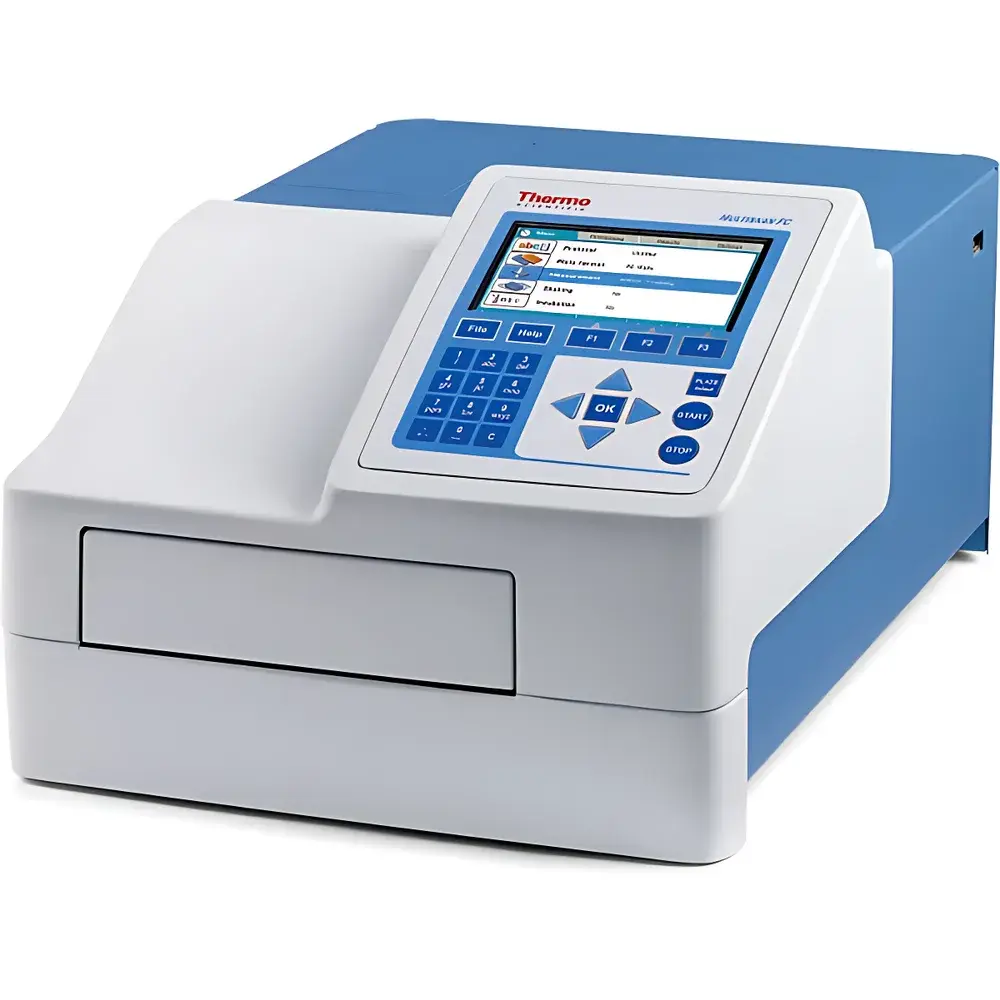
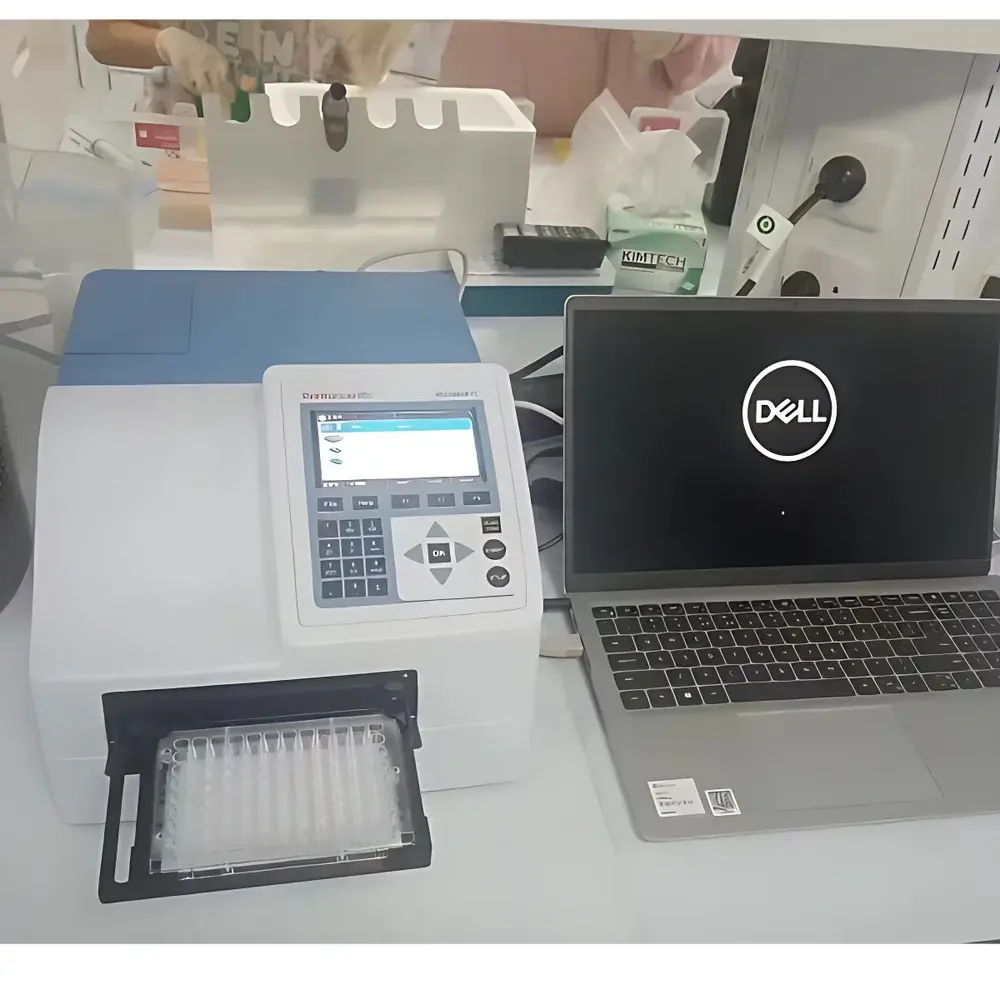
Thermo Scientific Multiskan FC Microplate Reader
| Brand | Thermo Fisher Scientific |
|---|---|
| Origin | USA |
| Model | FC |
| Detection Method | Absorbance (Photometric) |
| Functionality | Single-mode |
| Automation Level | Semi-automated |
| Measurement Mode | Endpoint Scanning |
| Curve Fitting | Polynomial, Linear, Log-Log, 4-Parameter Logistic (4PL), and Other Standard Functions |
| Detector Type | UV-Visible Photodiode Array |
| Wavelength Range | 340–850 nm |
| Absorbance Range | 0–6 ABS |
| Linear Range | 0–3 ABS (at 405 nm, 96-well, standard mode) |
| Wavelength Selection Speed | 6 s per wavelength (96-well plate, fast mode) |
| Accuracy | ±1% (0–3 ABS), ±2% (3–4 ABS) at 405 nm |
| Precision (CV) | ≤0.2% (0–3 ABS), ≤1.0% (3–4 ABS), standard mode |
| Optical Resolution | 0.001 ABS |
| Filter Wheel | 8-position, standard filters: 405 nm, 450 nm, 620 nm |
| optional filters available (FWHM | 3–9 nm) |
| Plate Formats | 96-well and 384-well microplates |
| Incubation (optional) | RT +4°C to 50°C |
| Shaking | Linear shaking with three speed settings |
| Display | 480 × 272 pixel color LCD touchscreen |
| Onboard Memory | 100 protocols + 100 result sets (96-well) |
| Interfaces | 3× USB (PC, printer, USB storage) |
| Compliance | RoHS, CE (2002/96/EC), FCC Part 15 Subpart B Class B, IEC 61010-1 |
Overview
The Thermo Scientific Multiskan FC Microplate Reader is a high-performance, semi-automated absorbance microplate reader engineered for precision photometric quantification in life science research, clinical diagnostics, and quality control laboratories. Based on a patented optical path design (U.S. Patent No. US6111636), the instrument employs a stable quartz-halogen light source coupled with an 8-position filter wheel to deliver accurate, reproducible absorbance measurements across a broad spectral range of 340–850 nm. Its core measurement principle relies on Beer–Lambert law-based photometry, where transmitted light intensity through sample-containing wells is converted into quantitative absorbance values (ABS). Designed for robustness and ease of use, the FC performs endpoint absorbance scans on standard 96-well and high-density 384-well microplates—supporting applications ranging from ELISA and enzyme kinetics to cell viability assays and protein quantification.
Key Features
- Patented dual-beam optical architecture ensures high baseline stability and minimizes drift during extended runs.
- High-resolution color LCD display (480 × 272 pixels) with intuitive keypad interface enables standalone operation without external PC.
- Onboard memory stores up to 100 user-defined protocols and 100 full 96-well result sets, facilitating rapid method recall and audit-ready data retention.
- Standard linear shaker with three adjustable speeds enhances reagent mixing uniformity—critical for homogeneous assay conditions prior to reading.
- Optional integrated incubator (RT +4°C to 50°C) supports temperature-sensitive assays including kinetic enzyme activity measurements and cell-based assays requiring controlled thermal environments.
- Three dedicated USB ports allow simultaneous connection to a host computer (for SkanIt software control), a USB printer, and removable storage media—enabling direct data export in CSV or XML formats.
- Complies with international safety and electromagnetic compatibility standards: CE (2002/96/EC), RoHS, FCC Part 15 Subpart B Class B, and IEC 61010-1 for laboratory equipment safety.
Sample Compatibility & Compliance
The Multiskan FC accommodates standard ANSI/SLAS-compliant 96-well and 384-well microplates—including clear, flat-bottom, U- and V-bottom polystyrene plates—as well as opaque or black plates for reduced crosstalk in low-signal applications. Its optical path is optimized for aqueous and buffered biological samples typical in immunoassays, nucleic acid quantitation (e.g., dsDNA at 260 nm via optional filter), and colorimetric cytotoxicity assays (e.g., MTT, XTT). While not designed for fluorescence or luminescence detection, its absorbance performance meets key regulatory expectations for routine QC testing under GLP and GMP frameworks. The instrument’s accuracy and linearity specifications align with ASTM E275 and ISO 15197 guidance for photometric instrumentation validation. Data integrity is supported by SkanIt software’s optional 21 CFR Part 11 compliance modules—including electronic signatures, audit trails, and user access controls—when deployed in regulated environments.
Software & Data Management
The FC operates natively via its embedded firmware, offering multilingual support (including English and Chinese) and built-in curve-fitting algorithms: linear regression, polynomial fits, log-log transformations, and the industry-standard 4-parameter logistic (4PL) model essential for ELISA dose-response analysis. For advanced experimental control and reporting, Thermo Scientific SkanIt PC software provides expanded capabilities—including multi-plate batch processing, custom protocol scripting, real-time kinetic monitoring (with compatible incubator), and automated report generation compliant with ISO/IEC 17025 documentation requirements. All raw absorbance data, metadata (wavelength, filter, plate map), and analysis parameters are timestamped and exportable to LIMS or statistical platforms such as GraphPad Prism or R. Internal storage and USB export ensure full traceability without dependency on network infrastructure.
Applications
- Enzyme-linked immunosorbent assays (ELISA) for antigen/antibody quantification in serum, plasma, or cell culture supernatants.
- Enzyme activity profiling (e.g., LDH, ALP, HRP) using chromogenic substrates across defined wavelength bands (e.g., 405 nm for pNPP).
- Cell proliferation and cytotoxicity assessment via colorimetric dyes (MTT, CCK-8, WST-1) measured at 450–490 nm.
- Protein concentration determination using Bradford, Lowry, or BCA assays (typically read at 595 nm, 750 nm, or 562 nm).
- Microbial growth monitoring in liquid culture (OD600) and antibiotic susceptibility testing.
- Quality control of reagents, standards, and calibrators in diagnostic kit manufacturing environments.
FAQ
Does the Multiskan FC support kinetic measurements?
Yes—when paired with the optional incubator module and operated via SkanIt software, the FC can perform time-resolved absorbance readings at user-defined intervals (e.g., every 30 seconds over 2 hours), enabling real-time monitoring of enzymatic reactions or cell metabolic activity.
Can I upgrade the FC to fluorescence or luminescence capability?
No—the FC is a dedicated absorbance reader. Thermo offers separate multimode readers (e.g., Varioskan LUX) for combined absorbance/fluorescence/luminescence detection.
What is the calibration verification procedure?
The instrument performs automatic self-checks at startup—including lamp intensity, filter positioning, and plate carriage alignment—and supports user-initiated optical calibration using NIST-traceable neutral density filters or certified reference standards.
Is the FC compatible with robotic liquid handlers?
Yes—the FC features standardized deck dimensions and mechanical handshake signals that enable integration with common lab automation systems (e.g., Hamilton STAR, Tecan Freedom EVO) via third-party middleware or direct API control through SkanIt.
How is data security managed in regulated labs?
When used with SkanIt software’s optional Compliance Pack, the system enforces role-based access control, immutable audit trails, electronic signatures, and secure data encryption—fulfilling core requirements of FDA 21 CFR Part 11 and EU Annex 11 for electronic records and signatures.




