
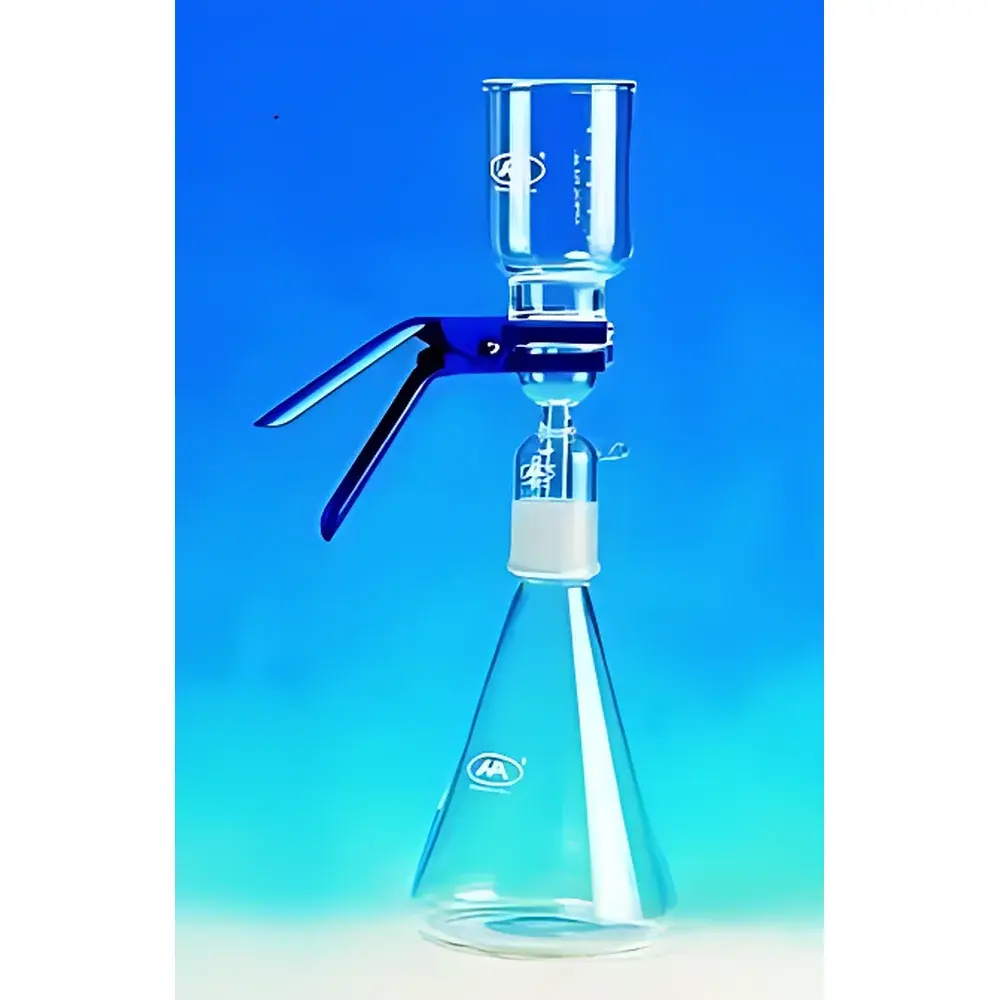
Jiayuan 1L Borosilicate Glass Solvent Filtration System
| Brand | Jiayuan |
|---|---|
| Origin | Beijing, China |
| Manufacturer Type | Authorized Distributor |
| Product Origin | Domestic (China) |
| Model | 1L |
| Price Range | USD 140–1,400 |
| Filter Cup Capacity | 300 mL |
| Receiver Bottle Capacity | 1000 mL |
| Funnel Diameter | 50 mm |
| Screen Plate Pore Size | 10 µm |
| Screen Plate Material | PTFE |
| Funnel & Housing Material | High-Borosilicate Glass (DIN/ISO Compliant) |
| Clamp Material | Anodized Aluminum Alloy |
| Sterilization Compatibility | Autoclavable at 121°C, 20 min |
| Filter Membrane Compatibility | Ø47 mm or Ø50 mm discs |
Overview
The Jiayuan 1L Borosilicate Glass Solvent Filtration System is a precision-engineered laboratory filtration assembly designed for rigorous solvent preparation in analytical and preparative workflows. Based on vacuum-driven dead-end filtration principles, it enables rapid, particle-free clarification of aqueous, organic, and aggressive chemical solvents—particularly critical for high-performance liquid chromatography (HPLC), ultra-high-performance liquid chromatography (UHPLC), and mass spectrometry (MS) mobile phase preparation. Its all-glass architecture eliminates extractables and leachables common in polymer-based systems, ensuring baseline stability and reproducible chromatographic performance. The system operates under controlled vacuum conditions (typically 0.05–0.09 MPa), facilitating efficient particulate removal while minimizing bubble entrapment—providing inherent degassing functionality that reduces column clogging and pump seal wear in HPLC systems.
Key Features
- High-borosilicate glass construction (e.g., Schott Duran®-grade equivalent) with uniform wall thickness, optical clarity, and thermal shock resistance up to 200°C.
- Standardized ground-glass joints (ISO 2955 / DIN 12216) ensure leak-tight, repeatable sealing between funnel, screen plate, and receiver bottle.
- Removable PTFE fritted disc (10 µm pore size) offers broad chemical compatibility—including concentrated acids (e.g., HNO₃, HCl), bases (e.g., NaOH), and halogenated solvents (e.g., CH₂Cl₂, THF).
- Anodized aluminum alloy clamp provides consistent clamping force without deformation, maintaining joint integrity during repeated sterilization cycles.
- Autoclavable design compliant with ISO 17665-1 for steam sterilization (121°C, 20 min, 100 kPa gauge pressure), supporting GLP/GMP-aligned lab practices.
- Receiver bottle calibrated to Class A volumetric accuracy per ISO 4787, enabling traceable volume verification post-filtration.
Sample Compatibility & Compliance
The system accommodates standard Ø47 mm and Ø50 mm microporous membranes—including mixed cellulose ester (MCE), polytetrafluoroethylene (PTFE), nylon, and polyethersulfone (PES)—enabling method-specific retention of particles ≥0.22 µm or ≥0.45 µm. It meets material compatibility requirements outlined in ASTM D854 (for glassware quality) and USP (for membrane filter validation). When used with certified low-protein-binding membranes, it supports biopharmaceutical buffer and reagent filtration under ICH Q5A and Q5B guidelines. All wetted parts comply with USP Class VI biological reactivity standards and are free of detectable heavy metals per EPA Method 6010D.
Software & Data Management
As a manually operated, non-electronic filtration device, the Jiayuan 1L system does not incorporate embedded firmware or digital interfaces. However, its design supports full integration into regulated environments: joint dimensions and labeling conform to ANSI/AAMI HE75 human factors standards for unambiguous identification; autoclave cycle logs (time, temperature, pressure) can be recorded in electronic lab notebooks (ELN) such as LabArchives or Benchling; and filter lot traceability—including membrane certification reports and glassware COA—is maintained per FDA 21 CFR Part 11-compliant documentation protocols when deployed in GxP laboratories.
Applications
- HPLC/UHPLC mobile phase filtration and degassing prior to system priming and gradient runs.
- Pre-filtration of sample diluents, extraction solvents, and calibration standards in environmental (EPA Methods 500/8000 series) and clinical toxicology labs.
- Clarification of cell culture supernatants and protein-containing buffers in upstream bioprocessing R&D.
- Preparation of IC (ion chromatography) eluents and ICP-MS rinse solutions requiring sub-ppq metal contamination control.
- Validation of membrane integrity via bubble point or diffusion testing per ASTM F838.
FAQ
Can this system be used with aggressive solvents like trifluoroacetic acid (TFA) or hot nitric acid?
Yes—the PTFE frit and high-borosilicate glass components exhibit full compatibility with TFA, concentrated HNO₃, and other Class 3–4 corrosive agents per ASTM D543 guidelines.
Is the filter funnel compatible with vacuum manifolds from major vendors (e.g., Millipore, Thermo Fisher)?
Yes—standard 50 mm funnel diameter and ISO 2955 ground-glass taper ensure mechanical and sealing interoperability with most benchtop vacuum filtration stations.
Does the system include a filter membrane, or must one be purchased separately?
Membranes are not included; users select appropriate Ø47 mm or Ø50 mm discs based on pore size, binding characteristics, and regulatory requirements.
What is the maximum recommended operating vacuum pressure?
For optimal membrane integrity and glass safety, maintain vacuum below −0.09 MPa (−90 kPa); use a vacuum regulator or controller to prevent sudden pressure surges.
How often should the PTFE frit be replaced?
Replace after 20–30 autoclave cycles or upon visible etching, cracking, or flow rate decline exceeding 15% relative to baseline—documented per internal SOPs.




