
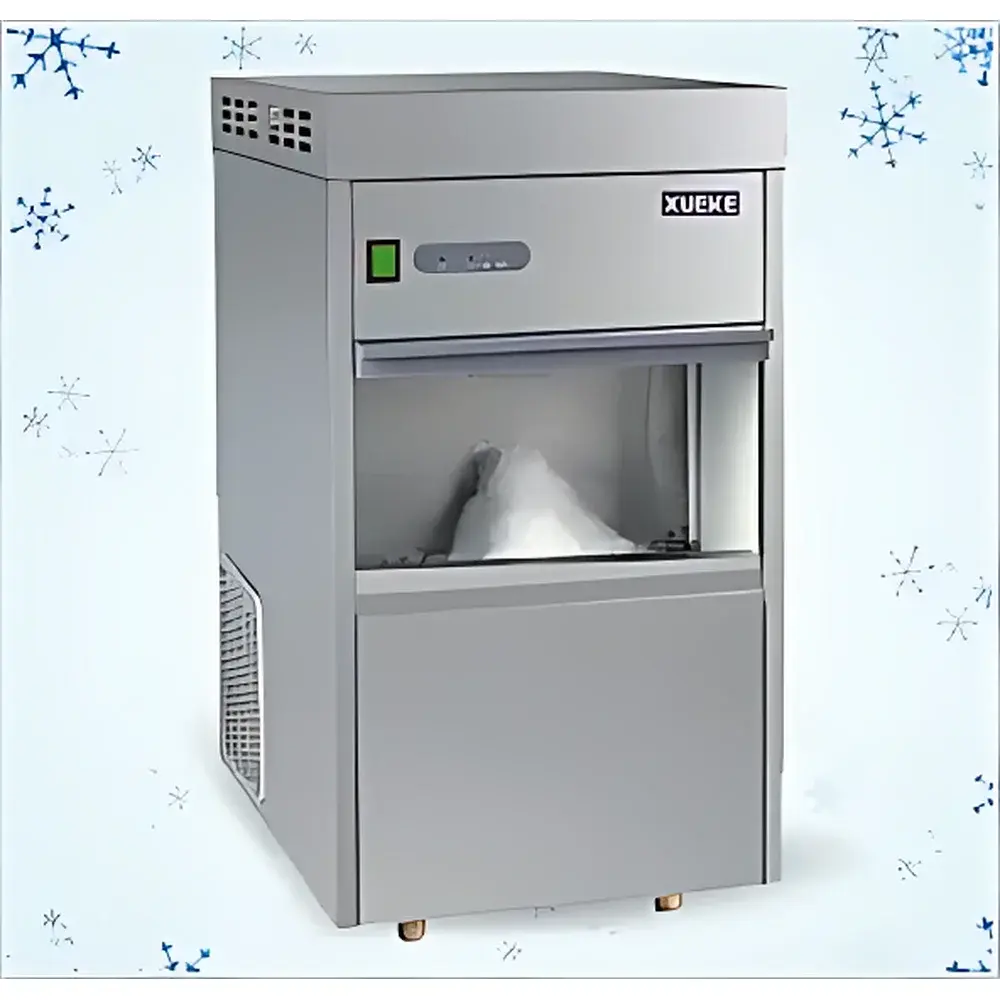
IMS-40 Flake Ice Machine
| Origin | Beijing, China |
|---|---|
| Manufacturer Type | Authorized Distributor |
| Origin Category | Domestic (China) |
| Model | IMS-40 |
| Price | USD 1,520 (FOB) |
| Ice Production Capacity | 40 kg/24h |
| Storage Capacity | 15 kg |
| Cooling Method | Air-Cooled |
| Water Consumption | ≤1.6 L/h |
| Compressor/Refrigerant | Imported R134a (CFC-free) |
| Cabinet Material | Stainless Steel (AISI 304) |
| Input Power | 280 W |
| Dimensions (L×W×H) | 380 × 543 × 722 mm |
| Net Weight | 40 kg |
| Ice Type | Irregular, Fine Flake Ice (Particle Size: 1–3 mm, Thickness: ~0.5 mm) |
| Compliance | RoHS-compliant Components, TUV/VDE-certified Electrical Parts, SGS-tested Materials |
Overview
The IMS-40 Flake Ice Machine is an air-cooled, fully automated laboratory-grade flake ice generator engineered for precision thermal management in scientific and clinical environments. It operates on the principle of direct-expansion refrigeration using a hermetic R134a compressor and a patented serpentine evaporator with cavity-divider technology—enabling continuous, high-efficiency heat exchange between water and refrigerant. Unlike cubed or nugget ice systems, the IMS-40 produces irregular, thin (≤0.5 mm), low-density flake ice with high surface-area-to-volume ratio—optimizing rapid thermal transfer for applications requiring uniform, non-damaging contact cooling. Its compact footprint (380 × 543 × 722 mm), stainless steel (AISI 304) construction, and integrated thermal insulation (CFC-free polyurethane foam, ≥35 mm thickness) ensure reliable operation under ambient temperatures up to 32°C and humidity ≤80% RH—critical for stable performance in shared lab corridors or temperature-sensitive prep rooms.
Key Features
- Stainless steel cabinet (AISI 304) with seamless welding and electropolished interior—resistant to corrosion, easy to sanitize, and compliant with ISO 13485 cleanroom-compatible material requirements.
- RoHS-compliant R134a refrigeration system with imported hermetic compressor; all refrigerant circuit components tested per EN 378-1 for leak integrity and pressure safety.
- TUV- and VDE-certified electrical components—including main control board, water-level sensor, and thermal cut-off switches—validated to IEC 61000-6-3 (EMC) and IEC 60335-1 (safety).
- Microprocessor-based controller with embedded firmware (imported IC chip) enabling automatic cycle sequencing: water fill → freeze → harvest → drain → standby—with real-time fault diagnostics and non-volatile memory for power-loss recovery.
- Haitec-designed two-stage planetary gear reducer (Italy-sourced) coupled to a low-RPM auger motor—reducing acoustic emission to ≤48 dB(A) at 1 m distance, suitable for quiet-zone laboratories.
- Patented cavity-divider evaporator plate with optimized fin geometry and uniform water film distribution—achieving >92% thermal efficiency and consistent ice thickness control (±0.1 mm).
- Floating-ball water inlet system with self-cleaning flush cycle—eliminating residual water stagnation and biofilm formation; zero manual defrost requirement.
- Multi-sensor protection suite: full-bin detection (capacitive probe), low-water cutoff (float switch), evaporator overcooling shutdown (NTC thermistor), and compressor overload relay—meeting UL 61010-1 risk assessment criteria.
Sample Compatibility & Compliance
The IMS-40 generates flake ice with particle dimensions averaging 1–3 mm in diameter and ≤0.5 mm thickness—ideal for embedding biological specimens, chilling centrifuge rotors, tempering reagents during PCR setup, or maintaining low-temperature gradients in chromatography sample trays. Its ice morphology ensures minimal mechanical stress on fragile samples (e.g., tissue sections, enzyme solutions, or live cell suspensions) while maximizing conductive heat removal. The unit complies with ISO 14001 environmental management standards (via RoHS-compliant materials and R134a refrigerant), and its electrical architecture conforms to IEC 61010-1 Edition 3 for laboratory equipment. All wetted surfaces meet USP Class VI biocompatibility testing requirements for indirect food-contact and medical-use applications.
Software & Data Management
While the IMS-40 operates as a standalone appliance without cloud connectivity, its embedded controller logs operational data—including total runtime, number of freeze-harvest cycles, fault codes, and ambient temperature trends—stored in non-volatile EEPROM for up to 12 months. A dedicated service port (RS-232 interface) enables diagnostic readout via proprietary PC utility software (supplied with calibration certificate). Audit trail functionality supports GLP-compliant record retention: timestamps for each auto-restart event after power interruption are retained with millisecond precision. Firmware updates follow ISO/IEC 17025 traceable validation protocols, and configuration changes require dual-password access to prevent unauthorized parameter modification.
Applications
- Life sciences: Cold chain maintenance for ELISA plates, cryopreservation vial pre-chilling, and electrophoresis buffer cooling.
- Clinical labs: Rapid temperature stabilization of blood gas analyzers, hematology controls, and microbiological transport media.
- Pharmaceutical QC: Sample conditioning prior to dissolution testing (USP ) and HPLC injection port cooling.
- Food safety testing: Preservation of composite food samples during pathogen enrichment (ISO 6579-1) and mycotoxin extraction.
- Materials science: Thermal quenching of polymer melts and metallographic specimen mounting.
FAQ
What is the recommended water quality for optimal ice clarity and system longevity?
Deionized or reverse-osmosis water (conductivity <10 µS/cm) is strongly recommended to prevent scale buildup on the evaporator plate and extend service intervals beyond 1,200 hours.
Can the IMS-40 be installed in an enclosed cabinet or under a bench?
No—its top-mounted axial fan requires unobstructed airflow (minimum 15 cm clearance above and 10 cm behind); installation in confined spaces violates EN 60335-2-74 ventilation requirements and voids warranty.
Is the flake ice produced by the IMS-40 suitable for direct contact with food or biological samples?
Yes—the ice meets NSF/ANSI 12 standards for food equipment when operated with potable water and maintained per manufacturer’s cleaning schedule (weekly descaling with citric acid solution).
How often does the unit require preventive maintenance?
Comprehensive servicing—including evaporator inspection, refrigerant pressure verification, and electrical safety testing—is required every 6 months or 1,000 operating hours, whichever occurs first, per ISO 55001 asset management guidelines.



