
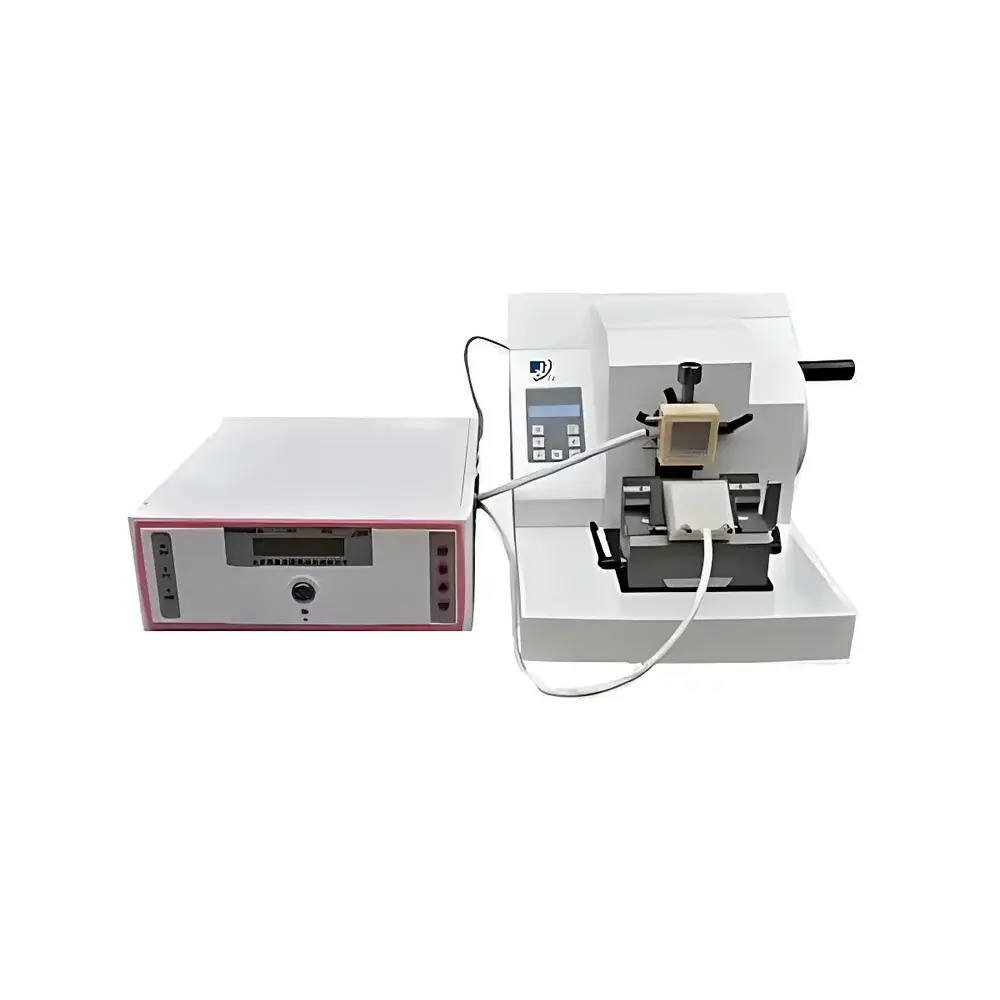
Jiayuan JY-335III Fully Automated Cryo-Paraffin Dual-Mode Microtome
| Brand | Jiayuan |
|---|---|
| Origin | Beijing, China |
| Model | JY-335III |
| Max Sample Size | 50×45 mm |
| Section Thickness Range | 0–100 µm |
| Section Increment | 1 µm (0–10 µm), 2 µm (10–20 µm), 5 µm (20–50 µm), 10 µm (50–100 µm) |
| Trimming Range | 0–500 µm |
| Horizontal Sample Travel | 28 mm |
| Vertical Sample Travel | 60 mm |
| Automatic Feed & Retraction | 12 µm |
| Feed Resolution | 1 µm |
| Sectioning Accuracy | ±5% |
| Cryostage Max Area | 45×40 mm |
| Blade Angle | 45° |
| Cooling Time | 2–7 min to Operating Temp |
| Dimensions | 520×450×300 mm |
Overview
The Jiayuan JY-335III Fully Automated Cryo-Paraffin Dual-Mode Microtome is engineered for precision sectioning of both frozen and paraffin-embedded biological specimens in histopathology, biomedical research, and preclinical laboratories. Unlike single-mode instruments, this dual-capability microtome integrates thermoelectric (Peltier) cryogenic cooling with robust mechanical sectioning architecture—enabling seamless transition between cryosectioning (at sub-zero temperatures) and room-temperature paraffin sectioning without hardware reconfiguration. Its operation relies on controlled linear advancement of the specimen block via a motorized feed mechanism, coupled with synchronized knife movement across a precisely angled 45° cryoblade. The system adheres to core principles of microtomy: consistent section thickness generation through calibrated micrometer-driven advancement, minimal compression or chatter via optimized blade geometry and thermal stabilization, and reproducible orientation control across serial sections. Designed for compliance with routine histological workflow standards—including CAP-accredited pathology labs and GLP-compliant tissue analysis—the JY-335III supports standardized tissue processing per ASTM E2919 (Standard Guide for Preparation of Tissue Sections for Microscopic Examination) and aligns with ISO 15189 requirements for pre-analytical instrumentation validation.
Key Features
- Fully automated sectioning and trimming cycles with programmable feed/retraction (12 µm default, adjustable)
- Stepwise section thickness control: 1 µm increments from 0–10 µm; 2 µm (10–20 µm); 5 µm (20–50 µm); 10 µm (50–100 µm)
- High-stability cryostage with ≥60 °C temperature differential (e.g., −30 °C stage surface at ambient 25 °C), powered by high-capacity semiconductor cooling
- Magnetically mounted cryoblade system enabling rapid, tool-free blade exchange while maintaining angular repeatability (45° bevel angle)
- Dual-channel LCD display showing independently set and real-time monitored temperatures for both cryostage and blade
- Auto-defrost functionality with thermal recovery protocol: system pauses cooling, executes defrost cycle, verifies condensate removal, then resumes stable refrigeration without manual intervention
- Memory retention for all user-defined parameters (thickness, temperature, feed rate, auto-count settings) after power cycling
- Lockable handwheel for secure specimen positioning during manual alignment or maintenance
- Quick-swap specimen holder system compatible with standard Leica/Thermo-compatible cassette adapters
Sample Compatibility & Compliance
The JY-335III accommodates a broad spectrum of specimen types—including soft tissues (liver, brain, kidney), calcified tissues (bone, teeth), fibrous matrices (tendon, cartilage), and embedded plastic or resin blocks—within its 50×45 mm maximum sectioning area. Its vertical travel (60 mm) and horizontal translation (28 mm) allow full access to large biopsy specimens or multi-tissue arrays. For frozen sectioning, the instrument maintains thermal stability under continuous operation per USP environmental control guidelines for sterile compounding support labs. When used for paraffin sectioning, it meets ISO 20631:2020 (Microtomy — Requirements for Performance Verification) for thickness consistency and edge integrity. All electronic controls comply with IEC 61010-1 safety standards for laboratory equipment. Data logging capabilities support audit-ready records required under FDA 21 CFR Part 11 when integrated with validated LIMS environments.
Software & Data Management
While the JY-335III operates via embedded firmware rather than PC-dependent software, its control interface provides full traceability features essential for regulated environments. Each sectioning session logs timestamped metadata—including start/stop time, total sections counted, average thickness setting, cryostage temperature profile, and defrost event history—to internal non-volatile memory (retained for ≥10,000 cycles). Optional RS-232 or USB-C output enables export of CSV-formatted logs for integration into laboratory information systems (LIS) or electronic lab notebooks (ELN). Firmware updates are performed via secure USB flash drive with SHA-256 signature verification. Audit trail functionality satisfies GLP/GMP documentation requirements for instrument usage history, including operator ID tagging when paired with external badge-reader peripherals.
Applications
- Routine intraoperative frozen section diagnosis in hospital pathology departments
- Preclinical toxicology studies requiring serial sectioning of rodent organ blocks
- Neuroscience research involving coronal/sagittal brain sectioning at 10–20 µm intervals
- Orthopedic tissue engineering: sectioning of mineralized scaffold composites for histomorphometric analysis
- Botanical microanatomy: cryosectioning of hydrated plant stems and roots without fixation artifacts
- Quality control of bioprinted tissue constructs where structural fidelity must be preserved across section planes
- Training laboratories requiring reliable, low-maintenance dual-mode operation for student instruction in histotechnique fundamentals
FAQ
Does the JY-335III require external coolant or refrigerant gases?
No. It uses solid-state Peltier elements for thermoelectric cooling—eliminating need for liquid nitrogen, Freon, or compressor-based systems.
Can the instrument perform ribbon collection for paraffin sections?
Yes. The stage geometry and knife clearance are optimized for continuous ribbon formation at thicknesses ≥3 µm, compatible with standard water bath and floatation systems.
What is the expected service life of the cryostage under daily clinical use?
Rated for ≥50,000 operational hours with scheduled thermal interface paste replacement every 24 months.
Is calibration certification available for regulatory submissions?
Factory calibration certificates (traceable to NIST standards) are provided with each unit; on-site IQ/OQ validation support is available through authorized service partners.
How does the system prevent ice crystal artifact during frozen sectioning?
By maintaining stable cryostage temperature (±0.5 °C) and minimizing thermal lag via high-efficiency heat sinking, the JY-335III reduces dynamic freezing gradients that cause crystalline distortion in sensitive neural or lipid-rich tissues.



