
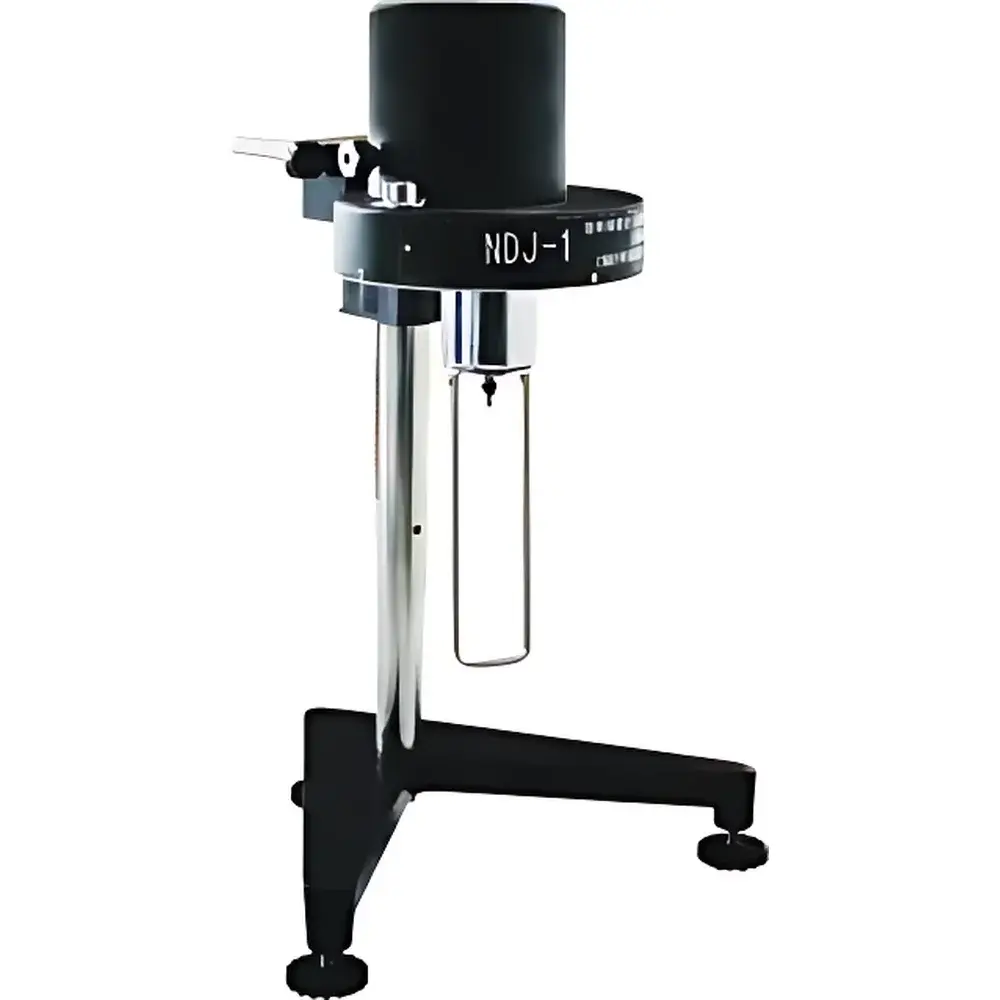
NDJ-1 Rotational Viscometer
| Origin | Shanghai, China |
|---|---|
| Manufacturer Type | Authorized Distributor |
| Origin Category | Domestic (PRC) |
| Model | NDJ-1 |
| Price | USD 395 (FOB Shanghai) |
| Display | Analog Dial |
| Rotational Speeds | 6 / 12 / 30 / 60 rpm |
| Included Rotors | #1–#4 |
| Measuring Range (Newtonian Fluids) | 10–10⁵ mPa·s |
| Accuracy | ±5% (at specified calibration points) |
| Power Supply | AC 220 V ±10%, 50 Hz |
Overview
The NDJ-1 Rotational Viscometer is a mechanically driven, analog-display viscometer engineered for routine viscosity assessment of Newtonian and mildly non-Newtonian fluids in quality control, R&D, and production environments. Based on the coaxial cylinder (Couette flow) principle, it measures torque resistance exerted on a rotating spindle immersed in the test sample—directly correlating to dynamic viscosity under defined shear conditions. Unlike digital or microprocessor-controlled instruments, the NDJ-1 employs a calibrated spring-and-pointer mechanical system, delivering stable, drift-free readings without dependency on firmware or software algorithms. Its fixed-speed operation at four discrete rotational frequencies (6, 12, 30, and 60 rpm) enables rapid screening across moderate viscosity ranges—particularly suited for oils, coatings, food emulsions, pharmaceutical suspensions, and adhesives where reproducibility under standardized shear rates is prioritized over full rheological profiling.
Key Features
- Mechanically robust analog dial display with high-contrast scale and damping mechanism for stable pointer settling—eliminates electronic noise, battery dependency, or calibration drift associated with digital sensors.
- Four interchangeable spindles (#1–#4) optimized for progressive viscosity coverage: #1 for low-viscosity liquids (e.g., solvents, thin syrups), #4 for higher-viscosity materials (e.g., greases, pastes).
- Fixed-speed gear-driven motor ensures consistent rotational accuracy across all four speeds (±1 rpm tolerance), minimizing speed-related measurement variance.
- Manual speed selection via front-panel knob—no external controllers, cables, or software required—ideal for cleanroom-adjacent labs or field-deployable QC stations with limited infrastructure.
- Compliance-ready mechanical design: All internal components conform to ISO 2555 (rotational viscometry of plastics) and ASTM D2196 (viscosity of paints and related materials) test protocols when operated per standard spindle immersion depth (e.g., 20 mm below meniscus) and temperature control (±0.5 °C recommended).
Sample Compatibility & Compliance
The NDJ-1 accommodates samples ranging from 10 mPa·s (e.g., light mineral oil) to 10⁵ mPa·s (e.g., heavy gear lubricants or tomato paste), provided the appropriate rotor and speed combination is selected per ISO 3219 Annex A guidelines. Sample volume requirement is minimal—typically 15–20 mL for full spindle immersion. It supports ambient-temperature measurements as well as thermostated testing when used with optional water bath fixtures (not included). While not certified for GLP/GMP audit trails or 21 CFR Part 11 compliance due to its analog architecture, the instrument meets essential metrological requirements for ISO/IEC 17025-accredited laboratories performing non-regulated routine checks—provided documented calibration against NIST-traceable standard oils (e.g., Cannon-Manning series) is performed semi-annually and recorded manually in lab notebooks.
Software & Data Management
The NDJ-1 operates independently of software; no drivers, USB interfaces, or data logging modules are integrated or supported. All readings are manually recorded from the analog dial, supporting paper-based SOPs and handwritten QC logs. For laboratories requiring digital capture, third-party USB microscope cameras or smartphone-based image-recognition tools may be employed to document pointer positions—though such workflows fall outside manufacturer validation scope. No firmware updates, cloud connectivity, or audit trail generation is available, aligning the device with environments where simplicity, long-term serviceability, and regulatory transparency outweigh automation features.
Applications
- Quality assurance of edible oils, margarines, and dairy-based sauces in food manufacturing—verifying batch-to-batch consistency per internal specifications aligned with AOAC Method 981.15.
- Routine viscosity checks of alkyd resins, solvent-borne paints, and ink formulations during production, supporting ASTM D1200 (Ford Cup) cross-validation.
- Stability monitoring of topical pharmaceutical gels and ointments during accelerated aging studies—tracking viscosity shifts indicative of polymer degradation or phase separation.
- Process validation of adhesive slurries in packaging and assembly lines—ensuring dispensing consistency prior to coating or bonding steps.
- Educational use in university chemistry and chemical engineering labs for teaching fundamental viscometric principles, shear rate dependence, and Newtonian fluid behavior.
FAQ
What calibration standards are recommended for the NDJ-1?
NIST-traceable silicone oil standards (e.g., Cannon-Manning Viscosity Standards, Grade 100–10,000 cP) should be used at least twice per year, with verification at two speeds (e.g., 12 rpm and 60 rpm) and two rotors (#2 and #3) per standard.
Can the NDJ-1 measure non-Newtonian fluids?
Yes—qualitatively—but results must be interpreted with caution. Apparent viscosity values depend heavily on selected speed/rotor; time-dependent effects (thixotropy, rheopexy) cannot be quantified without multi-speed ramp protocols unavailable on this model.
Is temperature control mandatory?
Not mandatory, but strongly advised: viscosity varies exponentially with temperature. A ±0.5 °C bath is recommended for reporting values compliant with ISO 2555 or ASTM D1084.
Does the NDJ-1 comply with FDA 21 CFR Part 11?
No—its analog readout and absence of electronic data capture preclude electronic signature, audit trail, or system validation capabilities required under Part 11.
What maintenance does the NDJ-1 require?
Annual mechanical inspection of gear train backlash, spindle bearing play, and dial zero alignment; cleaning of spindle threads and housing vents; replacement of worn drive belts every 3–5 years under continuous use.



