
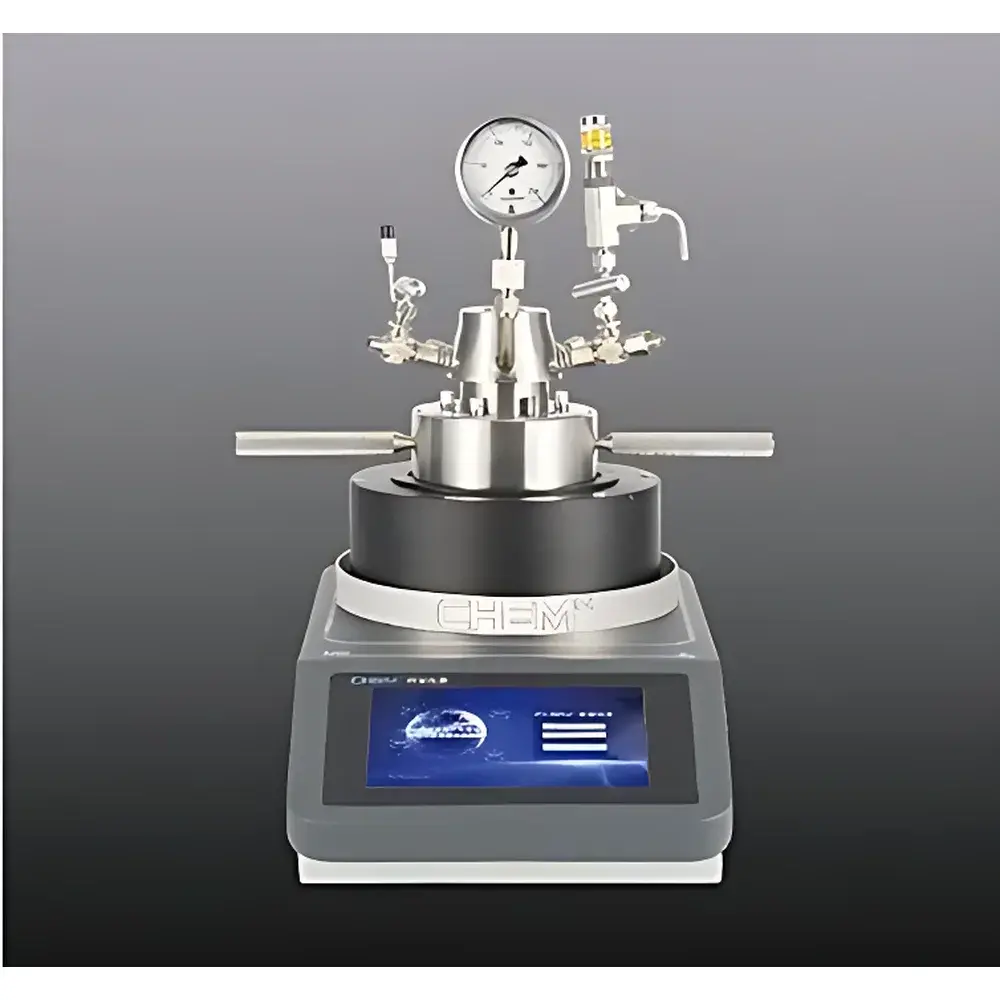
Kemi NSV Plus Photocatalytic Magnetic Stirring Reactor
| Origin | Anhui, China |
|---|---|
| Manufacturer Type | Distributor |
| Origin Category | Domestic |
| Model | NSV Plus |
| Price Range | USD 2,800 – 7,000 (est.) |
| Volume Options | 25 mL, 50 mL, 100 mL, 300 mL |
| Vessel Material | ASTM A240 S31603 (316L stainless steel) |
| Maximum Working Pressure | 103 bar (1500 psi) |
| Maximum Operating Temperature | 200 °C |
| Heating Method | Embedded stainless-steel cartridge heater (0.8 kW) |
| Stirring Speed Range | 400–1400 rpm (infinitely variable) |
| Stirring Mechanism | Internal magnetic coupling with PTFE-coated stir bar |
| Optical Window | Sapphire crystal viewport (26 mm clear aperture for 25–50 mL |
| Sealing System | Dual-axis (radial + axial) sealing with Kalrez® perfluoroelastomer O-rings (DuPont) |
| Safety Features | Overtemperature cutoff, Swagelok® inlet/outlet needle valves, Fitok® certified safety relief valve + custom rupture disk |
| Compliance Options | ASTM E2877, ISO 4775, USP <1058> (Analytical Instrument Qualification), GLP-compliant audit trail via optional software module |
Overview
The Kemi NSV Plus Photocatalytic Magnetic Stirring Reactor is an engineered benchtop system designed for controlled, reproducible photochemical synthesis and catalytic reaction studies under elevated temperature and pressure. It integrates high-integrity pressure containment with precise thermal regulation, homogeneous magnetic stirring, and broadband optical access—enabling quantitative photocatalysis experiments in inert or reactive atmospheres. The reactor operates on the principle of magnetically coupled agitation within a sealed, optically transparent vessel, where incident photons (UV–visible, typically 254–450 nm) activate semiconductor catalysts (e.g., TiO₂, g-C₃N₄) immobilized on substrates or suspended in solution. Its monolithic 316L stainless-steel construction—machined from solid billet—ensures structural integrity at up to 103 bar and 200 °C, while the sapphire viewport maintains >99.5% transmittance across 190–5500 nm, supporting both end-on (axial) and side-on (radial) irradiation configurations.
Key Features
- Monolithic pressure vessel body: CNC-machined from ASTM A240 S31603 billet with integral flange and thread; eliminates weld seams and leak paths.
- Fast-opening clamp mechanism with ergonomic assist tooling: Enables sub-60-second vessel access without torque wrenches—critical for iterative catalyst screening.
- Dual-axis sapphire viewport sealing: Radial compression + axial preload with Kalrez® 6375 perfluoroelastomer gaskets rated for continuous service at 200 °C and full pressure range.
- Embedded cartridge heating: 0.8 kW stainless-steel sheathed element integrated into vessel wall; delivers uniform thermal gradients and ramp rates up to 20 °C/min (verified per ASTM E2877 Annex A2).
- Intelligent PID temperature control: Digital algorithm with auto-tuning and deviation alarm output; supports external thermocouple input (Type K or Pt100) for independent verification.
- Variable-speed magnetic drive: 400–1400 rpm range with real-time digital display; compatible with PTFE- or glass-coated stir bars (standard 10 × 6 mm) for low-contamination mixing.
- Modular interface architecture: Standard Swagelok® 1/4″ NPT ports accommodate gas inlets, pressure transducers (0–150 bar range), liquid addition lines, and sampling valves—including balanced reflux and catalyst basket inserts.
Sample Compatibility & Compliance
The NSV Plus accommodates heterogeneous photocatalytic slurries (e.g., nanoparticle suspensions), homogeneous molecular systems, and gas–liquid–solid triphasic reactions. Its chemically resistant wetted surfaces (316L, Kalrez®, sapphire) are compatible with common solvents (acetonitrile, methanol, water, DMF), acidic media (pH ≥ 1), and oxidizing environments (e.g., H₂O₂, O₃ sparging). Optional materials—Hastelloy C-276, titanium Grade 2, or zirconium 702—extend compatibility to halide-rich or highly reducing conditions. The system meets mechanical design requirements of ASME BPVC Section VIII Div. 1 (when configured with third-party PED certification) and supports regulatory compliance workflows: pressure and temperature logs can be exported in CSV/Excel format for FDA 21 CFR Part 11–aligned electronic records; optional software add-ons provide time-stamped audit trails, user-level access control, and electronic signature capability per ALCOA+ principles.
Software & Data Management
While the base NSV Plus operates via front-panel controls, it is fully compatible with Kemi’s optional ReactorLink™ PC software suite (Windows 10/11, USB/RS485 interface). This platform enables synchronized logging of temperature, pressure, stirring speed, and external irradiance (via optional calibrated photodiode sensor). Data is stored in timestamped .csv files with metadata headers (operator ID, batch ID, protocol version). For GxP environments, the software supports IQ/OQ documentation templates aligned with USP , and includes configurable alarm thresholds with email/SMS notification (via SMTP gateway). All firmware updates are digitally signed and validated against SHA-256 checksums to ensure traceability.
Applications
- Photocatalytic hydrogen evolution (HER) and CO₂ reduction screening under simulated solar irradiation.
- Visible-light-driven organic transformations (C–N coupling, oxidation of alcohols, dehalogenation) with quantitative yield analysis.
- Stability testing of photocatalysts under accelerated thermal–pressure stress (e.g., 120 °C, 50 bar O₂).
- Kinetic modeling of heterogeneous surface reactions using in situ sampling through the balanced reflux valve.
- Development of flow-through photo-reactor modules by integrating NSV Plus vessels as static bed reactors with external LED arrays.
FAQ
What optical light sources are compatible with the NSV Plus viewport?
Standard 365 nm and 405 nm UV-LED arrays, Xe arc lamps (with appropriate bandpass filters), and collimated solar simulators (AM 1.5G) are routinely used. The sapphire window transmits >90% from 190–5500 nm; quartz or fused silica windows are available upon request for deep-UV (<190 nm) applications.
Can the NSV Plus be operated under vacuum prior to pressurization?
Yes—the vessel is rated for full vacuum (≤10⁻³ mbar) and includes a dedicated vacuum port. Leak testing per ISO 15848-1 is recommended before first use.
Is third-party calibration certification available?
Kemi provides factory calibration certificates (traceable to NIST standards) for temperature (±0.5 °C) and pressure (±0.5% FS). UKAS-accredited calibration services are available through authorized partners in EU/US regions.
How is catalyst recovery handled post-reaction?
The standard configuration includes a removable catalyst basket (316L mesh, 50 µm pore size); optional centrifugal separation inserts and magnetic retrieval tools are available for nanoparticle recovery.
Does the system support automated gas dosing?
Yes—when equipped with optional mass flow controllers (MFCs) and ReactorLink™ software, sequential or continuous gas introduction (H₂, O₂, CO₂, Ar) can be programmed with pressure feedback control.



