
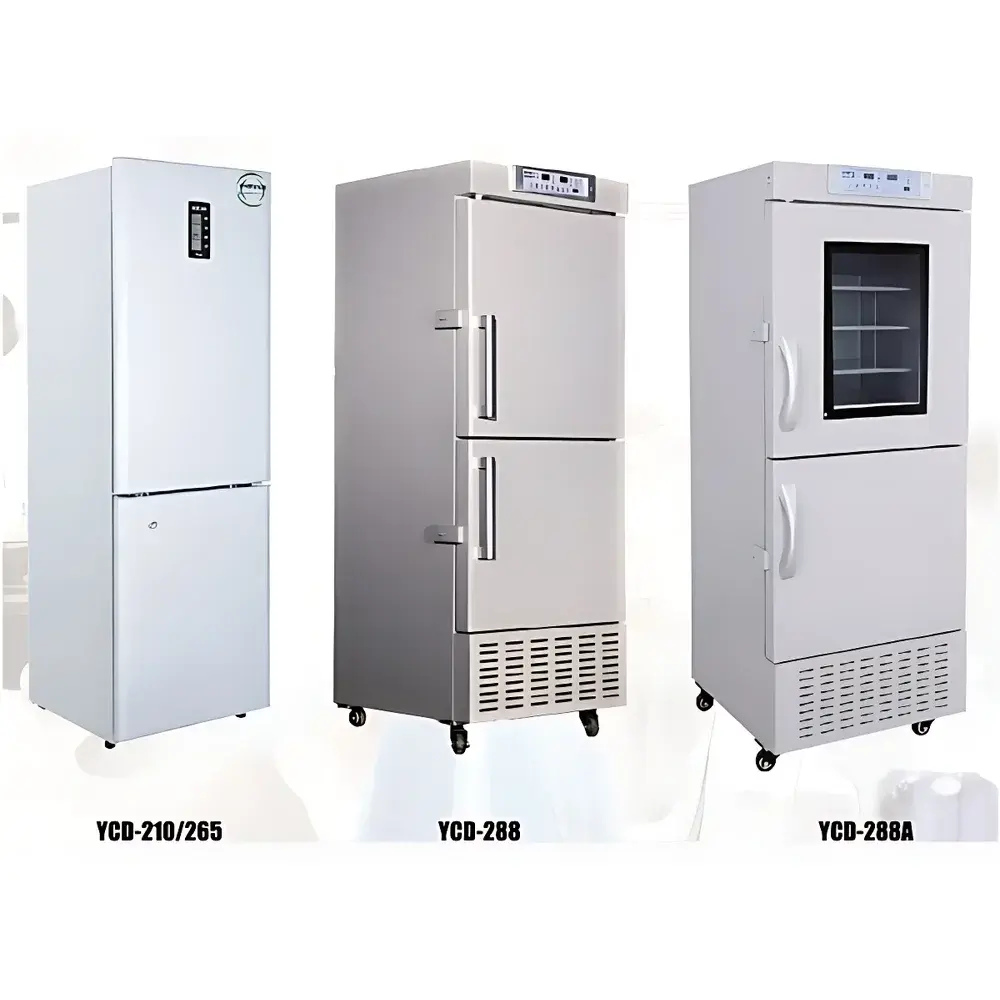
AUCMA YCD-265 Medical Refrigerator-Freezer
| Brand | AUCMA |
|---|---|
| Model | YCD-265 |
| Temperature Range (Refrigeration Compartment) | 2–8 °C |
| Temperature Range (Freezing Compartment) | –15 to –26 °C |
| Net Capacity | 265 L |
| Internal Dimensions (W×D×H) | 460×480×720 mm (refrigeration section) |
| External Dimensions (W×D×H) | 575×641×1687 mm |
| Power Supply | 220 V / 50 Hz |
| Control System | Microprocessor-based dual-zone digital display |
| Cooling Method | Forced-air (refrigeration), static cooling (freezing) |
| Door Lock | Mechanical safety lock |
| Insulation | CFC-free polyurethane foam |
| Refrigerant | R600a (isobutane) |
| Compliance | Designed per GB/T 20154–2014 (Chinese national standard for medical refrigerators), suitable for GLP-aligned storage environments |
Overview
The AUCMA YCD-265 Medical Refrigerator-Freezer is a dual-temperature, forced-air refrigerated cabinet engineered for reliable, compliant cold-chain storage of temperature-sensitive biological and pharmaceutical materials in clinical and research settings. It integrates two independently controlled compartments — a refrigeration zone maintained at 2–8 °C and a freezing zone operating between –15 °C and –26 °C — within a single robust stainless-steel and galvanized steel chassis. Unlike general-purpose domestic or laboratory chillers, the YCD-265 adheres to functional design principles aligned with ICH guidelines for stability storage and WHO recommendations for vaccine cold-chain integrity. Its microprocessor-based temperature management system continuously monitors both zones via high-stability NTC sensors, delivering stable thermal profiles with minimal fluctuation (< ±1.5 °C) under standard ambient conditions (10–32 °C). The unit employs an environmentally compliant R600a refrigerant and CFC-free polyurethane insulation, meeting international environmental directives including the Montreal Protocol phase-out requirements.
Key Features
- Dual independent temperature control: Separate PID-regulated circuits for refrigeration (2–8 °C) and freezing (–15 to –26 °C) compartments ensure simultaneous compliance with divergent storage mandates.
- Forced-air circulation in the refrigeration chamber enhances temperature uniformity (±0.8 °C across shelf levels) and reduces recovery time after door openings — critical for maintaining vaccine potency during frequent access.
- LCD digital display with dual-zone real-time readout provides immediate visibility of setpoints and actual temperatures; backlighting ensures legibility under low-light clinical conditions.
- Comprehensive alarm system includes audible buzzer and visual LED alerts for high/low temperature excursions, sensor failure, prolonged door opening (>30 s), and power interruption — configurable via front-panel interface.
- Mechanical door lock prevents unauthorized access to stored biologics, supporting institutional security policies and audit readiness for ISO 15189 or CAP-accredited laboratories.
- Wide-input voltage tolerance (198–242 V) accommodates unstable utility grids common in regional health facilities without requiring external stabilizers.
- Energy-efficient compressor with start-delay protection and compressor rest interval minimizes mechanical stress and extends service life under continuous 24/7 operation.
Sample Compatibility & Compliance
The YCD-265 supports storage of vaccines (e.g., mRNA, viral vector, and live-attenuated formulations), whole blood and plasma units, diagnostic reagents, monoclonal antibodies, and cryopreserved cell suspensions. Its interior configuration — three adjustable tempered-glass shelves in the refrigeration compartment and four transparent polypropylene drawers in the freezing section — enables segregation by sample type, expiration date, or project ID while preserving traceability. All internal surfaces are non-porous and compatible with common disinfectants (e.g., 70% ethanol, sodium hypochlorite ≤0.5%). While not certified to UL 471 or NSF/ANSI 456 (U.S. medical refrigerator standards), the unit conforms to GB/T 20154–2014, the Chinese national standard specifying performance thresholds for medical-grade refrigeration equipment, including temperature accuracy, uniformity, recovery time, and alarm response latency. Its architecture supports integration into GLP-compliant workflows when paired with external data loggers meeting FDA 21 CFR Part 11 requirements for electronic records.
Software & Data Management
The YCD-265 operates as a standalone hardware platform with no embedded network connectivity or proprietary software stack. Temperature logging requires external validation-grade data loggers (e.g., Vaisala viewLinc, DeltaTRAK FlashLink) connected via probe ports or placed inside chambers. The unit’s analog sensor outputs (0–5 V or 4–20 mA optional on custom orders) permit integration with building management systems (BMS) or centralized cold-chain monitoring platforms. Alarm events trigger local visual/audible notifications only; remote alerting (SMS/email) necessitates third-party middleware. For audit trails, users must maintain manual logbooks or implement validated electronic logging solutions that record timestamped temperature values, alarm activations, door-open durations, and user-initiated setpoint changes — all essential for GxP inspections.
Applications
- Hospital pharmacy and blood bank storage of vaccines, insulin, antivenoms, and blood components requiring strict 2–8 °C maintenance.
- Disease control centers managing outbreak-response inventories where rapid access to frozen reference strains (–20 °C range) and refrigerated diagnostics kits is required.
- Academic and contract research organizations storing clinical trial biospecimens (serum, PBMCs) prior to cryo-archiving or shipment.
- Veterinary clinics and public health labs handling zoonotic pathogen samples and veterinary biologics subject to national cold-chain regulations.
- Regional immunization programs deploying decentralized storage nodes in areas lacking ultra-low temperature infrastructure.
FAQ
Does the YCD-265 meet FDA or EU MDR requirements for medical device storage?
No — it is manufactured to GB/T 20154–2014 and is not CE-marked or FDA-listed as a medical device. It serves as ancillary storage equipment, not a regulated medical device itself.
Can the refrigeration and freezing compartments operate independently?
Yes — each zone has dedicated thermostatic control; either compartment may be deactivated while the other remains active.
What is the typical temperature recovery time after a 30-second door opening?
Under ISO 23913 test conditions (25 °C ambient), the refrigeration compartment recovers to ±0.5 °C of setpoint within ≤12 minutes; freezing compartment recovery is ≤22 minutes.
Is calibration documentation provided with the unit?
Factory calibration certificates are available upon request but are not included by default; users must perform initial and periodic verification using NIST-traceable thermistors or PT100 probes.
Are replacement parts such as drawers and shelves available separately?
Yes — OEM drawer assemblies (PP), glass shelves (tempered), and door gaskets are stocked by AUCMA’s authorized distributors for global supply chain continuity.




