
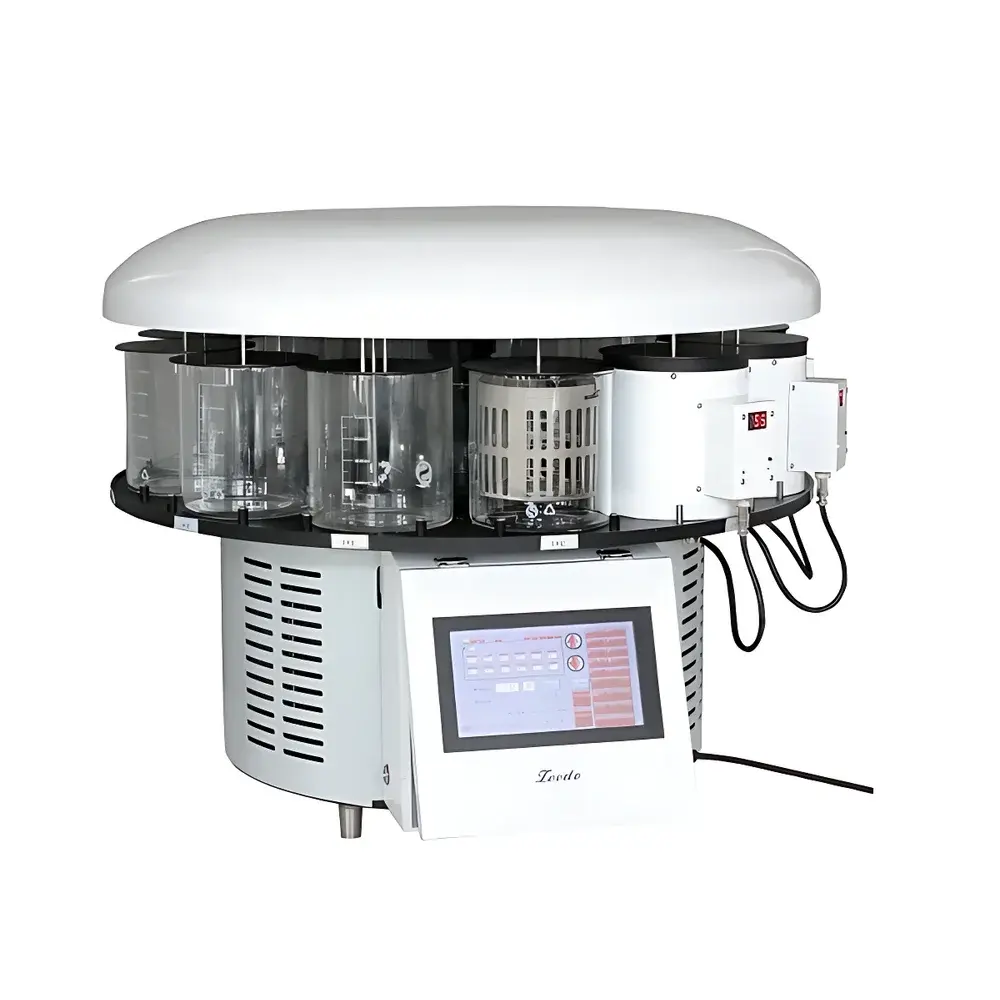
ZEEDO HS-566 Circular Vacuum Tissue Dehydrator
| Brand | ZEEDO |
|---|---|
| Origin | Zhejiang, China |
| Model | HS-566 |
| Tissue Processing Stages | 12 |
| Reagent Stations | 9 (1.2 L each) |
| Paraffin Stations | 3 (1.0 L each) |
| Temperature Control Range | 45–85 °C (±3 °C) |
| Max. Timer per Station | 999 min |
| Delay Start Time | 999 min |
| Vacuum Level | ≤0.053 MPa |
| Basket Agitation Frequency | 3 cycles/min |
| Basket Dimensions | Φ95 × 80 mm (single-tier & multi-tier) |
| Net Weight | ~60 kg |
| External Dimensions | 670 × 550 × 680 mm |
| Power Supply | AC 220 V, 50 Hz |
| Rated Power | 500 W |
| Operating Ambient | 5–40 °C, <85% RH (at 20 ± 5 °C) |
| Capacity | Up to 300 tissue cassettes per run |
Overview
The ZEEDO HS-566 Circular Vacuum Tissue Dehydrator is a microprocessor-controlled, fully automated histological processing instrument engineered for high-reproducibility dehydration of biological tissues under controlled vacuum and thermal conditions. Based on the principle of solvent exchange under reduced pressure—where vacuum accelerates reagent penetration while minimizing tissue distortion and lipid extraction—the HS-566 enables precise, programmable transition through graded alcohols, clearing agents (e.g., xylene), and molten paraffin. Its circular carousel architecture ensures uniform thermal distribution and consistent fluid dynamics across all stations, supporting standardized tissue preparation compliant with international histopathology workflows. Designed for routine use in clinical pathology laboratories, academic research facilities, and plant science core labs, the system prioritizes operational safety, reagent conservation, and process traceability without reliance on proprietary consumables.
Key Features
- Fully sealed processing chamber with integrated vacuum manifold (≤0.053 MPa), reducing volatile organic compound (VOC) emissions and operator exposure while enhancing infiltration kinetics.
- Stainless-steel reagent and paraffin reservoirs (9 × 1.2 L reagent tanks; 3 × 1.0 L wax tanks) resistant to corrosion from ethanol, isopropanol, xylene, and chloroform-based solvents.
- Programmable 12-stage protocol engine supporting up to eight user-defined templates, each configurable with independent time, temperature, agitation, and vacuum parameters per station.
- Intelligent basket handling system featuring dual-basket configurations (Φ95 × 80 mm standard and layered variants), enabling single-hand loading/unloading and accommodating 100–300 cassettes per cycle.
- Color LCD interface with English-language menu navigation, real-time status display (temperature, vacuum level, elapsed time, active station), and audible/visual end-of-cycle alerts.
- Dual-safety architecture: hardware-based overtemperature cutoff (activated >88 °C) and non-volatile memory with power-fail recovery—resuming from last completed step upon grid restoration.
- Three-stage reagent drainage system with optimized siphon geometry and residual-volume minimization design, lowering carryover between solvents and extending reagent service life.
Sample Compatibility & Compliance
The HS-566 accommodates human, animal, and botanical tissue specimens embedded in standard histology cassettes (e.g., Leica, Sakura, or generic polypropylene formats). It supports common dehydration sequences aligned with CAP (College of American Pathologists) and ISO 15189-accredited laboratory requirements. While not FDA-cleared as a medical device, its operational logic adheres to GLP principles for preclinical research and complies with CE-mandated electrical safety (IEC 61010-1) and electromagnetic compatibility (EN 61326-1). Vacuum and thermal stability data are logged internally for audit readiness, and all parameter settings are timestamped and retained for ≥30 days—supporting internal quality assurance reviews.
Software & Data Management
The onboard control firmware provides deterministic sequencing with millisecond-level timer resolution and closed-loop thermal regulation via PID-controlled heating elements. No external PC dependency is required for routine operation; however, optional RS-232 or USB-to-serial interfaces enable integration into centralized lab information systems (LIS) for event logging. Audit trail functionality records operator ID (via optional keypad login), program selection, start/stop timestamps, deviation alerts (e.g., vacuum loss >5% tolerance), and manual overrides—all exportable as CSV files. The system does not implement FDA 21 CFR Part 11 electronic signature controls but maintains immutable session logs suitable for ISO/IEC 17025 documentation frameworks.
Applications
- Routine diagnostic histology in hospital pathology departments requiring batch processing of surgical biopsies, excisions, and autopsy specimens.
- Preclinical toxicology studies where tissue integrity must be preserved across large cohorts (e.g., rodent organ panels).
- Plant morphology research involving lignified or waxy tissues (e.g., woody stems, leaf cuticles), benefiting from vacuum-enhanced solvent penetration.
- Core facility environments serving multiple investigators, where reproducible turnaround time (<6 hr for standard 12-step protocols) and minimal hands-on intervention are critical.
- Training laboratories in medical schools and life sciences programs, leveraging intuitive UI and fail-safe interlocks for student-operated workflows.
FAQ
What vacuum level does the HS-566 achieve, and how is it maintained during extended cycles?
The system sustains ≤0.053 MPa (≈400 torr) using an oil-free diaphragm vacuum pump with automatic pressure modulation; vacuum is actively monitored and adjusted every 3 seconds throughout each station dwell time.
Can the HS-566 accommodate custom dehydration protocols for specialized tissues like bone or calcified samples?
Yes—users may define extended dwell times (up to 999 minutes per station), variable agitation patterns, and multi-phase vacuum pulses within any of the 12 programmable steps.
Is remote monitoring or network connectivity supported out of the box?
No native Ethernet or Wi-Fi capability is included; however, serial communication permits connection to local PCs running terminal emulation software for log extraction and firmware updates.
How frequently should maintenance be performed on the vacuum pump and fluid pathways?
Diaphragm pump membranes require replacement every 12–18 months under typical usage (2–3 cycles/day); reagent line filters should be inspected weekly and cleaned monthly with isopropanol.
Does the HS-566 meet environmental standards for solvent containment and disposal?
The sealed chamber and triple-stage drainage system reduce airborne VOC concentrations below OSHA PEL thresholds; waste solvent collection must still comply with local hazardous material regulations (e.g., EPA 40 CFR Part 261).



