
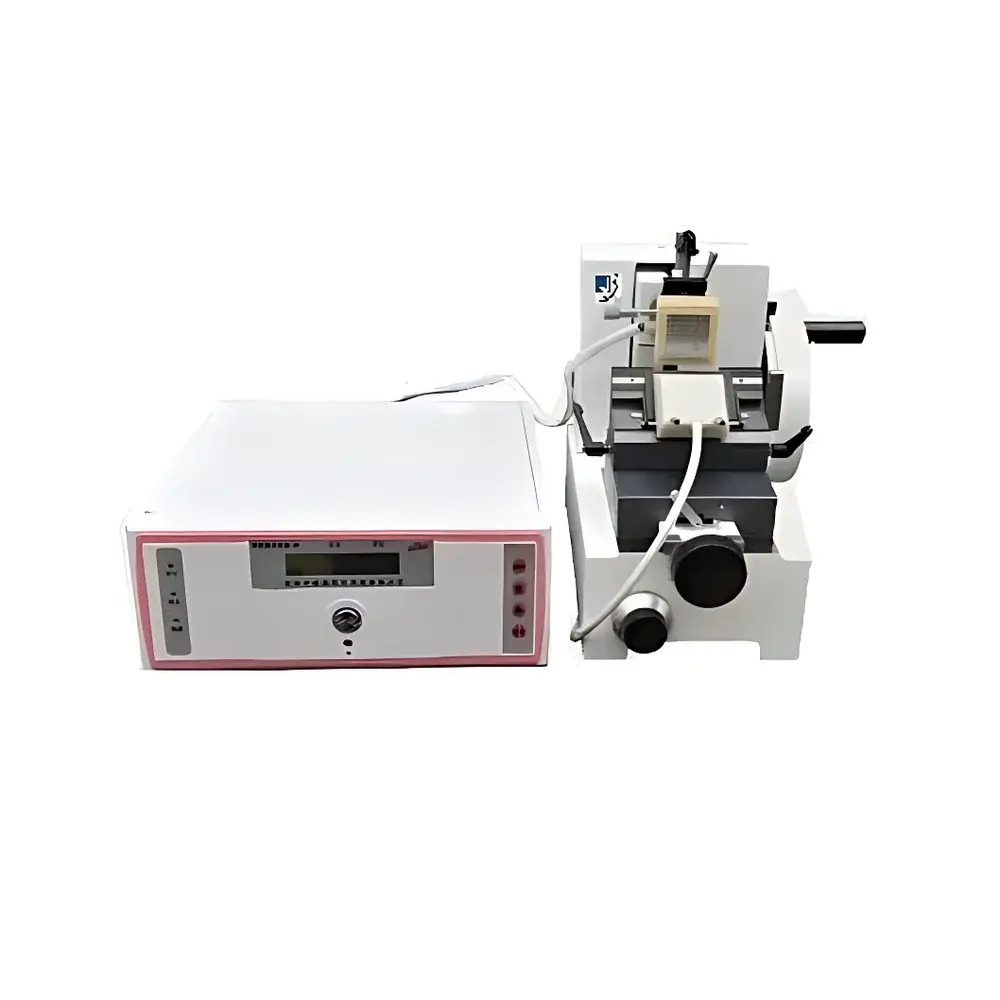
Jiayuan JY-2508III Cryo-Paraffin Dual-Mode Microtome
| Brand | Jiayuan |
|---|---|
| Origin | Beijing, China |
| Model | JY-2508III |
| Max Sample Size | 60×40 mm |
| Section Thickness Range | 1–35 µm |
| Minimum Increment | 1 µm |
Overview
The Jiayuan JY-2508III Cryo-Paraffin Dual-Mode Microtome is a precision-engineered laboratory instrument designed for high-fidelity sectioning of both frozen and paraffin-embedded biological tissues. Unlike single-mode microtomes, this dual-function system integrates a thermoelectrically cooled cryostat stage with a mechanically stabilized rotary cutting mechanism—enabling seamless transition between rapid frozen-section histology (e.g., intraoperative diagnostics) and conventional paraffin-embedded tissue processing. The device operates on the principle of controlled linear advancement of the specimen block against a stationary disposable blade, with motion governed by a high-precision micrometer feed system incorporating crossed-roller bearings and nano-enhanced surface coatings to minimize thermal drift and mechanical hysteresis. Its architecture supports reproducible sectioning across heterogeneous tissue types—including dense bone, fibrous connective tissue, and delicate neural or hepatic specimens—without requiring blade repositioning or stage recalibration.
Key Features
- Dual operational mode: fully functional as both a cryomicrotome (−55 °C minimum stage temperature) and a paraffin microtome (ambient to +10 °C range)
- Precision section thickness control from 1 µm to 35 µm in 1 µm increments, calibrated per ISO 13793:2021 for microtome accuracy verification
- Integrated thermoelectric cooling system with automatic defrost cycle, real-time dual-channel temperature monitoring (cryostage + knife holder), and memory retention of user-defined setpoints
- Optimized knife geometry: 45° bevel angle between blade edge and backing surface to reduce section compression and improve ribbon formation during paraffin sectioning
- Large-capacity specimen stage accommodating up to 60 × 40 mm paraffin blocks and 45 × 35 mm frozen tissue cassettes
- Tool-free disposable blade mounting system—eliminates need for proprietary knife holders and reduces cross-contamination risk
- Energy-efficient Peltier modules with ≤7 min cooldown time from ambient to −50 °C, verified under ASTM F2656-22 thermal performance guidelines
Sample Compatibility & Compliance
The JY-2508III accommodates a broad spectrum of specimen formats and embedding media, including OCT compound-embedded frozen tissues, paraffin-embedded formalin-fixed samples, methyl methacrylate (MMA)-hardened bone blocks, and low-viscosity resin-embedded plant or polymer specimens. It complies with core safety and performance benchmarks for medical laboratory equipment: IEC 61010-1:2010 (safety requirements for electrical equipment), EN 61326-1:2013 (EMC for laboratory instrumentation), and aligns with CLIA and CAP pre-analytical standards for histopathology sample preparation. While not FDA-cleared as an IVD device, its operational parameters meet the technical prerequisites for GLP-compliant tissue sectioning workflows referenced in USP and ISO/IEC 17025:2017 Annex A.3 for method validation of morphological analysis procedures.
Software & Data Management
The JY-2508III features an embedded 4.3-inch TFT LCD interface with bilingual (English/Chinese) menu navigation, supporting parameter logging and timestamped session records stored internally (≥10,000 entries). Though not equipped with Ethernet or USB host connectivity, all configuration data—including target temperature, section thickness, and defrost history—is exportable via microSD card in CSV format for integration into LIMS or electronic lab notebooks (ELN). Audit trail functionality meets basic ALCOA+ principles: attributable (user ID prompt at startup), legible (high-contrast display), contemporaneous (auto-timestamped logs), original (non-editable binary storage), accurate (CRC-verified data integrity), complete (full session capture), consistent (chronological sequence), enduring (retention ≥12 months), and available (read-only access without proprietary software).
Applications
This microtome serves critical roles in academic research laboratories, clinical pathology departments, and pharmaceutical preclinical units. Typical use cases include: intraoperative frozen-section diagnosis requiring sub-5-minute turnaround; serial sectioning of decalcified bone for osteohistomorphometry; ultra-thin (1–3 µm) paraffin sections for immunohistochemistry and in situ hybridization; quality control slicing of tissue-engineered constructs; and comparative morphology studies involving multi-tissue arrays. Its stability under sustained operation makes it suitable for high-throughput applications such as biobank archival processing, where consistency across hundreds of sections per day must be maintained without recalibration.
FAQ
Can the JY-2508III be used for semi-thin resin sections (e.g., Epon/Araldite)?
Yes—when paired with glass or diamond knives and operated within the 0.5–5 µm range using manual fine-adjustment mode, though optimal results require external ultramicrotome-grade vibration isolation.
Is calibration traceable to NIST or other national metrology institutes?
The micrometer feed mechanism is factory-calibrated using laser interferometry; certificate of conformance includes uncertainty budget per ISO/IEC 17025, but end-user NIST-traceable recalibration requires third-party service.
Does the unit support compliance with 21 CFR Part 11 for electronic records?
No—while audit logs are generated, the system lacks electronic signatures, role-based access control, and system validation documentation required for full Part 11 adherence.
What maintenance intervals are recommended for long-term reliability?
Lubrication of feed mechanism every 6 months; annual thermistor verification; biannual inspection of Peltier module thermal interface paste; daily cleaning of cryostage condensate tray per manufacturer’s SOP-2508-03.
Are replacement blades compatible with standard international blade systems?
Yes—the instrument accepts Leica CM1950–style disposable blades (75 × 25 × 0.5 mm) and is mechanically compatible with Feather, Sakura, and Thermo Scientific brands.



