
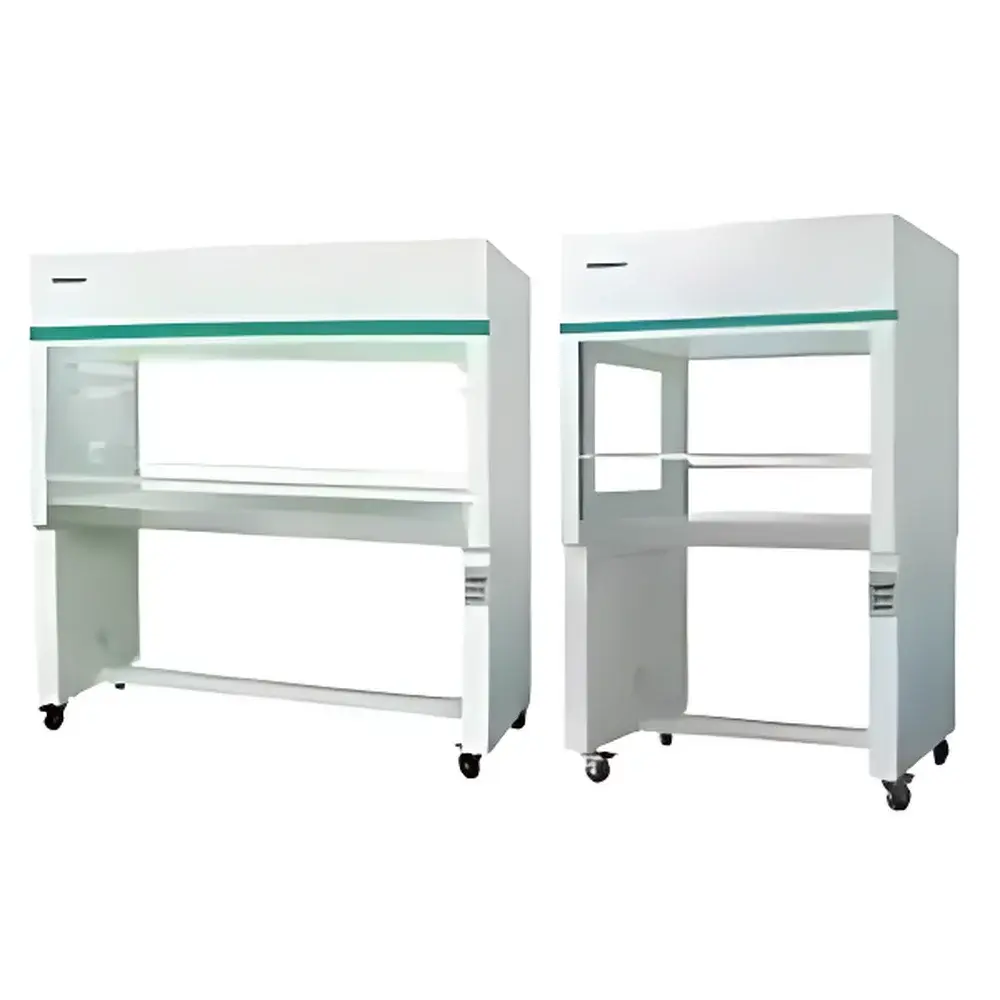
SW-CJ-1F & SW-CJ-1FD Vertical Laminar Flow Clean Benches
| Origin | Jiangsu, China |
|---|---|
| Manufacturer Type | Authorized Distributor |
| Origin Category | Domestic (China) |
| Model | SW-CJ-1F, SW-CJ-1FD |
| Instrument Category | Vertical Laminar Flow Clean Bench |
| Cleanliness Class | ISO 5 (Class 100 per US Federal Standard 209E) |
| Noise Level | ≤62 dB(A) |
| User Capacity | Single-operator, dual-sided or single-sided configuration |
| Airflow Pattern | Vertical downward laminar flow |
| Average Air Velocity | ≥0.3 m/s (adjustable) |
| Illumination | ≥300 lx |
| Power Supply | 220 V / 50 Hz |
| Input Power | 250 VA (SW-CJ-1F), 500 VA (SW-CJ-1FD) |
| Weight | 130 kg (SW-CJ-1F), 170 kg (SW-CJ-1FD) |
| Work Area Dimensions (W×D×H) | 870×690×520 mm (SW-CJ-1F), 1360×690×520 mm (SW-CJ-1FD) |
| Overall Dimensions (W×D×H) | 1010×730×1600 mm (SW-CJ-1F), 1500×730×1600 mm (SW-CJ-1FD) |
| HEPA Filter Specification | 820×650×50 mm ×1 (SW-CJ-1F), 610×610×50 mm ×2 (SW-CJ-1FD) |
| Lighting | 14 W fluorescent lamp ×1 / 14 W UV lamp ×1 (SW-CJ-1F) |
| Microbial Contamination | ≤0.5 CFU/plate (90 mm Petri dish, 1-hour exposure) |
Overview
The SW-CJ-1F and SW-CJ-1FD Vertical Laminar Flow Clean Benches are engineered for precision particle-free environments in non-hazardous laboratory applications. These units operate on the principle of vertical laminar airflow—filtered air is drawn through a high-efficiency particulate air (HEPA) filter and delivered uniformly downward across the work surface at a controlled velocity (≥0.3 m/s), creating a unidirectional barrier that prevents ambient contaminants from entering the sterile workspace. Designed to meet ISO 5 (Class 100 per US Federal Standard 209E), they provide a validated clean environment suitable for microbiological culture handling, pharmaceutical aseptic preparation, electronics assembly, and other processes requiring protection of samples—not personnel or environment. Unlike biological safety cabinets, these clean benches do not incorporate recirculation or exhaust ducting for hazardous agents; they are strictly for non-toxic, non-biohazardous operations where product protection is the primary objective.
Key Features
- Patented adjustable sash system enabling precise, tool-free positioning of the vertical sliding front window for ergonomic access and consistent airflow integrity
- Seamless, one-piece stainless steel work surface with radiused corners—resistant to corrosion, non-porous, and compliant with ISO 14644-1 surface cleanliness requirements for routine disinfection and validation
- Dual operational configurations: SW-CJ-1F supports single-operator dual-sided access (front and rear), while SW-CJ-1FD offers single-sided front access only—optimized for space-constrained or wall-mounted installations
- Interlocked lighting and UV germicidal irradiation system: UV lamps deactivate automatically when the sash is raised above a defined threshold, and fluorescent lighting remains active during operation to ensure continuous visual clarity without compromising operator safety
- Digital LED control panel with intuitive interface for real-time monitoring of airflow status, UV timer, and lighting activation—designed to support GLP-compliant documentation workflows
- Structural compliance with IEC 61010-1 (Safety Requirements for Electrical Equipment for Measurement, Control, and Laboratory Use) and GB/T 16292–2010 (Chinese national standard for clean bench performance testing)
Sample Compatibility & Compliance
These clean benches accommodate standard Petri dishes (90 mm), multi-well plates, glassware, pipette racks, and small-scale aseptic transfer tools. The work area dimensions (870 × 690 × 520 mm for SW-CJ-1F; 1360 × 690 × 520 mm for SW-CJ-1FD) allow flexible arrangement of equipment while maintaining laminar uniformity. All materials—including housing, filter frame, and interior lining—are selected for low particle shedding and compatibility with common disinfectants (e.g., 70% ethanol, hydrogen peroxide vapor, quaternary ammonium compounds). Units are validated per ISO 14644-3 Annex B for airborne particle concentration and per ISO 14644-1 for classification stability under dynamic operating conditions. They are not certified for biosafety level 2 (BSL-2) or higher applications and must not be used with volatile organic solvents, radioactive isotopes, or pathogenic microorganisms requiring containment.
Software & Data Management
While these models do not feature embedded data logging software, their digital control interface supports manual timestamped operation records—critical for audit readiness in regulated environments. The LED display provides immediate feedback on UV cycle completion, lighting status, and airflow confirmation. For laboratories requiring electronic recordkeeping, integration with external environmental monitoring systems (EMS) is achievable via optional analog voltage output (0–5 V DC) representing fan speed feedback—a feature compatible with SCADA or LabVantage platforms. All operational parameters align with FDA 21 CFR Part 11 expectations when paired with validated procedural controls, including operator training logs, preventive maintenance schedules, and HEPA filter integrity test documentation (per EN 1822-4 or IEST-RP-CC001.4).
Applications
- Aseptic handling of cell cultures and tissue explants in academic and industrial life science labs
- Preparation of media, reagents, and standards under GMP Annex 1-aligned conditions (non-sterile grade manufacturing support)
- Microelectronics component inspection and soldering of sensitive PCB assemblies
- Calibration and handling of reference standards in metrology laboratories
- Quality control sampling for cosmetics, food additives, and nutraceuticals where microbial load minimization is required
- Support function in ISO/IEC 17025-accredited testing laboratories performing non-hazardous physical or chemical analyses
FAQ
What is the difference between SW-CJ-1F and SW-CJ-1FD?
The SW-CJ-1F features a dual-sided open design (front and rear access) for shared-use benchtop integration, whereas the SW-CJ-1FD is configured for front-only access—ideal for placement against a wall or within enclosed cabinetry.
Can this unit be used for handling pathogens or toxic chemicals?
No. These are laminar flow clean benches—not biological safety cabinets. They protect only the sample, not the operator or environment. Pathogens, cytotoxic drugs, or volatile solvents require containment-grade equipment (e.g., Class II BSCs or fume hoods).
How often should the HEPA filter be replaced?
Filter replacement frequency depends on usage intensity and ambient air quality. Under typical lab conditions (8 hrs/day, ISO 8 ambient), annual replacement is recommended. Integrity testing (e.g., DOP/PAO scan) should be performed semiannually per ISO 14644-3.
Is UV sterilization sufficient for decontaminating the work surface?
UV irradiation (254 nm) effectively reduces surface bioburden but does not penetrate organic residue or shadowed areas. It must be combined with manual wiping using validated disinfectants prior to critical procedures.
Does this model comply with international cleanroom standards?
Yes—performance is certified to ISO 5 (Class 100) per ISO 14644-1 and US Federal Standard 209E. Full test reports—including particle count, airflow velocity mapping, and noise measurement—are available upon request for regulatory submission.
Related Products



