
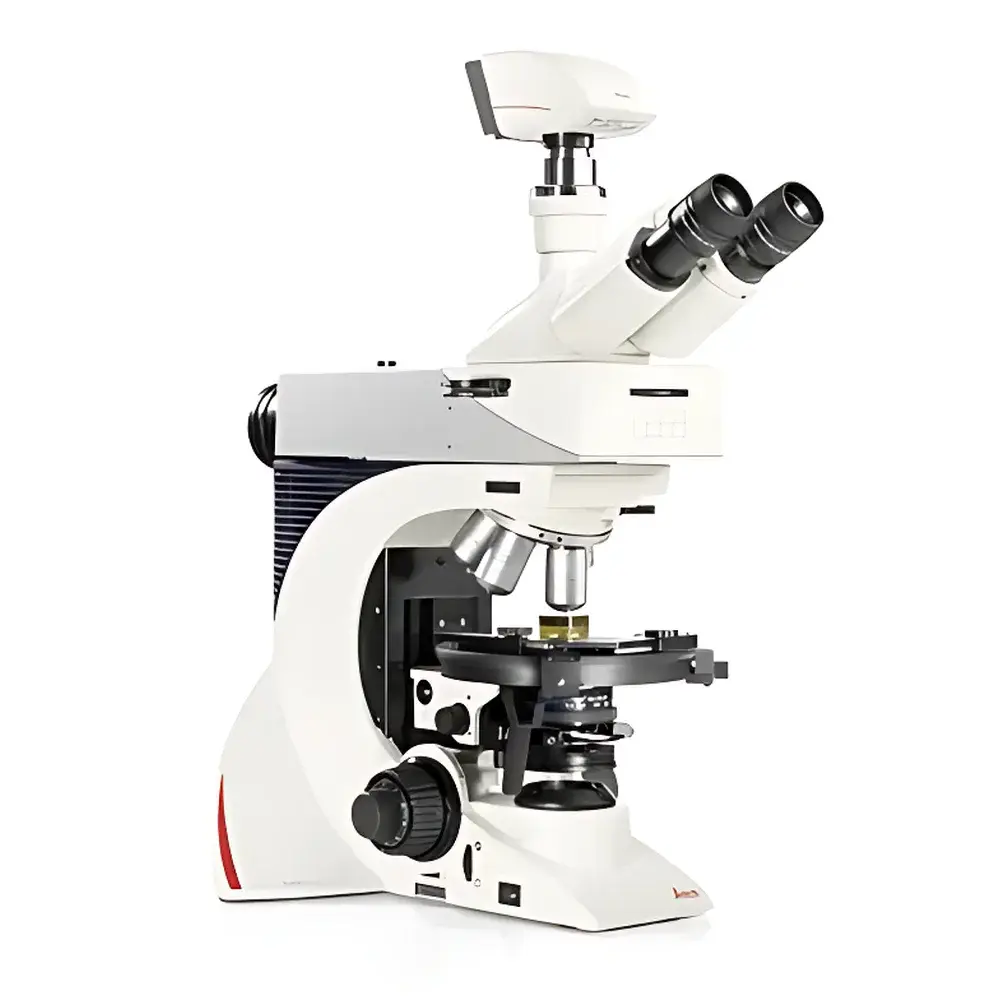
Leica DM2700M Metallurgical Microscope
| Brand | Leica |
|---|---|
| Origin | Germany |
| Model | DM2700M |
| Illumination | White LED (4500 K) |
| Contrast Methods | Brightfield, Darkfield, DIC, Polarization, Oblique Illumination |
| Maximum Specimen Size | 100 × 100 mm |
| Maximum Specimen Height | 80 mm |
| Macro Viewing Field | Ø40 mm |
| LED Lifetime | ≥35,000 h |
| Focus Mechanism | Coaxial coarse/fine focusing with adjustable torque and integrated focus stop |
| Objective Turret | 5× or 6–7× BF/DF or BF/FLUO configuration |
| Compliance | CE, ISO 9001, ISO 13485 (as applicable to lab instrumentation), GLP-ready documentation support |
Overview
The Leica DM2700M is a high-performance upright metallurgical microscope engineered for precision material evaluation in industrial quality control, failure analysis, geological specimen examination, forensic metallography, and academic research. Designed around the core principle of incident-light optical microscopy, it employs Köhler illumination geometry with a stable, high-intensity white LED light source (4500 K correlated color temperature) to deliver consistent, artifact-free contrast across multiple observation modes—including brightfield (BF), darkfield (DF), differential interference contrast (DIC), polarization (POL), and oblique illumination. Its rigid mechanical design, thermally stable optical path, and optimized light management ensure minimal chromatic aberration and high-fidelity true-color imaging—critical for quantitative phase identification, grain boundary delineation, inclusion analysis, and microstructural documentation per ASTM E3, ISO 643, and USP . The system is fully compatible with digital imaging workflows and supports integration into regulated environments requiring audit trails and data integrity.
Key Features
- Stable 4500 K white LED illumination: Delivers uniform spectral output across all brightness levels—enabling true-color reproduction without manual color correction or lamp warm-up delays.
- Dual-purpose illumination module: Seamlessly switches between BF, DF, DIC, POL, and oblique modes via manual or motorized turret controls; no alignment recalibration required between modalities.
- Color-Coded Aperture (CCDA) system: Integrates color-matched objective lenses with corresponding aperture diaphragm settings to automate optimal resolution–contrast–depth-of-field trade-offs for each magnification.
- Three-gear coaxial focusing mechanism: Provides precise, backlash-free coarse and fine adjustment (1 µm graduation on fine drive); integrated focus stop prevents objective crash during routine operation.
- Modular nosepiece options: Supports 5-position BF/DF M32 turrets or 6–7-position BF/FLUO configurations for extended application flexibility—including optional fluorescence capability with external light sources.
- Ergonomic stage and height-adjustable focus knobs: Accommodate diverse user anthropometrics and reduce repetitive strain during extended inspection sessions.
- Macro viewing capability: Integrated macro objective enables rapid overview imaging of up to Ø40 mm field of view—ideal for initial sample survey, defect localization, and report-level documentation.
Sample Compatibility & Compliance
The DM2700M accommodates specimens up to 100 × 100 mm in planar dimension and 80 mm in vertical height—covering standard metallographic mounts, semiconductor wafers, PCB assemblies, and machined mechanical components. Its open-stage architecture permits direct mounting of irregular or oversized samples without auxiliary holders. All optical components comply with ISO 10934-1 (microscope terminology) and ISO 8578 (optical resolution standards). The instrument meets CE marking requirements under the EU Machinery Directive 2006/42/EC and Electromagnetic Compatibility Directive 2014/30/EU. When paired with Leica Application Suite (LAS) X software and optional validation packages, the system supports GLP/GMP-aligned workflows—including electronic signatures, 21 CFR Part 11-compliant audit trails, and IQ/OQ documentation templates.
Software & Data Management
Digital imaging is enabled via Leica DMC series cameras and LAS X software—a modular platform supporting image acquisition, annotation, measurement (length, area, particle count), and export in TIFF, JPEG, or vendor-neutral formats (e.g., OME-TIFF). For metallurgical quantification, dedicated modules include Leica Steel Expert (for ASTM E112 grain size analysis), Phase & Grain Expert (phase fraction mapping and grain topology), and Cleanliness Expert (inclusion rating per ISO 4967 or ASTM E45). All modules operate within a single interface, support batch processing, and generate PDF or Excel reports compliant with internal QA protocols. Raw image metadata—including objective ID, illumination mode, exposure time, and calibration stamp—is embedded automatically for traceability.
Applications
- Metallurgical QC: Routine assessment of heat-treated alloys, weld microstructures, casting porosity, and surface decarburization per ISO 643 or ASTM E3.
- Failure analysis: Crack propagation mapping, fatigue striation identification, and intergranular corrosion evaluation in aerospace or power-generation components.
- Geoscience: Thin-section mineralogical analysis, texture classification of igneous/metamorphic rocks, and fluid inclusion characterization.
- Forensic engineering: Toolmark comparison, bullet jacket microstructure correlation, and fracture surface morphology interpretation.
- Semiconductor & electronics: Solder joint integrity, die attach voiding, wire bond pull-test cross-sections, and PCB delamination detection.
- Academic research: In-situ thermal cycling studies (with optional heating stage), phase transformation kinetics, and multi-scale correlative microscopy (combined with SEM/EDS).
FAQ
Does the DM2700M support fluorescence imaging?
Yes—when equipped with the BF/FLUO nosepiece and an external fluorescence light source (e.g., Leica EL6000), the system supports standard filter cube sets for DAPI, FITC, TRITC, and other common fluorophores.
Is the LED illumination intensity adjustable during live observation?
Yes—intensity is continuously variable via front-panel dial or software control, with real-time feedback and memory recall for predefined protocols.
Can the microscope be integrated into automated production line inspection systems?
While primarily a manual platform, its digital interface (USB 3.0, GigE option), programmable illumination triggers, and LAS X SDK enable OEM-level integration with PLC-controlled conveyors or robotic sample handlers.
What calibration documentation is provided for regulatory compliance?
Leica provides factory calibration certificates for focus drive linearity, stage positioning accuracy, and illumination uniformity. Optional IQ/OQ validation kits include test protocols, acceptance criteria, and editable SOP templates aligned with ISO/IEC 17025.
Are replacement objectives backward-compatible with older Leica stand models?
Most DM2700M objectives (HC PL Fluotar and EC series) maintain mechanical and optical compatibility with prior DM series stands—but full functionality (e.g., CCDA recognition) requires firmware-matched hardware.



