
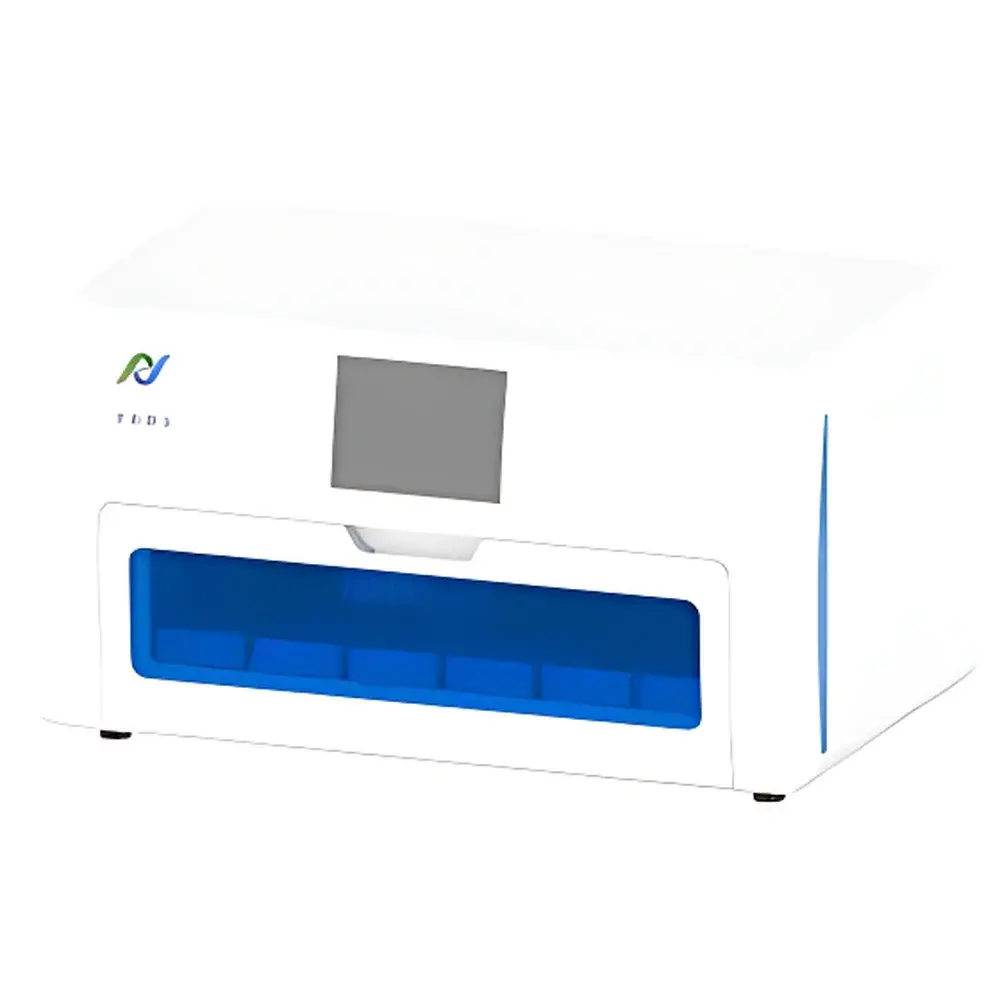
ZK-96 Automated 96-Channel Nucleic Acid Extraction System
| Origin | Jiangsu, China |
|---|---|
| Manufacturer Type | Authorized Distributor |
| Origin Category | Domestic (China) |
| Model | ZK-96 |
| Price Range | USD 28,000 – 42,500 |
| Instrument Type | Magnetic Bead-Based Extraction |
| Automation Level | Dedicated Fully Automated Platform |
| Throughput | 1–96 Samples per Run |
| Sample Volume Range | 30 µL – 1000 µL |
| Processing Time per Batch | 20–60 min |
| Magnetic Bead Recovery Efficiency | >98% |
| Heating Temperature Range (Lysis/Elution) | Ambient to 110 °C |
| Oscillation | Multi-Speed & Multi-Amplitude Programmable |
| Air Filtration | Dual HEPA + UV-C Sterilization |
| Control Interface | 7-inch Capacitive Touchscreen (Chinese UI) |
| Connectivity | Wi-Fi Enabled |
| Remote Monitoring | Mobile App Supported |
| Dimensions (W×D×H) | 780 × 440 × 500 mm |
| Weight | 42 kg |
| Power Supply | AC 110–220 V, 50/60 Hz |
| Operating Environment | 10–40 °C, <80% RH (non-condensing) |
Overview
The ZK-96 Automated 96-Channel Nucleic Acid Extraction System is a benchtop, fully integrated magnetic bead-based purification platform engineered for high-throughput, reproducible isolation of genomic DNA and total RNA from diverse biological matrices. It operates on the principle of solid-phase extraction using functionalized superparamagnetic nanoparticles—specifically, carboxyl- or silane-modified magnetic beads that reversibly bind nucleic acids under controlled chaotropic salt and pH conditions. During lysis, cellular membranes are disrupted by proprietary or third-party reagents; liberated nucleic acids bind selectively to the bead surface in high-salt buffer. Subsequent wash steps remove proteins, salts, and inhibitors using ethanol-based solutions, while elution in low-ionic-strength buffer (e.g., TE or nuclease-free water) releases purified nucleic acids with minimal carryover. The system employs a synchronized 96-position magnetic rod array to immobilize and transport beads through sequential liquid handling zones—lysis, binding, washing, drying, and elution—eliminating cross-contamination risks associated with tip-based liquid handlers.
Key Features
- True 96-well parallel processing capability using standardized 96-deep-well plates, enabling full batch scalability without manual intervention.
- Programmable thermal control across two independent heating zones: lysis (up to 110 °C) and elution (ambient to 110 °C), supporting optimized protocols for difficult samples including FFPE tissue, soil, and blood clots.
- Multi-dimensional oscillation system with variable amplitude and frequency settings ensures uniform bead suspension and efficient binding kinetics during incubation steps.
- Integrated biosafety architecture: laminar airflow path (side inlet → top exhaust), dual-stage HEPA filtration (≥99.99% @ 0.3 µm), and timed UV-C irradiation (254 nm) between runs to mitigate aerosol-mediated carryover.
- Robust mechanical design featuring sealed reaction chamber, safety interlock doors, and acoustic dampening materials achieving ≤70 dB(A) operational noise—compliant with ISO 7779 and ANSI S12.55 laboratory ambient standards.
- Intuitive 7-inch capacitive touchscreen interface with context-sensitive prompts, real-time protocol progress tracking, and error logging compliant with GLP documentation requirements.
Sample Compatibility & Compliance
The ZK-96 supports extraction from human whole blood, serum, plasma, saliva, buccal swabs, cultured cells, bacterial pellets, plant tissues, and environmental samples (e.g., wastewater, food homogenates). It is compatible with all major commercial magnetic bead kits—including QIAGEN QIAamp, Thermo Fisher KingFisher, and Promega Maxwell formats—without hardware modification. The platform meets essential regulatory expectations for molecular diagnostics workflows: adherence to ISO 13485 quality management principles, compatibility with FDA 21 CFR Part 11–enabled software extensions (via optional audit trail module), and alignment with CLSI EP12-A2 and ISO 20387 biobanking guidelines for nucleic acid integrity assessment. All consumables—including disposable tips, deep-well plates, and collection tubes—are certified DNase/RNase-free and pyrogen-tested per USP .
Software & Data Management
The embedded operating system provides comprehensive protocol management: users may create, duplicate, edit, and archive extraction methods with version control. Each method stores critical parameters—including temperature ramp profiles, mixing durations, magnet engagement timing, and wash cycle counts—as structured metadata. Data export options include CSV-formatted run logs with timestamps, operator IDs, and instrument status flags. Optional Wi-Fi connectivity enables remote monitoring via secure TLS-encrypted mobile application (iOS/Android), supporting push notifications for completion alerts and system fault diagnostics. Audit trail functionality—when enabled—records all user actions, parameter changes, and calibration events with immutable timestamps, satisfying GMP Annex 11 and ISO/IEC 17025 traceability requirements.
Applications
This system serves core needs across academic research, clinical diagnostics, public health surveillance, forensic analysis, agricultural biotechnology, and food safety testing. Typical use cases include: preparation of templates for qPCR and digital PCR assays; library construction for next-generation sequencing (NGS); viral load quantification in respiratory panels (e.g., SARS-CoV-2, influenza A/B); pathogen detection in foodborne outbreak investigations; epigenetic studies requiring high-integrity cfDNA; and biobank-scale sample processing where batch consistency and chain-of-custody integrity are mandatory. Its throughput and reliability make it especially suited for laboratories transitioning from manual spin-column methods or lower-capacity 8-/32-channel platforms.
FAQ
Does the ZK-96 support both DNA and RNA extraction in a single run?
Yes—by selecting appropriate magnetic bead chemistry and adjusting lysis buffer composition (e.g., guanidinium thiocyanate for RNA stabilization), the same run can isolate either DNA, RNA, or co-purified nucleic acids.
Can third-party reagent kits be used without validation?
While the system is physically compatible with most 96-well magnetic bead kits, optimal yield and purity require protocol optimization; we recommend initial validation using kit-specific reference protocols provided by the reagent manufacturer.
Is the UV-C sterilization cycle validated for RNase deactivation?
UV-C irradiation at 254 nm achieves ≥4-log reduction of airborne microorganisms and surface-bound RNases when applied for ≥15 minutes post-run, per ISO 15714:2019 test methodology.
What maintenance intervals are recommended for long-term reliability?
Daily wipe-down of the magnetic head and plate carrier; monthly cleaning of HEPA filters and UV lamp housing; annual recalibration of temperature sensors and magnet actuation timing—documented in the included service logbook.
Is remote software update capability available?
Firmware updates are delivered via encrypted USB drive; over-the-air updates are not supported to maintain network security compliance in regulated environments.




