
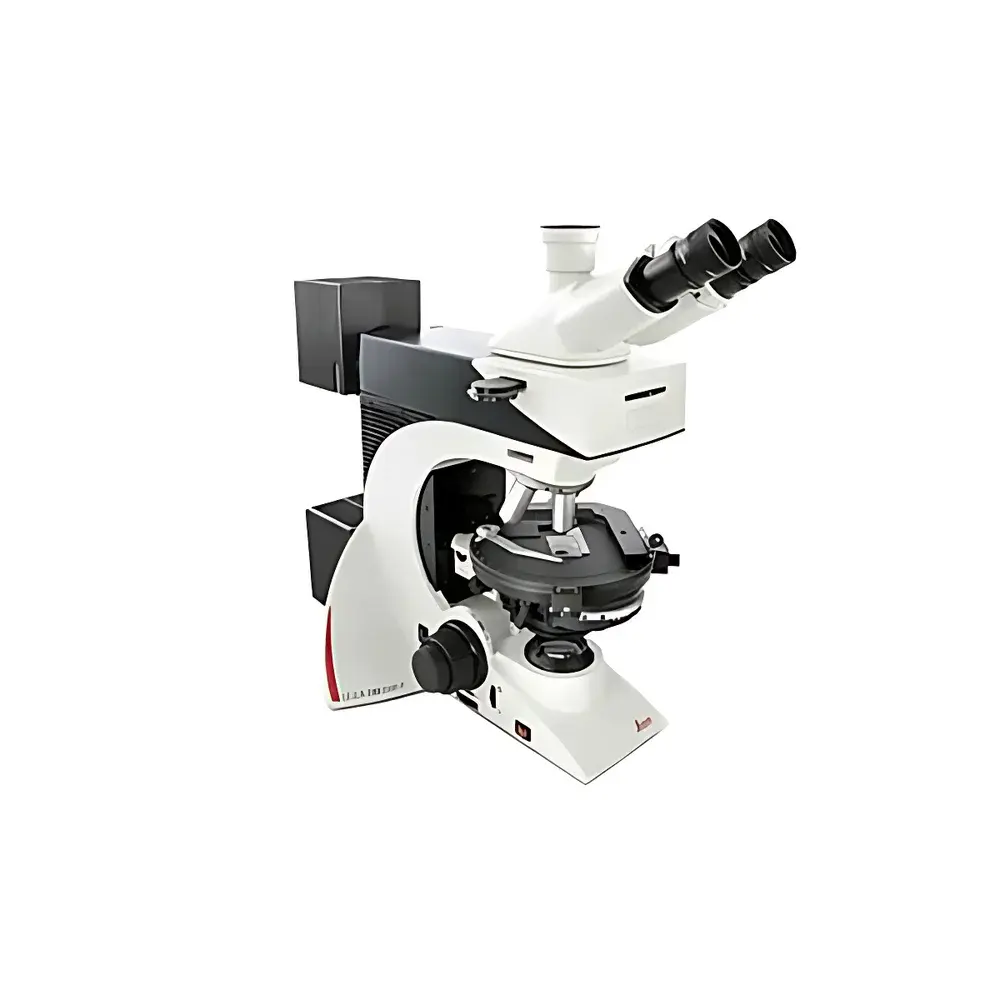
Leica DM2500P Polarizing Microscope
| Brand | Leica |
|---|---|
| Origin | Germany |
| Model | DM2500P |
| Optical Configuration | Transmitted & Reflected Light |
| Illumination | 12 V / 100 W Halogen |
| Focus System | Dual-Height-Adjustable Manual Coarse/Fine Focus |
| Objective Turret | 5-position, Centerable |
| Field of View | 25 mm |
| Observation Modes | Brightfield, Darkfield, Phase Contrast, DIC, Fluorescence (reflected), Orthogonal Polarization, Conoscopy |
| Polarization System | Standard or Advanced Bertrand Lens Module with Centering & Focusing Adjustment |
| Condenser | Manual or CDA-assisted, Polarization-optimized |
| Stage Options | 45°-click Rotation Stage, Optional Heating Stage |
| Objective Types Supported | Achromatic, Plan-Achromatic, Plan-Fluor, Oil Immersion |
| Software Compatibility | Leica Application Suite (LAS) X with Image Acquisition, Measurement & Analysis Modules |
| Compliance | Designed for ISO/IEC 17025-compliant laboratories |
Overview
The Leica DM2500P Polarizing Microscope is a high-precision, research-grade optical instrument engineered for quantitative birefringence analysis and anisotropic material characterization. Built upon Leica Microsystems’ decades-long expertise in polarized light microscopy, the DM2500P employs a dual-path optical architecture supporting both transmitted and reflected illumination — enabling rigorous evaluation of crystalline structure, stress distribution, molecular alignment, and phase transitions. Its core optical design adheres to Köhler illumination principles and integrates strain-free optics certified to DIN/ISO standards, ensuring minimal polarization artifact generation across all magnifications. The system is widely deployed in academic geoscience laboratories, industrial quality control environments (e.g., glass tempering verification, polymer film orientation analysis), semiconductor wafer inspection, and advanced materials R&D where reproducible retardation measurement and extinction angle determination are critical.
Key Features
- Ergonomic dual-height-adjustable focus mechanism with coarse/fine focusing gears — reduces operator fatigue during extended observation sessions and accommodates users of varying stature and hand size.
- Integrated focus limiter prevents objective-lens or specimen damage during rapid focusing maneuvers — especially critical when using high-NA oil immersion objectives or heated stages.
- Color-coded aperture diaphragm and objective turret linkage ensures optimal numerical aperture matching per magnification — minimizing spherical aberration and maximizing contrast in both orthoscopic and conoscopic imaging.
- Dual Bertrand lens module options: Standard module includes centerable Bertrand lens and built-in polarizer/analyzer with grain-detection aperture; Advanced module adds fine-focus adjustment and extended field-of-view optics for high-resolution conoscopy of uniaxial/biaxial crystals.
- Modular stage configuration: Standard rotating mechanical stage with 45° detent positions; optional motorized or heated stages (up to 150 °C) for in-situ thermal birefringence studies.
- CDA (Contrast Device Assistant) integration enables one-touch switching between brightfield, DIC, and polarized modes — streamlining workflow consistency and reducing setup variability in regulated environments.
Sample Compatibility & Compliance
The DM2500P accommodates standard 25 mm field-of-view specimens on 1″ × 3″ or 2″ × 3″ microscope slides, including polished thin sections (30 µm), bulk mineral mounts, polymer films, liquid crystal cells, fiber cross-sections, and semiconductor wafers. Its strain-free optical train meets ISO 10934-1 (Microscopy — Terminology for Polarized Light Microscopy) and ASTM D4126 (Standard Test Method for Birefringence of Plastics). When operated with Leica LAS X software configured for audit trail and electronic signature, the system supports compliance with FDA 21 CFR Part 11, EU Annex 11, and ISO/IEC 17025 documentation requirements — making it suitable for GLP and GMP-regulated QC laboratories conducting material certification or failure analysis.
Software & Data Management
The microscope integrates natively with Leica Application Suite (LAS) X, a modular, validation-ready platform supporting image acquisition, multi-channel fluorescence registration, linear and angular birefringence quantification (retardation in nm, slow-axis orientation), and automated grain boundary detection. LAS X provides full metadata embedding (objective ID, condenser position, analyzer angle, exposure time), timestamped operation logs, and role-based user access control. Export formats include TIFF (16-bit), JPEG2000, and CSV for downstream statistical analysis in MATLAB or Python-based scientific computing environments. Optional modules enable real-time stress mapping, time-lapse conoscopy, and DIC-polarization fusion imaging.
Applications
- Geosciences: Quantitative petrographic analysis of igneous/metamorphic rocks, identification of pleochroism and optic sign in minerals, strain analysis in deformed quartz aggregates.
- Materials Science: Orientation mapping of polymeric fibers and films, residual stress assessment in tempered glass and injection-molded components, liquid crystal director alignment verification.
- Electronics Manufacturing: Detection of photoelastic stress in silicon wafers and encapsulant resins, inspection of birefringent defects in display substrates.
- Pharmaceuticals: Polymorph screening of crystalline active pharmaceutical ingredients (APIs), hydrate/anhydrate differentiation, and tablet coating uniformity analysis via stress-induced birefringence.
- Textiles & Composites: Fiber type identification (e.g., cellulose vs. synthetic), weave architecture analysis, interfacial adhesion assessment in reinforced composites.
FAQ
Does the DM2500P support automated stage scanning or motorized focus?
No — the DM2500P is a manually operated platform optimized for precision ergonomic control. Motorized components (stage, focus, filter wheels) are available only on the higher-tier DM6 P series.
Can I perform quantitative retardation measurements with this system?
Yes — when paired with LAS X Polarization Analysis Module and calibrated λ/4 and λ plates, the DM2500P enables quantitative retardation measurement down to ±1 nm resolution under standardized illumination conditions.
Is the halogen lamp compatible with long-term continuous operation?
The 12 V / 100 W halogen source is rated for ≥1,000 hours at nominal voltage; use of the integrated light intensity regulator and automatic lamp shut-off after idle timeout extends service life and maintains color temperature stability.
What certifications apply to the optical train?
All objectives and tube lenses are certified strain-free per DIN EN ISO 10934-1; polarizers meet ISO 9211-4 specifications for extinction ratio (>10,000:1) and wavefront distortion (<λ/4 PV).
How is calibration traceability maintained?
Leica provides factory calibration certificates for polarization axis alignment and field flatness; users may perform in-house verification using NIST-traceable quartz wedge standards and certified reference thin sections (e.g., U.S. Geological Survey standard samples).






