
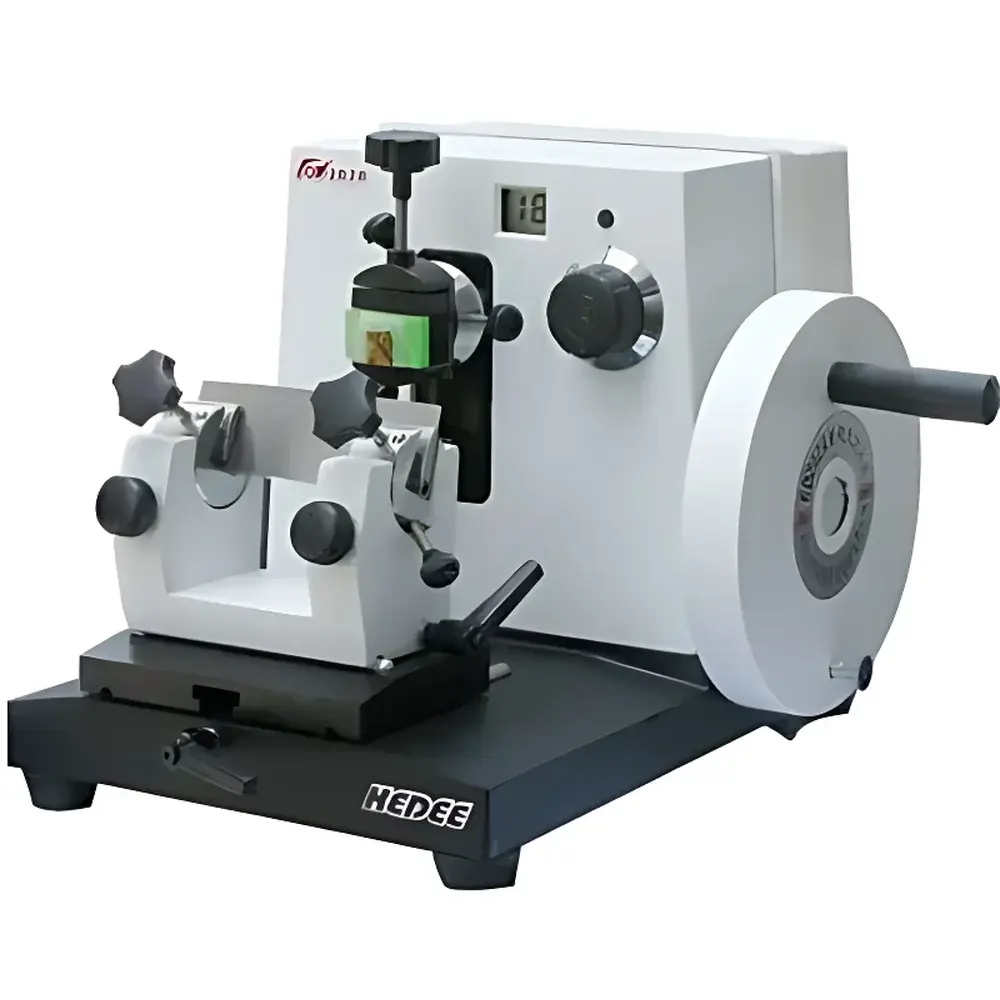
KD-202A Rotary Microtome
| Origin | Zhejiang, China |
|---|---|
| Manufacturer Type | Authorized Distributor |
| Origin Category | Domestic (PRC) |
| Model | KD-202A |
| Price | USD 1,780 (FOB Zhejiang) |
| Cutting Thickness Range | 1–25 µm (continuous), >25 µm (step-adjustable) |
| Minimum Graduation | 1 µm |
| Max Specimen Area (Paraffin) | 40 × 30 mm |
| Thickness Accuracy | ±10% |
| Blade Holder Adjustment | Horizontal & Anterior–Posterior Translation |
| Dimensions (W×D×H) | 380 × 340 × 270 mm |
| Net Weight | 21.5 kg |
Overview
The KD-202A Rotary Microtome is a precision-engineered, manually operated microtome designed for routine histological sectioning of paraffin-embedded tissue specimens in academic, clinical, and industrial pathology laboratories. It operates on the fundamental principle of rotary motion—where a handwheel-driven crank mechanism advances the specimen holder toward a stationary steel or disposable blade in a precisely controlled vertical stroke. Each full rotation delivers one section; thickness is governed by micrometer-based advancement of the specimen block holder along the Z-axis. The KD-202A integrates mechanical robustness with ergonomic refinements—including a high-point handwheel lock for safe cassette exchange—and conforms to ISO 13806:2007 (Microtomes — Requirements and test methods) for dimensional stability and repeatability under standard laboratory conditions (20–25°C, 40–60% RH).
Key Features
- Stepless thickness adjustment from 1 to 25 µm with 1 µm graduation resolution, enabling consistent sectioning across routine H&E, special stains, and immunohistochemistry protocols.
- Reinforced aluminum alloy base and sealed housing structure minimize vibration transmission and prevent paraffin debris accumulation—critical for maintaining long-term cutting accuracy and operator hygiene.
- LCD digital slice counter with non-volatile memory retains cumulative count across power cycles; integrated audible alarm triggers when specimen advance exceeds preset safety threshold or blade contact is detected.
- Multi-axis blade holder allows fine-tuned horizontal translation (±5 mm) and anterior–posterior positioning (±3 mm), facilitating optimal knife–specimen angle alignment and efficient trimming of paraffin blocks prior to serial sectioning.
- Ergonomic handwheel with dual-density grip and positive detent locking at top-dead-center eliminates accidental specimen retraction during cassette loading or blade replacement.
- Compact footprint (380 × 340 × 270 mm) and 21.5 kg mass ensure stable operation on standard laboratory benches without anchoring requirements.
Sample Compatibility & Compliance
The KD-202A accommodates standard 40 × 30 mm paraffin-embedded tissue cassettes and supports both reusable stainless-steel knives and disposable low-profile blades (e.g., Leica RM2235-compatible). It is validated for use with routinely processed formalin-fixed, paraffin-embedded (FFPE) human and animal tissues per CAP/CLIA pre-analytical guidelines. While not certified for ISO 15195 (Reference measurement laboratories), its ±10% thickness tolerance meets ASTM E2015-22 criteria for “general-purpose microtomes used in diagnostic histopathology.” The enclosed housing design complies with IEC 61000-6-3 for electromagnetic compatibility and reduces airborne particulate generation—supporting adherence to OSHA 1910.1200 (Hazard Communication Standard) in shared lab environments.
Software & Data Management
As a fully manual mechanical instrument, the KD-202A does not incorporate embedded firmware or network connectivity. All operational parameters—including slice count, cumulative usage hours (tracked via optional external logbook or LIMS-integrated barcode scanning), and maintenance history—are documented externally. The LCD counter provides timestamp-free numeric readout only; no audit trail, user authentication, or electronic record storage is implemented. For laboratories operating under FDA 21 CFR Part 11 or GLP/GMP frameworks, procedural documentation must be maintained via paper-based or validated electronic systems independent of the device.
Applications
- Routine histology workflows in hospital pathology departments and contract research organizations (CROs).
- Preclinical toxicology studies requiring serial sectioning of rodent organ blocks for morphometric analysis.
- Teaching laboratories where mechanical transparency, reliability, and low total cost of ownership are prioritized over automated throughput.
- Resource-constrained settings requiring field-deployable, electricity-independent sectioning capability (handwheel operation only).
- Quality control of embedding media consistency through comparative section uniformity assessment.
FAQ
Is the KD-202A compatible with cryogenic sectioning?
No. This model is strictly intended for room-temperature paraffin sectioning. For frozen sections, a dedicated cryomicrotome (e.g., Leica CM1950 or Thermo Scientific HM525) is required.
What blade types are supported?
Standard wedge-shaped steel knives (length ≤ 120 mm) and disposable microtome blades with 25 mm width and 0.5 mm thickness (e.g., Feather S35, Sakura Super 40).
Does the device include calibration certification?
Factory calibration is performed against NIST-traceable micrometer standards; however, no ISO/IEC 17025-accredited certificate is supplied. Users may perform in-house verification using certified step gauges per CLSI EP10-A3 protocol.
Can the KD-202A be integrated into a LIMS environment?
Not directly. Integration requires external hardware (e.g., USB footswitch + counter interface) and middleware configuration to relay slice counts to LIMS via HL7 or CSV export.
What maintenance intervals are recommended?
Lubrication of the crankshaft and feed screw every 200 operating hours; annual inspection of micrometer gear backlash and handwheel clutch engagement by qualified biomedical engineering personnel.
Related Products



