
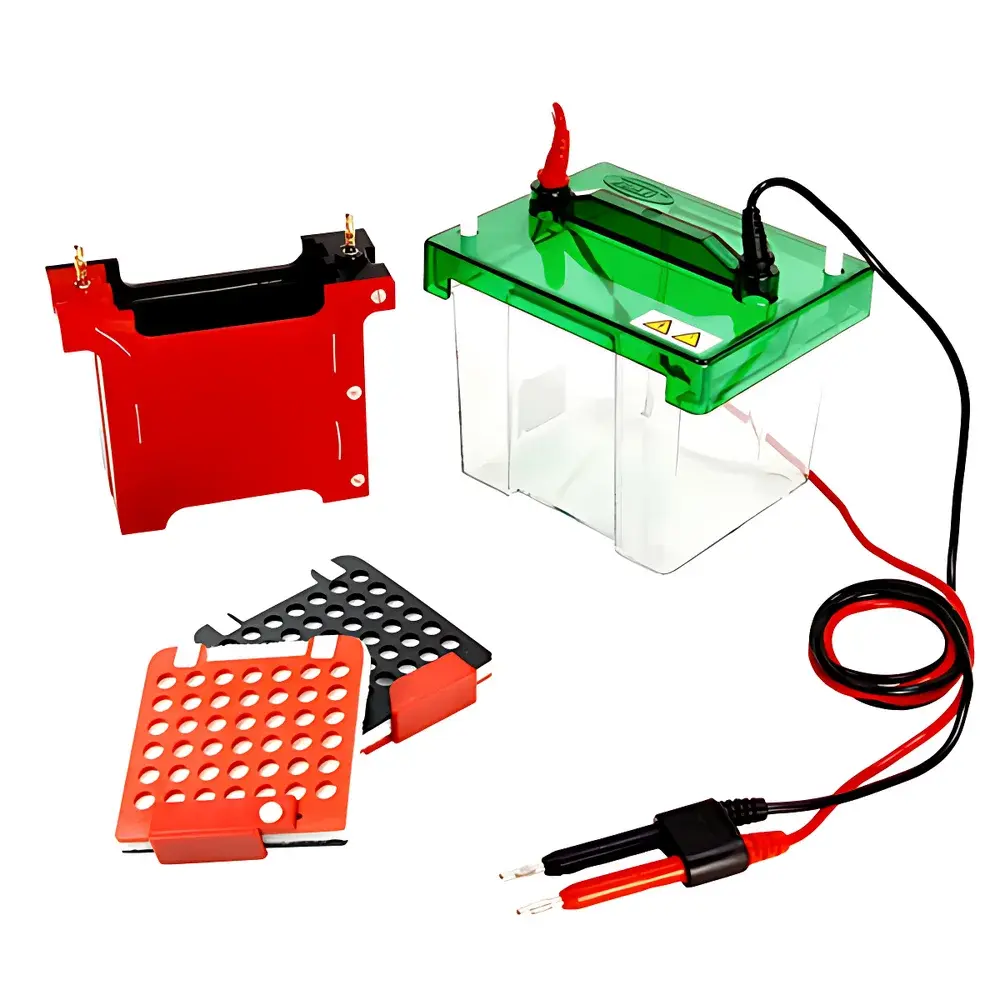
Junyi JY-ZY5 Semi-Dry Transfer Electrophoresis Unit
| Brand | Junyi |
|---|---|
| Origin | Beijing, China |
| Model | JY-ZY5 |
| Instrument Type | Semi-Dry Electroblotting Apparatus |
| Main Component | Transfer Cassette |
| Gel Format | 100 × 100 mm |
| Buffer Volume | ~750 mL |
| Dimensions (L×W×H) | 150 × 120 × 115 mm |
| Net Weight | 0.8 kg |
| Housing Material | Optical-grade polycarbonate |
| Electrode Configuration | Parallel-plate, removable stainless-steel electrodes |
| Safety Feature | Lid-activated circuit interruption |
| Compatibility | Modular integration with JY-SCZ2+ electrophoresis buffer tank and lid |
Overview
The Junyi JY-ZY5 Semi-Dry Transfer Electrophoresis Unit is an engineered solution for rapid, efficient, and reproducible electroblotting of proteins and nucleic acids from polyacrylamide or agarose gels onto solid supports—including nitrocellulose, PVDF, and nylon membranes. Operating on the principle of semi-dry electrotransfer, the JY-ZY5 applies a direct current electric field across a compact sandwich assembly consisting of gel, membrane, and filter papers saturated with transfer buffer. Its optimized electrode geometry—featuring closely spaced, parallel stainless-steel plates—minimizes electrical resistance and enables high-field-strength transfer at low buffer volumes, significantly reducing transfer time compared to traditional wet-tank systems while maintaining high retention of antigenicity and epitope integrity. Designed for routine use in molecular biology, proteomics, and immunoassay development laboratories, the unit delivers consistent performance under standardized protocols aligned with widely adopted methods such as those described in Current Protocols in Molecular Biology and recommended by manufacturers of commercial blotting membranes.
Key Features
- Optical-grade, one-piece molded polycarbonate housing ensures structural rigidity, chemical resistance to common electrophoresis buffers (e.g., Tris-glycine, CAPS), and long-term optical clarity for real-time process monitoring.
- Fixed 100 × 100 mm active transfer area accommodates standard mini-gel formats and supports uniform field distribution across the entire blotting surface.
- Color-coded electrode plates and alignment-marked transfer夹板 (clamping plates) eliminate orientation errors during cassette assembly—critical for directional protein migration and downstream antibody probing.
- Integrated safety interlock system automatically de-energizes the high-voltage circuit upon lid opening, complying with IEC 61010-1 requirements for laboratory electrical equipment.
- Tool-free, slide-out electrode modules allow rapid cleaning, inspection, or replacement without disassembly of the main chassis—reducing downtime and contamination risk.
- Modular mechanical and fluidic interface enables seamless coupling with the Junyi JY-SCZ2+ horizontal electrophoresis tank, permitting shared buffer reservoirs and unified lid handling in multi-step workflows.
Sample Compatibility & Compliance
The JY-ZY5 supports transfer of denatured and native proteins (3–200 kDa), double- and single-stranded DNA/RNA (50 bp–20 kb), and glycoproteins under both constant-current and constant-voltage modes (when used with compatible external power supplies). It is validated for compatibility with common transfer buffers—including 25 mM Tris, 192 mM glycine, 20% methanol—and alternative low-methanol or SDS-containing formulations. While not certified to ISO/IEC 17025 or FDA 21 CFR Part 11 out-of-the-box, its design facilitates documentation of operational parameters (voltage, current, duration) required for GLP-compliant western blotting workflows. Users may implement manual logbook entries or integrate digital power supply data logging to meet internal QA/QC traceability standards.
Software & Data Management
As a standalone passive transfer apparatus, the JY-ZY5 does not incorporate embedded firmware, touchscreen interfaces, or proprietary software. All operational parameters—including voltage, current, and run time—are controlled externally via a programmable DC power supply (e.g., Junyi JY-300C or equivalent). This architecture ensures full compatibility with third-party lab information management systems (LIMS) and electronic lab notebooks (ELN) when paired with power supplies offering RS-232/USB data output and audit-trail-capable firmware. No driver installation or vendor-specific configuration is required.
Applications
- Western blotting: High-efficiency transfer of SDS-PAGE-resolved proteins for subsequent immunodetection.
- Eastern blotting: Transfer of post-translationally modified proteins (e.g., phosphorylated, ubiquitinated) preserving labile epitopes.
- Northern/Southern blotting: Membrane-based hybridization of RNA/DNA following denaturing electrophoresis.
- Antibody validation: Reproducible preparation of blots for primary antibody specificity testing.
- Teaching laboratories: Robust, low-maintenance platform for introducing core concepts of electrophoretic mobility and charge-driven macromolecular transport.
FAQ
What gel thicknesses are compatible with the JY-ZY5?
The unit accommodates standard 0.75–1.5 mm thick mini-gels when assembled with appropriate filter paper spacers; thicker gels (>1.5 mm) may require extended transfer time or buffer optimization.
Can the JY-ZY5 be used for wet transfer?
No—it is engineered exclusively for semi-dry electroblotting; it lacks a submerged buffer chamber and temperature control features required for conventional wet-tank transfer.
Is the polycarbonate housing resistant to ethanol and isopropanol?
Yes—the optical-grade polycarbonate meets ASTM D543 standards for resistance to aliphatic alcohols and common laboratory disinfectants, enabling safe surface decontamination between runs.
Does the JY-ZY5 include a power supply?
No—users must provide an external DC power supply capable of delivering 0–100 V and 0–2.0 A, with adjustable current limiting and timer functionality.
How often should the electrodes be cleaned?
Electrodes should be rinsed with deionized water and wiped with lint-free cloth after each use; periodic polishing with non-abrasive metal cleaner is recommended every 20–30 runs to maintain conductivity and prevent oxidation buildup.




