
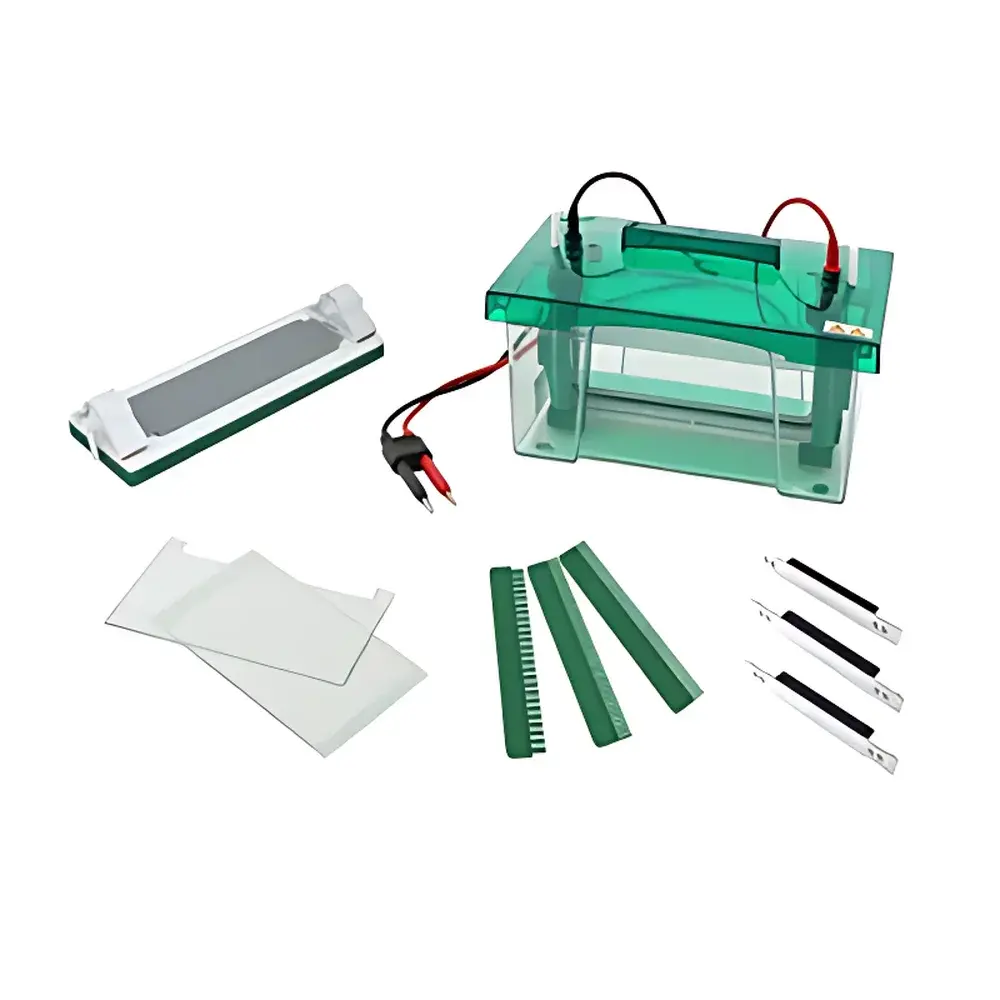
Junyi JY-CZ-B Vertical Electrophoresis Tank
| Brand | Junyi |
|---|---|
| Origin | Beijing, China |
| Model | JY-CZ-B |
| Instrument Type | Protein Electrophoresis Apparatus |
| Gel Dimensions (W×L) | 186 × 95 mm |
| Gel Thickness | 1.0 mm |
| Number of Gels | 1–2 |
| Sample Capacity | 104 wells (with 1.0 mm thickness) |
| Buffer Volume | ~2200 mL |
| External Dimensions (L×W×H) | 300 × 190 × 129 mm |
| Net Weight | 4.1 kg |
| Gel Plate Dimensions (W×L) | 216 × 110 mm |
| Safety Feature | Lid-activated power cutoff |
| Optional Accessory | External cooling circulator interface |
Overview
The Junyi JY-CZ-B Vertical Electrophoresis Tank is an engineered platform for high-reproducibility polyacrylamide gel electrophoresis (PAGE), specifically optimized for analytical separation of proteins and nucleic acid fragments—including SSR (Simple Sequence Repeat) amplification products. Based on the classic vertical slab-gel configuration, it operates on the principle of electrophoretic mobility under a controlled DC electric field, where charged biomolecules migrate through a porous polyacrylamide matrix at rates inversely proportional to their molecular size and charge-to-mass ratio. Designed as an evolution of the JX series, the JY-CZ-B integrates in-situ gel casting functionality—eliminating post-casting handling, agarose sealing steps, and inter-device transfer—thereby reducing procedural variability and contamination risk. Its rigid acrylic chamber, precision-machined electrode assembly, and thermally stable buffer reservoir support consistent migration kinetics across repeated runs, meeting core requirements for qualitative and semi-quantitative analysis in academic, diagnostic, and QC laboratories.
Key Features
- In-situ gel casting system with integrated comb alignment guides and leak-proof sealing mechanism—enables direct polymerization within the electrophoresis tank without gel removal or repositioning.
- Dual-gel capability (1–2 gels simultaneously) with standardized 186 × 95 mm separation area and 1.0 mm uniform thickness—ensures reproducible resolution and inter-gel comparability.
- 104-well sample capacity (compatible with standard 1.0 mm thick gels), supported by ergonomic sample loading aid: transparent comb guide with high-contrast background coloration and fixed-position alignment markers.
- Safety-engineered lid interface featuring automatic high-voltage circuit interruption upon lid opening—compliant with IEC 61010-1 electrical safety standards for laboratory equipment.
- Optimized thermal management: large-volume (~2200 mL) buffer chamber provides stable pH buffering and passive heat dissipation; optional external cooling port enables integration with certified recirculating chillers (e.g., Julabo, Thermo Scientific) for temperature-sensitive applications.
- Modular design with removable electrode assemblies and autoclavable components—facilitates cleaning, maintenance, and long-term calibration stability.
Sample Compatibility & Compliance
The JY-CZ-B supports standard SDS-PAGE, native PAGE, and discontinuous Tris-Glycine buffer systems. It accommodates common acrylamide concentrations (8–20%) and gradient gels when used with compatible casting accessories. The system is routinely deployed in SSR fragment analysis workflows per ISO/IEC 17025-accredited protocols and aligns with general Good Laboratory Practice (GLP) principles for documentation of gel preparation, run parameters, and result traceability. While not FDA 21 CFR Part 11–certified as a standalone unit, its operational transparency—combined with manual logbook or LIMS-integrated recordkeeping—supports audit readiness in regulated environments requiring evidence of method consistency and operator accountability.
Software & Data Management
The JY-CZ-B is a hardware-only electrophoresis platform and does not include embedded firmware or proprietary software. All operational parameters—including voltage, current, and run duration—are externally controlled via compatible power supplies (e.g., Junyi JY-300E or equivalent constant-voltage/constant-current sources). Users maintain full control over protocol documentation using standard laboratory notebooks or electronic lab notebooks (ELNs) compliant with ALCOA+ data integrity principles. Buffer composition, gel percentage, sample loading volume, and run conditions are manually recorded prior to each electrophoresis cycle—ensuring full traceability and alignment with ISO/IEC 17025 clause 7.5 on technical record requirements.
Applications
- High-resolution separation of protein subunits in SDS-PAGE for molecular weight estimation and purity assessment.
- SSR marker profiling in plant and animal genetics, including allele sizing and heterozygosity screening.
- Verification of PCR product integrity and specificity following amplification of microsatellite loci.
- Native gel electrophoresis for functional protein complex analysis under non-denaturing conditions.
- Preparative electrophoresis for downstream extraction of resolved bands (e.g., electroelution or passive diffusion).
- Training and teaching labs requiring robust, low-maintenance vertical electrophoresis infrastructure.
FAQ
Does the JY-CZ-B support gradient gels?
Yes—when used with appropriate gradient mixers and casting combs, the tank accommodates linear or stepwise acrylamide gradients across the 186 × 95 mm gel area.
What power supply is recommended for optimal performance?
A programmable constant-voltage/constant-current supply rated for ≥300 V and ≥500 mA output is recommended; compatibility with Junyi JY-300E and similar models has been verified.
Is the tank compatible with precast gels?
Yes—the internal dimensions and electrode spacing are compatible with commercially available precast polyacrylamide gels measuring 186 × 95 mm.
Can the unit be sterilized?
All non-electrical components—including the main chamber, glass plates, and combs—are autoclavable at 121°C for 20 minutes; electrodes must be disassembled and cleaned chemically per manufacturer guidelines.
What is the maximum recommended run time at 200 V?
Under standard SDS-PAGE conditions (12% gel, Tris-Glycine buffer), continuous operation up to 90 minutes is typical; extended runs require active cooling to maintain gel integrity and band sharpness.




