
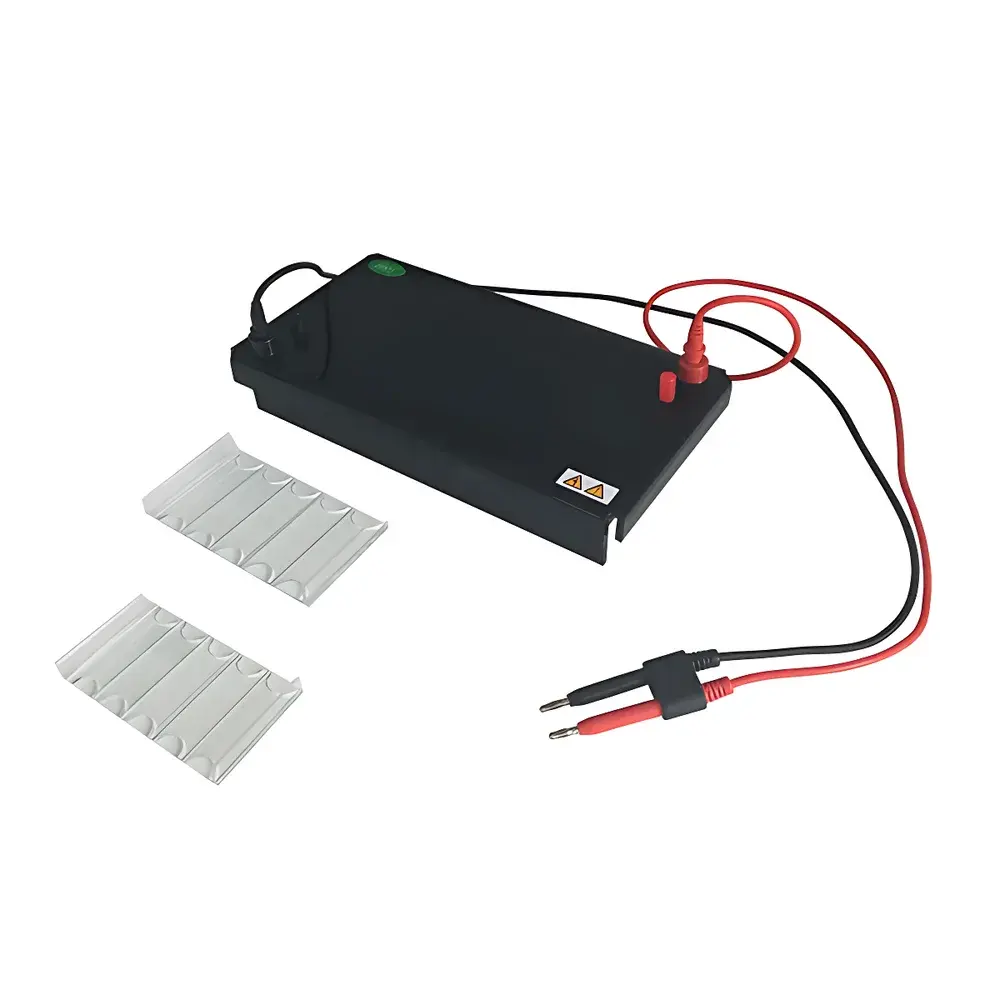
Junyi JY-SC10 Comet Assay Electrophoresis Chamber
| Brand | Junyi |
|---|---|
| Origin | Beijing, China |
| Manufacturer Type | Authorized Distributor |
| Product Category | Domestic |
| Model | JY-SC10 |
| Instrument Type | Comet Assay Electrophoresis Chamber |
| Slide Capacity | 10 microscope slides |
| Buffer Volume | 400 mL |
| Dimensions (L×W×H) | 365 × 165 × 55 mm |
| Net Weight | 1.2 kg |
| Safety Feature | Lid-activated power cutoff |
| Optional Accessory | External recirculating chiller for temperature control |
| Electrode Assembly | Removable and serviceable electrode holder |
Overview
The Junyi JY-SC10 Comet Assay Electrophoresis Chamber is a purpose-engineered platform for single-cell gel electrophoresis (SCGE), widely recognized as the comet assay—a standardized technique for quantifying DNA strand breaks and alkali-labile sites in individual eukaryotic cells. Designed in accordance with internationally accepted comet assay protocols (e.g., OECD Test Guideline 489, ISO 21427-1), the JY-SC10 provides a controlled, low-UV environment essential for minimizing artifactual DNA damage during electrophoresis. Its compact, benchtop architecture integrates structural features that support reproducible sample handling, consistent electric field distribution, and operator safety—critical parameters for genotoxicity screening in pharmaceutical development, environmental toxicology, and radiation biology laboratories.
Key Features
- Optimized chamber geometry ensuring uniform electric field strength across all 10 microscope slides, supporting high inter-slide reproducibility in tail moment and % DNA in tail measurements.
- Light-tight enclosure with opaque lid and UV-blocking gasketing to prevent ambient UV exposure during lysis, unwinding, and electrophoresis—reducing background DNA degradation and improving assay fidelity.
- Lid-integrated safety interlock system that automatically de-energizes the high-voltage circuit upon lid opening, compliant with IEC 61010-1 requirements for laboratory electrical equipment.
- Modular electrode assembly with corrosion-resistant platinum or stainless-steel electrodes; designed for rapid disassembly, cleaning, and replacement without tools—minimizing downtime during routine maintenance.
- Standardized buffer reservoir (400 mL capacity) compatible with common alkaline (pH >13) and neutral electrophoresis buffers; accommodates both horizontal and vertical orientation of slides depending on protocol requirements.
- Optional integration with external recirculating chillers (e.g., Julabo F25 or similar) to maintain buffer temperature between 0–4 °C during extended electrophoresis runs—critical for preserving DNA integrity under alkaline conditions.
Sample Compatibility & Compliance
The JY-SC10 supports standard 25 × 75 mm microscope slides pre-coated with normal-melting-point (NMP) or low-melting-point (LMP) agarose, accommodating both embedded cell suspensions (e.g., peripheral blood lymphocytes, hepatocytes, or cultured cell lines) and tissue-derived nuclei. It is validated for use with standard comet assay workflows including lysis (2–24 h at 4 °C), alkaline unwinding (20–60 min), and electrophoresis (20–30 min at 0.7–1 V/cm). The device conforms to GLP-aligned operational practices and is routinely deployed in laboratories adhering to OECD, ISO, and EFSA guidance documents for in vitro genotoxicity testing. While not FDA-cleared as a diagnostic device, its design facilitates traceable, auditable assay execution suitable for regulatory submission packages requiring instrument qualification data.
Software & Data Management
As a hardware-only electrophoresis chamber, the JY-SC10 does not include proprietary software or onboard data acquisition. It is fully interoperable with industry-standard comet analysis platforms—including TriTek CometScore™, Kinetic Imaging Komet 7, or open-source alternatives such as OpenComet (ImageJ plugin)—enabling automated scoring of tail length, tail intensity, olive tail moment, and other ICH-compliant endpoints. Users are advised to pair the chamber with a calibrated high-resolution fluorescence imaging system (e.g., Olympus BX53 or Zeiss Axio Imager) equipped with appropriate filter sets (e.g., FITC/TRITC dual-band) and CCD/CMOS sensors capable of ≥12-bit dynamic range for quantitative image capture.
Applications
- Genotoxicity assessment of novel chemical entities in preclinical drug development programs.
- Environmental monitoring of aquatic or soil contaminants using sentinel organisms (e.g., fish erythrocytes, earthworm coelomocytes).
- Radiation biodosimetry studies evaluating DNA repair kinetics post-ionizing exposure.
- Nutritional intervention trials assessing oxidative DNA damage modulation by antioxidants or phytochemicals.
- Quality control of cryopreserved cell banks where baseline DNA integrity must be established prior to banking.
FAQ
What voltage and current ranges are supported?
The JY-SC10 is a passive electrophoresis chamber and requires an external DC power supply. It is compatible with standard laboratory power supplies delivering 0–300 V and 0–500 mA, typical for alkaline comet assays operated at 0.7–1.0 V/cm.
Is the chamber compatible with neutral comet assay protocols?
Yes—its electrode spacing and buffer volume support both alkaline (pH >13) and neutral (pH 9.0) electrophoresis conditions, provided appropriate buffer composition and run time adjustments are applied per ISO 21427-1 Annex A.
Can the JY-SC10 be sterilized for aseptic cell processing?
The chamber body is constructed from chemical-resistant ABS plastic and may be surface-decontaminated with 70% ethanol or 0.5% sodium hypochlorite; autoclaving is not recommended due to thermal limitations of the material.
Does Junyi provide IQ/OQ documentation templates?
Junyi supplies basic technical specifications and mechanical drawings upon request; users are responsible for developing site-specific installation and operational qualification protocols aligned with internal quality systems and regulatory expectations.
What slide brands or agarose types are validated for use?
No proprietary slide or agarose is required; the chamber accepts standard frosted-end or plain glass slides and has been verified with Lonza Seakem LE, Bio-Rad MetaPhor, and Sigma-Aldrich Low EEO agaroses across multiple independent lab validations.
Related Products




