
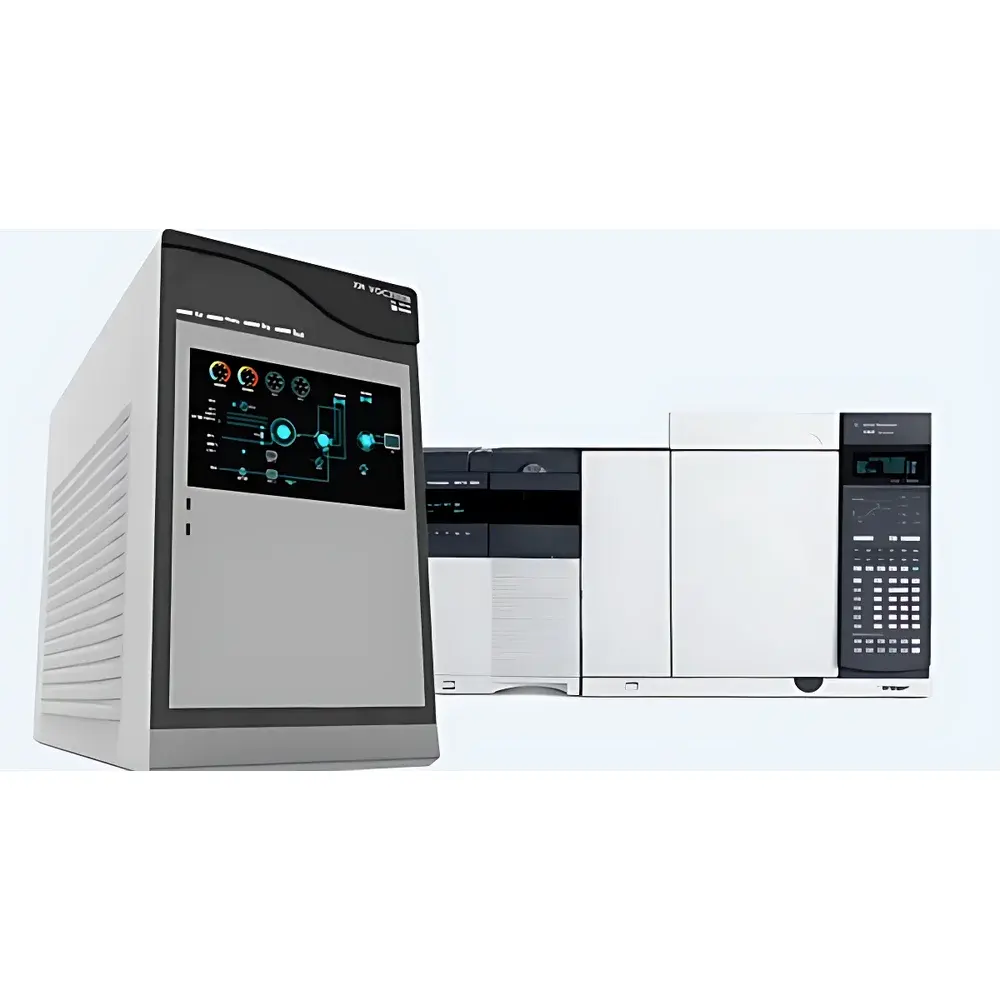
SAIL HERO XHVOC6000 Online Atmospheric Volatile Organic Compounds Analyzer
| Brand | SAIL HERO |
|---|---|
| Origin | Sichuan, China |
| Manufacturer Type | Manufacturer |
| Product Category | Domestic |
| Model | XHVOC6000 |
| Detection Principle | Gas Chromatography-Mass Spectrometry (GC-MS) |
| Instrument Type | Online Analyzer |
| Typical Configuration | Multi-component VOC Monitoring System |
Overview
The SAIL HERO XHVOC6000 is a fully automated, online atmospheric volatile organic compounds (VOCs) analyzer engineered for continuous, unattended monitoring of ambient air. It integrates thermal desorption sampling with high-resolution gas chromatography-mass spectrometry (GC-MS) detection to deliver precise qualitative and quantitative analysis of trace-level VOCs in real-world environmental matrices. The system employs a dual-stage thermal desorption module coupled with electronic cooling technology to achieve efficient capture, concentration, and focused injection of target analytes—enabling robust sensitivity across a broad volatility range (C₂–C₁₂). Designed for regulatory-grade compliance and long-term field deployment, the XHVOC6000 supports 24/7 operation with minimal manual intervention, making it suitable for urban air quality networks, industrial fence-line monitoring, and regional background stations.
Key Features
- High-Inertness Flow Path: Entire sample introduction and transfer path constructed from SilcoNert®-treated stainless steel and fused silica components to minimize adsorption, catalytic degradation, or surface reactivity—critical for labile compounds including aldehydes, terpenes, and reactive halogenated VOCs.
- Full-Path Temperature Control: Heated zones maintained at ≥150 °C throughout the sampling line, trap, transfer lines, and GC inlet eliminate cold spots and prevent condensation losses of semi-volatile organic compounds (SVOCs) such as naphthalene, biphenyl, and alkyl benzenes.
- Multi-Analyte Capability: Simultaneous quantification of >100 VOCs and SVOCs per analytical cycle—including aliphatic hydrocarbons (C₂–C₁₂), BTEX, chlorinated solvents, oxygenates (e.g., acetone, MEK), sulfur-containing species (e.g., CS₂, DMS), and polar compounds—within a single GC-MS method.
- Dry-Purge Functionality: Integrated dry-purge step prior to desorption removes residual moisture from the sorbent tube, preventing ice formation during cryo-focusing and ensuring consistent trap efficiency and chromatographic reproducibility under high-humidity conditions.
- Enhanced Identification Confidence: Equipped with a quadrupole mass spectrometer featuring NIST/EPA spectral libraries, automated deconvolution algorithms, and retention index matching—enabling reliable identification of co-eluting isomers and structural analogs without requiring prior method development.
- Unknown Compound Screening: Full-scan MS acquisition mode (m/z 35–300) allows retrospective analysis of untargeted peaks; spectral matching and fragmentation pattern interpretation support rapid identification of emerging contaminants or incident-related emissions.
- Retention Time Stability: Precision temperature-controlled oven and pressure-programmed carrier gas delivery ensure <±0.02 min retention time repeatability over 30-day operational cycles—reducing recalibration frequency and supporting long-term trend analysis.
Sample Compatibility & Compliance
The XHVOC6000 accepts direct ambient air sampling via integrated mass flow controller and heated inlet manifold. It is fully compatible with standard EPA TO-17 sorbent tubes (e.g., Tenax TA/Carbograph 1TD), as well as certified whole-air sampling containers including SUMMA®-polished canisters and Tedlar® bags. Method validation aligns with U.S. EPA Compendium Method TO-15A and EU EN 14662 for ambient VOC measurement. Data integrity features—including audit trails, user access controls, and electronic signatures—support compliance with ISO/IEC 17025:2017, GLP, and FDA 21 CFR Part 11 requirements when deployed in accredited laboratories or regulatory monitoring programs.
Software & Data Management
The instrument is operated via SAIL HERO’s proprietary VOCView™ software platform, which provides intuitive method setup, real-time chromatogram visualization, automated peak integration, and customizable reporting templates. All raw data files (including GC-MS scans, calibration curves, and system logs) are stored in vendor-neutral formats (e.g., NetCDF, mzML) for third-party reprocessing. Remote diagnostics, firmware updates, and alarm notifications (e.g., low trap efficiency, column degradation, vacuum failure) are supported via secure TLS-encrypted Ethernet or 4G LTE connectivity. Audit trail records capture operator actions, parameter changes, and QC event timestamps—fully traceable for regulatory review.
Applications
- Ambient air quality monitoring networks (urban, suburban, rural, background sites)
- Industrial emission source characterization and fence-line compliance verification
- Indoor air quality assessment in commercial buildings and manufacturing facilities
- Emergency response and accidental release investigation (e.g., chemical spills, refinery incidents)
- Research on atmospheric chemistry, ozone precursor speciation, and secondary organic aerosol (SOA) formation potential
- Long-term trend analysis for national air toxics programs and health risk assessments
FAQ
Does the XHVOC6000 support EPA Method TO-15A compliance?
Yes—the system meets all hardware, calibration, and data reporting requirements specified in EPA TO-15A for ambient air VOC analysis, including minimum detection limits, retention time stability, and library match criteria.
Can the instrument analyze semi-volatile organic compounds (SVOCs)?
Yes—through optimized trap desorption parameters and extended GC temperature programming, the system reliably detects and quantifies SVOCs up to ~300 °C boiling point, including polycyclic aromatic hydrocarbons (PAHs) and phthalate esters.
Is remote operation and data retrieval possible?
Yes—VOCView™ software enables full remote control, live data streaming, and secure cloud-based data backup through configurable network protocols.
What maintenance intervals are recommended for routine operation?
Sorbent traps require replacement every 3–6 months depending on ambient dust loading; GC columns should be conditioned monthly and replaced annually; MS ion source cleaning is recommended quarterly or after high-matrix samples.
Does the system support internal standard addition and surrogate recovery tracking?
Yes—automated liquid standard injection and vapor-phase surrogate spiking are programmable within each analysis sequence, enabling real-time correction for breakthrough, desorption efficiency, and matrix effects.







