
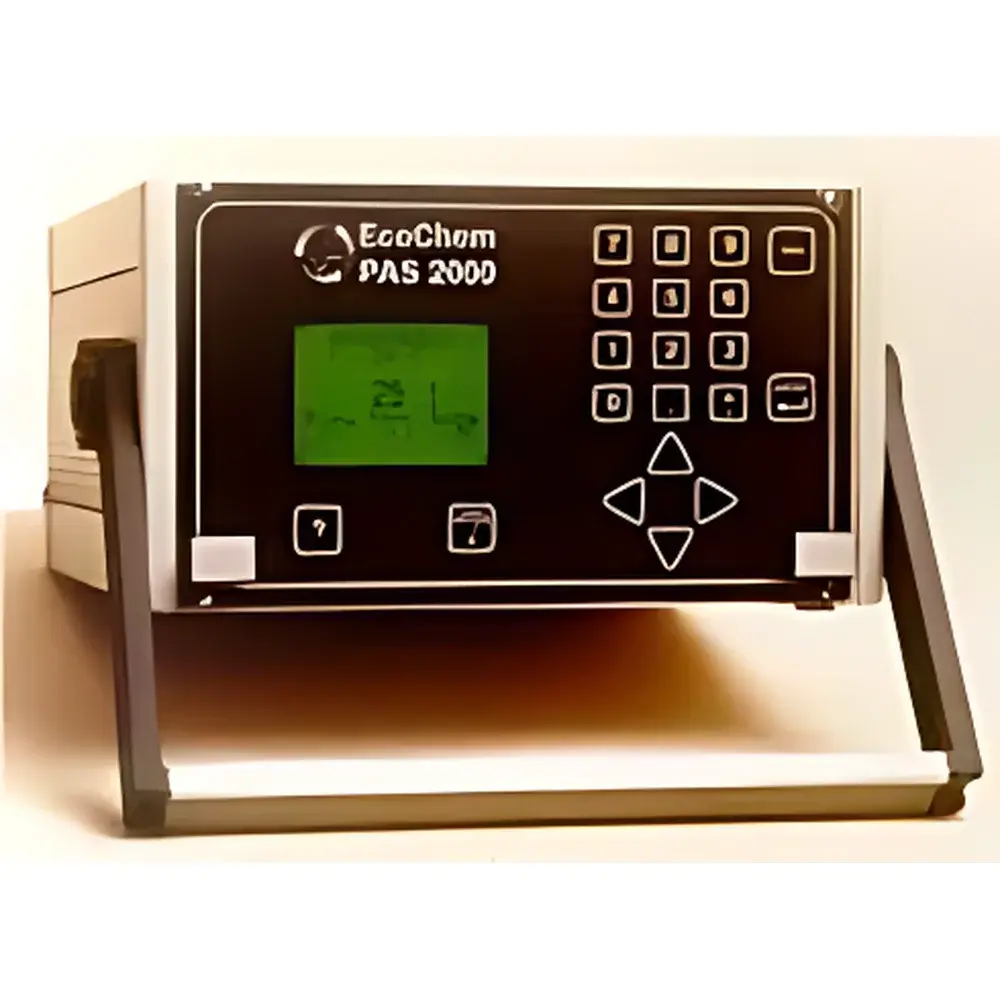
EcoChem PAS2000 STD Photoionization Aerosol Sensor for Real-Time Particulate-Bound PAH Monitoring
| Brand | EcoChem |
|---|---|
| Origin | USA |
| Model | PAS2000 STD |
| Instrument Type | Aerosol Detector |
| Detection Principle | UV Photoionization of Particle-Bound Polycyclic Aromatic Hydrocarbons (PAHs) |
| Measurement Range | 0–100 µg/m³ (PAH), 0–100 µg/m³ (Elemental Carbon), 0–100 pA (Ion Current) |
| Detection Limit | 3 ng total adsorbed PAH |
| Sensitivity | 0.3–1 µg/m³ PAH per pA |
| Response Time | <10 s (adjustable) |
| Flow Rate | 2 LPM |
| Operating Temperature | 5–40 °C |
| Data Storage | 8,000 points (timestamped) |
| Display | 2×16-character LED |
| Output Interfaces | RS-232, 0–10 V, 0–20 mA, or 4–20 mA |
| Dimensions | 68 × 175 × 124 mm |
| Weight | 9 kg |
| Power Supply | 220 V AC / 50 Hz |
| Optional Heated Sampling Probe | 5–300 °C |
| Dilution Ratios | 0.05, 0.1, 0.2 (with mass flow controller and critical orifice) |
Overview
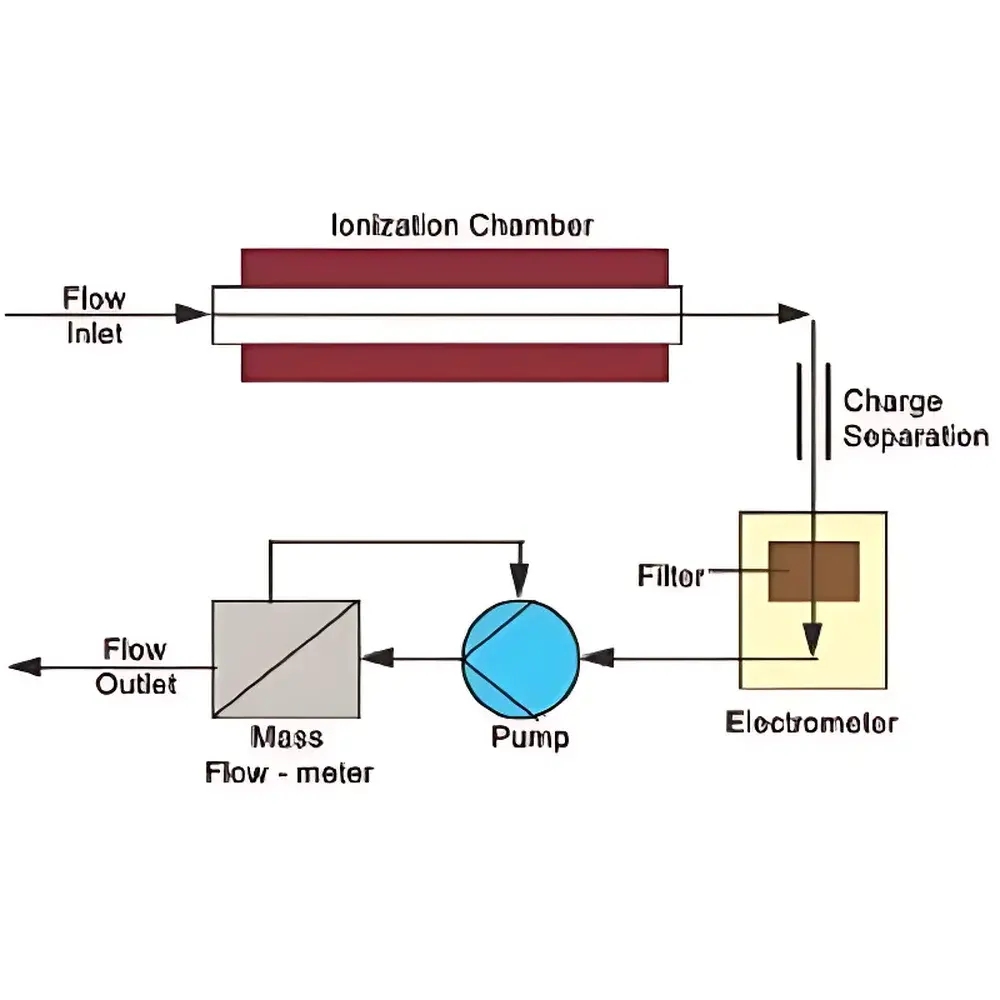
The EcoChem PAS2000 STD is a field-deployable, real-time photoionization aerosol sensor engineered for the quantitative measurement of particulate-bound polycyclic aromatic hydrocarbons (PAHs) in ambient and source emissions environments. Since its introduction in 1991, it has served as a foundational instrument in atmospheric chemistry and occupational exposure assessment—leveraging vacuum ultraviolet (VUV) photoionization physics to selectively ionize only PAH-coated carbonaceous aerosols while remaining inert to gaseous species and non-carbonaceous particulates. The system operates on the principle of resonant excitation: a pulsed excimer lamp emits narrowband UV radiation (typically at 172 nm, corresponding to ~7.2 eV photon energy), which lies above the ionization potentials of most 3–6 ring PAHs (e.g., phenanthrene: 7.89 eV; pyrene: 7.44 eV; benzo[a]pyrene: 7.15 eV) but below those of common atmospheric gases (N₂: 15.6 eV; O₂: 12.1 eV) and inorganic aerosols. Ionized particles are then drawn through an electrostatic precipitator and quantified via a precision electrometer, generating a current signal linearly proportional to total adsorbed PAH mass concentration (ng/m³ to µg/m³). Unlike chromatographic methods requiring offline extraction and analysis, the PAS2000 STD delivers continuous, second-resolution data without consumables or calibration gases—making it suitable for long-term unattended monitoring in regulatory, research, and industrial hygiene applications.
Key Features
- Patented excimer lamp-based photoionization technology enabling selective, real-time detection of particle-adsorbed PAHs with no chemical reagents or carrier gases
- Optimized sensitivity for carcinogenic high-molecular-weight PAHs (≥3 rings), including fluoranthene, pyrene, benz[a]anthracene, and benzo[a]pyrene analogues
- Integrated heated sampling probe (5–300 °C) with mass flow control and calibrated critical orifices for precise dilution (0.05, 0.1, 0.2) during source characterization
- Onboard microprocessor-controlled data acquisition with storage capacity for up to 8,000 timestamped records and internal memory retention of 2,500 operational logs
- Ruggedized mechanical design (9 kg, compact footprint) validated for transport, vibration resistance, and operation across diverse field conditions (5–40 °C)
- Multi-modal analog and digital outputs (RS-232, 0–10 V, 0–20 mA, 4–20 mA) compatible with SCADA systems, data loggers, and central environmental monitoring platforms
Sample Compatibility & Compliance
The PAS2000 STD is designed for direct analysis of airborne aerosols collected from ambient air, stack effluents, combustion plumes, and indoor environments. It accepts undiluted or pre-diluted samples delivered via stainless-steel or quartz sampling lines and accommodates both filter-based and continuous-flow configurations. Its measurement protocol aligns with the conceptual framework of EPA Method TO-13A (for PAH analysis in particulate matter) and supports compliance-oriented workflows under ISO 12103-1 (test dust standards), ASTM D6245 (indoor air quality assessment), and EU Directive 2004/107/EC (arsenic, cadmium, mercury, nickel and PAHs in ambient air). While not a certified reference method per se, the instrument’s traceable response function and documented intercomparison studies (e.g., against GC-MS in urban traffic and biomass burning scenarios) enable its use in GLP-compliant exposure assessments and Tier 2 source apportionment modeling. All firmware and data handling routines support audit-ready metadata tagging—including operator ID, location GPS coordinates (when externally interfaced), and environmental parameters (T, RH, flow)—facilitating alignment with FDA 21 CFR Part 11 requirements when deployed in pharmaceutical or medical waste incineration settings.
Software & Data Management
Data acquisition and visualization are managed through EcoChem’s PC-compatible desktop software suite, which supports real-time telemetry, remote configuration, and post-processing export to CSV, Excel (.xlsx), and MATLAB (.mat) formats. The software implements configurable averaging intervals (1 s to 60 min), alarm thresholds with email/SMS notification triggers (via optional gateway), and automatic zero-check routines using modulated excimer lamp chopping to suppress dark-current drift and background interference—particularly critical near combustion sources where broadband IR/UV emission may otherwise saturate detectors. Raw ion current (pA), calculated PAH mass concentration (µg/m³), elemental carbon equivalent (µg/m³ EC), and auxiliary sensor inputs (flow, temperature, pressure) are time-synchronized and stored with millisecond-level timestamp resolution. Exported datasets include full calibration history, lamp duty cycle logs, and diagnostic flags for maintenance scheduling—ensuring full traceability required for regulatory reporting and peer-reviewed publication.
Applications
- Ambient air quality monitoring at traffic corridors, highway tunnels, urban intersections, and parking structures
- Indoor air assessment in residential and commercial buildings with combustion appliances (kerosene heaters, wood stoves, fireplaces) and tobacco smoke exposure
- Occupational health surveillance in refineries, coke ovens, aluminum smelters, steel foundries, and asphalt production facilities
- Source characterization of biomass burning, wildfire plumes, tire pyrolysis, agricultural residue combustion, and municipal/medical waste incineration
- Mobile platform deployments on vehicles, drones, or backpack systems for spatial mapping of PAH hotspots (e.g., Los Angeles freeway studies, Quito urban surveys)
- Process validation and emission control optimization in catalytic cracking units, thermal oxidizers, and aftertreatment systems for diesel/gasoline engines
FAQ
Does the PAS2000 STD identify individual PAH compounds?
No—it reports total photoionizable PAH mass concentration adsorbed onto carbonaceous aerosol surfaces. Speciation requires complementary techniques such as GC-MS or HPLC-fluorescence.
Can it distinguish between freshly emitted soot and aged, oxidized particles?
Not directly; however, temporal correlation with co-located BC (black carbon), CO, and NOx measurements enables inference of emission age and mixing state in source apportionment models.
Is routine calibration required?
Yes—field calibration using standard PAH-coated aerosol generators (e.g., phenanthrene-doped DEHS) is recommended every 3–6 months, depending on usage intensity and matrix complexity.
What maintenance does the excimer lamp require?
Excimer lamps have a typical service life of 1,000–2,000 hours. Replacement is user-performed and requires no optical realignment; lamp status is continuously monitored and reported in system diagnostics.
Is the PAS2000 STD compliant with any international air quality standards?
It is not a certified reference method, but its performance characteristics meet data quality objectives outlined in WHO Air Quality Guidelines (AQG) for carcinogenic PAH surrogates and supports implementation of EU and U.S. NAAQS-related exposure assessment frameworks.
Related Products







