
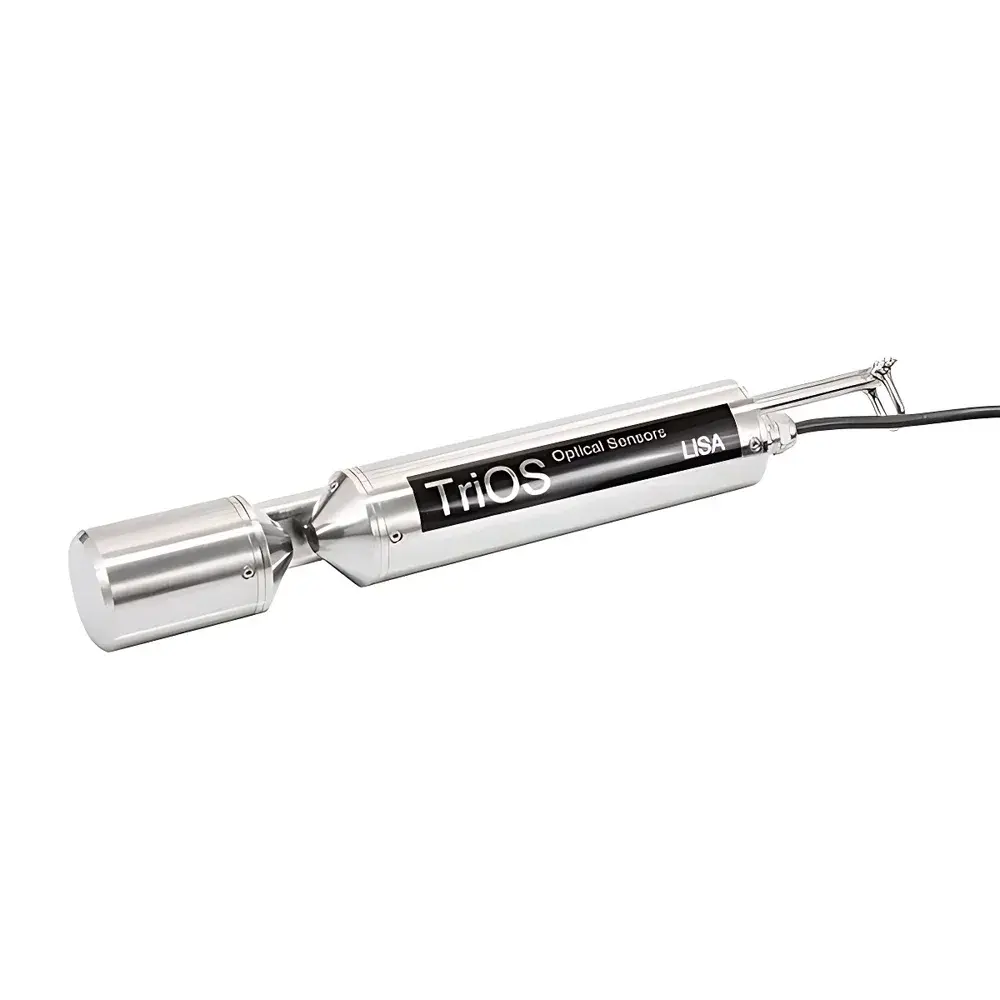
TriOS LISA SAC 254 UV-Vis Optical Sensor
| Brand | TriOS |
|---|---|
| Origin | Germany |
| Model | LISA SAC 254 |
| Measurement Principle | UV absorbance at 254 nm (SAC₂₅₄) and visible reference at 530 nm |
| Light Source | Dual LED (254 nm UV-C, 530 nm green) |
| Detector | Filtered photodiode |
| Path Length Options | 1, 2, 5, 10, or 50 mm |
| Output Interfaces | Ethernet (TCP/IP), RS-232/RS-485 (Modbus RTU, TriOS protocol), 4–20 mA analog |
| Turbidity Compensation | Internal dual-wavelength correction (530 nm channel) |
| Accuracy | ±0.2% FS |
| Response Time | 4 s |
| Measurement Interval | 2 s |
| Data Logging Capacity | 2 MB (T100 format) |
| Operating Temperature | 2–40 °C (sample & ambient) |
| Storage Temperature | −20–80 °C |
| Flow Velocity Range | 0.1–10 m/s |
| Max. Pressure (SubConn) | 30 bar |
| Max. Pressure (Fixed Cable) | 3 bar |
| Max. Pressure (Flow Cell) | 1 bar (2–4 L/min) |
| Enclosure Material | Stainless Steel 1.4571 / 1.4404 or Titanium Grade 3.7035 |
| IP Rating | IP68 |
| Power Supply | 12–24 VDC (±10%) |
| Power Consumption | ≤1 W |
| Dimensions (10 mm path) | 300 mm × 48 mm |
| Weight (10 mm, stainless steel) | 1.6 kg |
| Compliant With | ISO 7027 (turbidity correlation), ASTM D5540 (SAC-based organic carbon estimation), EN ISO 8466-1 (calibration linearity), FDA 21 CFR Part 11-ready data logging (via TriOS software) |
Overview
The TriOS LISA SAC 254 UV-Vis Optical Sensor is an in-situ, non-contact absorption photometer engineered for continuous, reagent-free quantification of dissolved organic matter (DOM) in aqueous environments. It operates on the principle of specific ultraviolet absorbance at 254 nm (SAC254), a well-established surrogate parameter correlated with spectral absorbance coefficient, which reflects aromatic carbon content in natural and wastewater matrices. The sensor integrates a second optical channel at 530 nm to enable real-time, internal turbidity compensation—eliminating interference from suspended solids without mechanical moving parts or external calibration standards. Its dual-LED architecture (254 nm UV-C + 530 nm visible) ensures stable, drift-resistant operation over extended deployment cycles. Designed for permanent submersion or inline flow-cell integration, the LISA SAC 254 delivers trace-level sensitivity across five selectable optical path lengths (1–50 mm), enabling precise adaptation to low-absorbance drinking water or high-absorbance industrial effluent applications.
Key Features
- UV-LED light source (254 nm) with >10,000-hour lifetime and minimal thermal drift—no mercury lamps or warm-up delays
- Nano-coated sapphire optical window combined with optional compressed-air purge system for fouling resistance in high-biofouling or high-sediment environments
- G2 digital interface supporting seamless interoperability with TriOS controllers (e.g., RAMSES, OCEANUS), handheld readers (TRIOS Handheld), and third-party SCADA/DCS platforms via Modbus RTU or TCP/IP
- Configurable analog output (4–20 mA) for direct integration into legacy PLC systems without protocol translation
- Titanium (3.7035) or marine-grade stainless-steel (1.4571 / 1.4404) housing rated IP68 and pressure-resistant up to 30 bar (SubConn variant)
- Onboard calculation of derived parameters—including BODeq, CODeq, and TOCeq—using application-specific calibration curves validated per ISO 8466-1 linearity protocols
- Low-power design (<1 W) enabling solar- or battery-powered deployments in remote monitoring stations
Sample Compatibility & Compliance
The LISA SAC 254 is validated for use in raw surface water, treated drinking water, wastewater influent/effluent, seawater (with titanium housing), and UV disinfection process streams. Its optical design conforms to ISO 7027 for turbidity-related correction methodology and supports traceable correlation to laboratory-based UV254 spectrophotometry (ASTM D5540 Annex A3). All firmware and data logging functions comply with GLP/GMP data integrity requirements: timestamped measurements include checksums, audit trails, and configurable user access levels. When paired with TriOS’s certified software suite (e.g., TriOS View, TriOS Cloud), the system meets FDA 21 CFR Part 11 criteria for electronic records and signatures—including operator authentication, change history, and immutable raw-data archiving.
Software & Data Management
TriOS provides native configuration and visualization tools compatible with Windows, macOS, and Linux. The embedded T100 data logger stores up to 2 MB of time-stamped, parameter-tagged records (SAC254, CODeq, BODeq, TOCeq, turbidity-corrected absorbance, temperature, status flags) with configurable sampling intervals down to 2 seconds. Data export supports CSV, XML, and industry-standard SDI-12-compatible formats. Remote firmware updates, diagnostic telemetry, and alarm thresholds (e.g., window fouling warning, signal saturation, temperature out-of-range) are managed via secure HTTPS or Modbus TCP. Integration with cloud-based platforms (e.g., AWS IoT Core, Microsoft Azure IoT Hub) is supported through MQTT or RESTful API gateways—enabling scalable fleet monitoring across distributed watershed networks.
Applications
- Real-time early-warning detection of organic contamination events in drinking water intakes
- Process optimization in UV disinfection systems—monitoring UV transmittance (UVT) and lamp fouling via SAC254 trend analysis
- Biological treatment performance tracking in activated sludge and MBR plants via BODeq dynamics
- TOC surrogate monitoring in pharmaceutical manufacturing water loops (PW, WFI) per USP guidance
- Regulatory compliance reporting for municipal wastewater discharge permits (e.g., EPA NPDES, EU Urban Wastewater Treatment Directive)
- Long-term DOM characterization in ecological research—lake eutrophication studies, riverine carbon flux modeling
FAQ
Does the LISA SAC 254 require periodic recalibration?
No routine recalibration is required under normal operating conditions. The dual-wavelength design and nano-coated window minimize drift; however, field verification using NIST-traceable UV-absorbing standards (e.g., potassium permanganate solutions) is recommended annually or after maintenance.
Can the sensor operate in seawater or brackish environments?
Yes—when equipped with titanium (3.7035) housing and SubConn wet-mateable connector, the LISA SAC 254 is rated for continuous immersion in saline media up to 30 bar pressure and chloride concentrations exceeding 20,000 mg/L.
How is turbidity compensation implemented physically?
The 530 nm reference channel shares the same optical path as the 254 nm measurement channel. Scattering effects from suspended particles attenuate both wavelengths proportionally; the instrument applies a real-time ratio-based correction algorithm—not a separate turbidity sensor—to isolate true UV absorbance.
Is the 4–20 mA output isolated and intrinsically safe?
The analog output is galvanically isolated and compliant with IEC 61000-6-2/6-4 EMC standards. For hazardous area installation (e.g., Zone 1), an externally certified safety barrier must be used—TriOS does not provide intrinsic safety certification for the base unit.
What flow velocity range ensures optimal measurement stability?
For laminar, bubble-free flow conditions, a minimum velocity of 0.3 m/s is recommended to prevent boundary layer formation on the optical window; maximum velocity is limited by mechanical stress and pressure drop—10 m/s is permissible only with reinforced flow cells and proper mounting alignment.







