
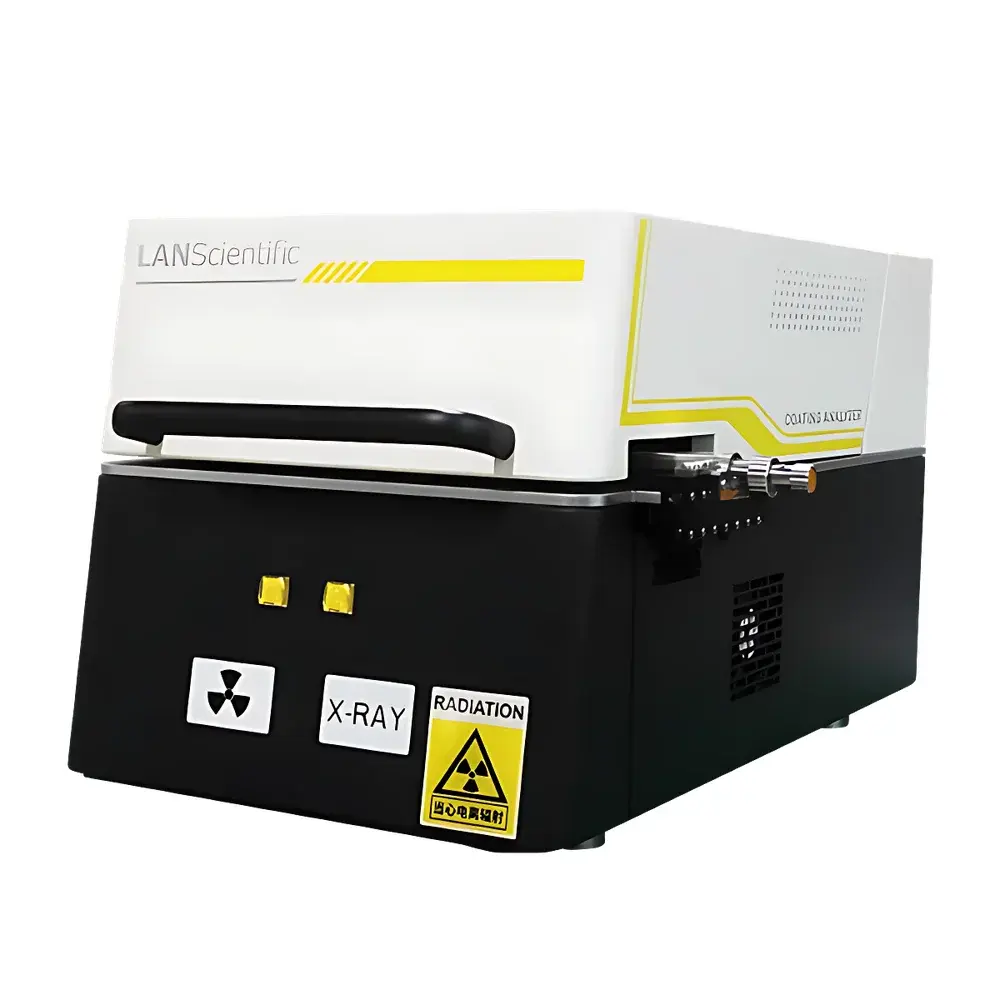
Brookfield ScopeX PC3 Benchtop X-Ray Fluorescence Coating Thickness Analyzer
| Brand | LANScientific |
|---|---|
| Origin | Jiangsu, China |
| Manufacturer Type | Manufacturer |
| Region of Origin | Domestic (China) |
| Model | ScopeX PC3 |
| Price | USD 1.00 |
Overview
The Brookfield ScopeX PC3 is a benchtop energy-dispersive X-ray fluorescence (EDXRF) coating thickness analyzer engineered for high-precision, non-destructive elemental quantification and multi-layer thickness measurement. Operating on the fundamental principle of X-ray fluorescence spectroscopy, the instrument irradiates the sample surface with a focused primary X-ray beam; characteristic secondary X-rays emitted from constituent elements are detected and spectrally resolved to determine both elemental composition and layer thicknesses via fundamental parameter (FP) modeling. Designed specifically for industrial process control and quality assurance laboratories, the ScopeX PC3 employs a downward-facing (bottom-illumination) optical geometry that eliminates manual focusing requirements and enables rapid positioning over irregular, recessed, or miniature components—making it especially suitable for high-mix, low-volume production environments where flexibility and repeatability are critical.
Key Features
- Downward-Facing Optical Configuration: Enables direct placement of samples on the stage without repositioning or alignment adjustments—ideal for automated workflow integration and operator-independent measurements.
- Muti-FP Quantitative Algorithm: A physics-based fundamental parameters software engine that accounts for matrix effects, absorption, and enhancement across multi-layer systems, delivering traceable thickness results without reliance on empirical calibration standards.
- Micro-Focused X-ray Source Option: Optional micro-spot X-ray tube (≤50 µm focal spot) supports spatially resolved analysis of fine features such as solder bumps, wire bond pads, or watch spring coatings.
- Motorized Multi-Channel Collimator & Filter System: Software-selectable collimators (100–1000 µm) and interference filters allow dynamic optimization of excitation conditions for diverse substrate/coating combinations—from Au/Ni/Cu on PCBs to Zn/Fe on automotive fasteners.
- Adjustable Zoom Distance Sensor: Integrated laser triangulation system provides real-time distance feedback (0–30 mm range), ensuring consistent geometric conditions for accurate fluorescence yield calculation—even in deep grooves or stepped topographies.
- Manual High-Resolution X-Y Stage: Precision-machined mechanical stage with 25 µm resolution facilitates repeatable micro-area targeting, supporting ISO 3497-compliant measurement site definition for statistical process control (SPC) reporting.
Sample Compatibility & Compliance
The ScopeX PC3 accommodates a broad spectrum of coated substrates—including metallic, ceramic, and polymer-based parts—with no requirement for conductive coating or vacuum environment. Its EDXRF architecture complies with ISO 3497:2022 (Metallic coatings — Measurement of coating thickness — X-ray spectrometric methods) and supports method validation per ASTM B568 and ASTM E1086. The system meets electromagnetic compatibility (EMC) requirements per IEC 61326-1 and radiation safety standards under IEC 61010-1. Data integrity features—including user access levels, audit trail logging, and electronic signature support—are configurable to align with GLP and GMP documentation practices, including FDA 21 CFR Part 11 readiness when deployed with validated software modules.
Software & Data Management
The proprietary ScopeX Analysis Suite provides intuitive workflow navigation, multi-layer stack modeling, and real-time spectral visualization. All measurement parameters—including tube voltage/current, dwell time, collimation, and filter selection—are stored with each result in a structured SQLite database. Export options include CSV, XML, and PDF reports compliant with ISO/IEC 17025 documentation requirements. Batch analysis mode enables automated processing of sequential measurements across multiple sites or samples, while SPC charting tools generate X-bar/R charts directly from thickness data for in-line quality monitoring. Raw spectra and FP model inputs are retained for full traceability and retrospective reprocessing.
Applications
The ScopeX PC3 is routinely deployed in R&D and QC labs serving electroplating facilities, precision machining suppliers, and OEMs in the automotive, aerospace, electronics, and jewelry sectors. Typical use cases include verification of Ni barrier layer thickness beneath Au flash on connector contacts; measurement of Cr(VI)-free trivalent chromium coatings on hydraulic fittings; quantification of Sn-Pb vs. lead-free solder thickness on flex circuits; and certification of rhodium plating uniformity on precious metal watch components. Its ability to resolve sub-micron layers on high-Z substrates (e.g., Cu/Ni/Au on brass) and accommodate complex geometries (e.g., threaded fasteners, turbine blade cooling holes) makes it a preferred tool for first-article inspection and PPAP submission support.
FAQ
Does the ScopeX PC3 require radioactive sources or vacuum operation?
No. It uses a sealed-tube X-ray generator and operates at atmospheric pressure—no licensing, shielding enclosures, or maintenance-intensive vacuum pumps are required.
Can it measure organic coatings such as paint or lacquer?
Yes, provided the coating contains detectable elements (e.g., Ti in TiO₂ pigments, Cr in corrosion-inhibiting primers); pure hydrocarbon films without elemental markers cannot be quantified by EDXRF.
Is calibration transfer possible between different ScopeX PC3 units?
Yes—using certified reference materials traceable to NIST or PTB, combined with FP-based normalization, ensures inter-instrument comparability within ±5% relative standard deviation for common coating systems.
What is the minimum measurable coating thickness?
Detection limits vary by element pair and matrix, but typical lower limits range from 0.01 µm for high-Z coatings (e.g., Au on Ni) to 0.1 µm for light-element systems (e.g., P on steel), assuming optimal counting statistics and measurement time.
How is measurement uncertainty estimated?
Uncertainty budgets follow ISO/IEC Guide 98-3 (GUM), incorporating contributions from counting statistics, FP model assumptions, stage positioning error, and source stability—automatically reported alongside each result.



