
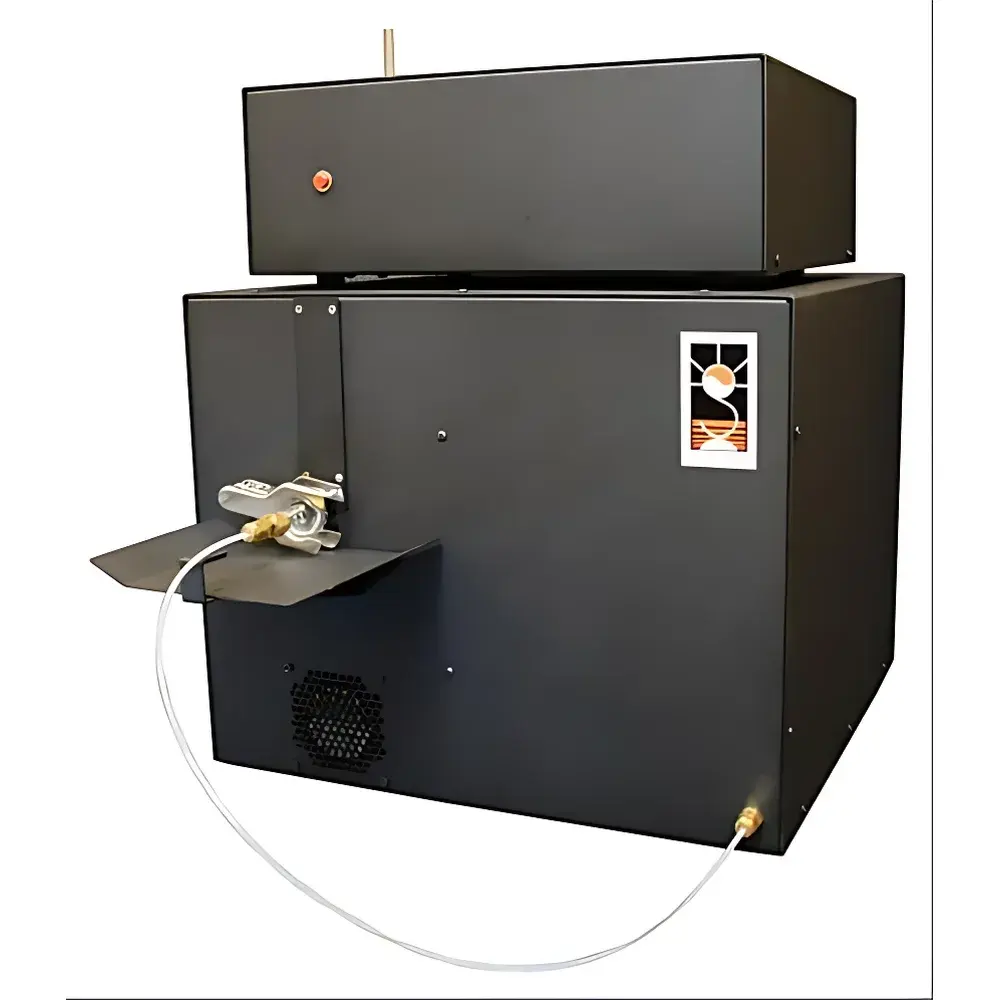
Sunset Lab Model 5L Organic Carbon/Elemental Carbon (OC/EC) Analyzer
| Brand | SAIL HERO |
|---|---|
| Origin | USA |
| Manufacturer | Sunset Laboratory, Inc. |
| Model | Model 5L |
| Instrument Type | Aerosol OC/EC Thermal-Optical Analyzer |
| Compliance | NIOSH Method 5040, IMPROVE_A, EUSAAR2, EPA STN |
| Detection Principle | Thermal-Optical Transmittance (TOT) with Flame Ionization Detection (FID) |
| Calibration Standards | NIST-traceable sucrose solution and certified gas standards |
| Data Output | OC (µgC/cm²), EC (µgC/cm²), CC (µgC/cm²) |
| Software | Sunset OC/EC Data Analysis Suite with audit trail, manual peak integration, and dual-mode (transmittance/reflection) charring correction |
Overview
The Sunset Lab Model 5L Organic Carbon/Elemental Carbon (OC/EC) Analyzer is a benchtop thermal-optical transmittance (TOT) instrument engineered for precise quantification of carbonaceous aerosol fractions in ambient, source, and occupational air samples. Designed and manufactured by Sunset Laboratory, Inc. — a U.S.-based pioneer in aerosol carbon analysis since 1984 — the Model 5L implements a rigorously validated two-phase thermal desorption protocol under controlled inert and oxidative atmospheres. Particulate matter collected on quartz fiber filters is subjected to stepwise heating in helium (for OC volatilization and charring) followed by helium/oxygen (for EC oxidation), with evolved carbon species quantified in real time via flame ionization detection (FID). A collimated laser beam continuously monitors optical attenuation through the filter substrate; the inflection point where laser transmittance recovers to its pre-analysis baseline defines the OC/EC split point — a physically grounded, instrumentally determined boundary critical for regulatory comparability and interlaboratory reproducibility.
Key Features
- Thermal-optical transmittance (TOT) architecture compliant with NIOSH Method 5040, IMPROVE_A, EUSAAR2, and EPA STN protocols
- Dual-atmosphere furnace system with independent mass flow controllers for He and He/O₂ gas delivery
- Integrated 633 nm laser photometer with real-time transmittance monitoring and optional reflectance mode selection
- High-sensitivity flame ionization detector (FID) calibrated using NIST-traceable sucrose solutions and certified CH₄-in-He standards
- Programmable temperature ramp profiles (up to 8 heating steps) supporting method customization and method validation
- Onboard thermocouple inputs for external temperature calibration verification
- Rugged, laboratory-grade construction with stainless-steel gas pathways and quartz furnace components for long-term stability
Sample Compatibility & Compliance
The Model 5L accepts standard 47 mm or 25 mm quartz fiber filters (e.g., Pallflex Tissuquartz QAT-UP) loaded with ambient, stack, or indoor aerosol samples. It meets data quality requirements for U.S. EPA Federal Reference Methods (FRMs) and Federal Equivalent Methods (FEMs) for carbonaceous aerosol speciation. Its analytical output satisfies reporting criteria under the IMPROVE network, the European Supersites for Atmospheric Research (EUSAAR), and occupational health surveillance programs aligned with OSHA and NIOSH guidelines. All hardware and software components support GLP-compliant operation, including electronic signatures, user access controls, and full audit trails per FDA 21 CFR Part 11 requirements.
Software & Data Management
The proprietary Sunset OC/EC Data Analysis Suite provides comprehensive instrument control, real-time visualization, and post-run evaluation. Raw FID signals and laser transmittance/reflectance curves are logged at 1 Hz resolution. The software automatically identifies the OC/EC split point using derivative-based algorithms applied to the optical signal; users may override this with manual integration or switch between transmittance- and reflectance-derived charring corrections. Quantitative results — OC (µgC/cm²), EC (µgC/cm²), and CC (µgC/cm²) — are exported to customizable ASCII text files compatible with statistical analysis platforms. Batch processing, calibration curve management, and report generation templates adhere to ISO/IEC 17025 documentation standards.
Applications
- Ambient air quality monitoring networks (e.g., IMPROVE, CASTNET, EMEP)
- Source apportionment studies using carbon ratios (e.g., OC/EC, EC/PM₂.₅)
- Indoor air and occupational exposure assessments per NIOSH 5040
- Method development and intercomparison exercises across research laboratories
- Validation of online OC/EC monitors (e.g., Sunset semi-continuous analyzers, DRI models)
- Carbon speciation in biomass burning, traffic, and industrial plume characterization
FAQ
What thermal-optical protocols does the Model 5L support?
NIOSH 5040, IMPROVE_A, EUSAAR2, EPA STN, and user-defined methods with fully configurable temperature ramps and gas switching logic.
How is the OC/EC split point determined?
Via real-time laser transmittance monitoring during thermal evolution; the algorithm identifies the point where optical signal recovery intersects the initial baseline — optionally adjustable using reflectance mode.
Is the instrument suitable for regulatory reporting?
Yes — it fulfills performance specifications for FRM/FEM designation and supports audit-ready data handling under GLP, GMP, and 21 CFR Part 11 frameworks.
What calibration standards are recommended?
NIST-traceable sucrose solutions for liquid calibration and certified CH₄-in-He gas standards for FID response verification; external thermocouple calibration is also supported.
Can the software integrate peaks manually?
Yes — the analysis suite includes interactive chromatogram tools enabling manual baseline correction and peak integration for OC, EC, and carbonate carbon fractions.
Related Products







