
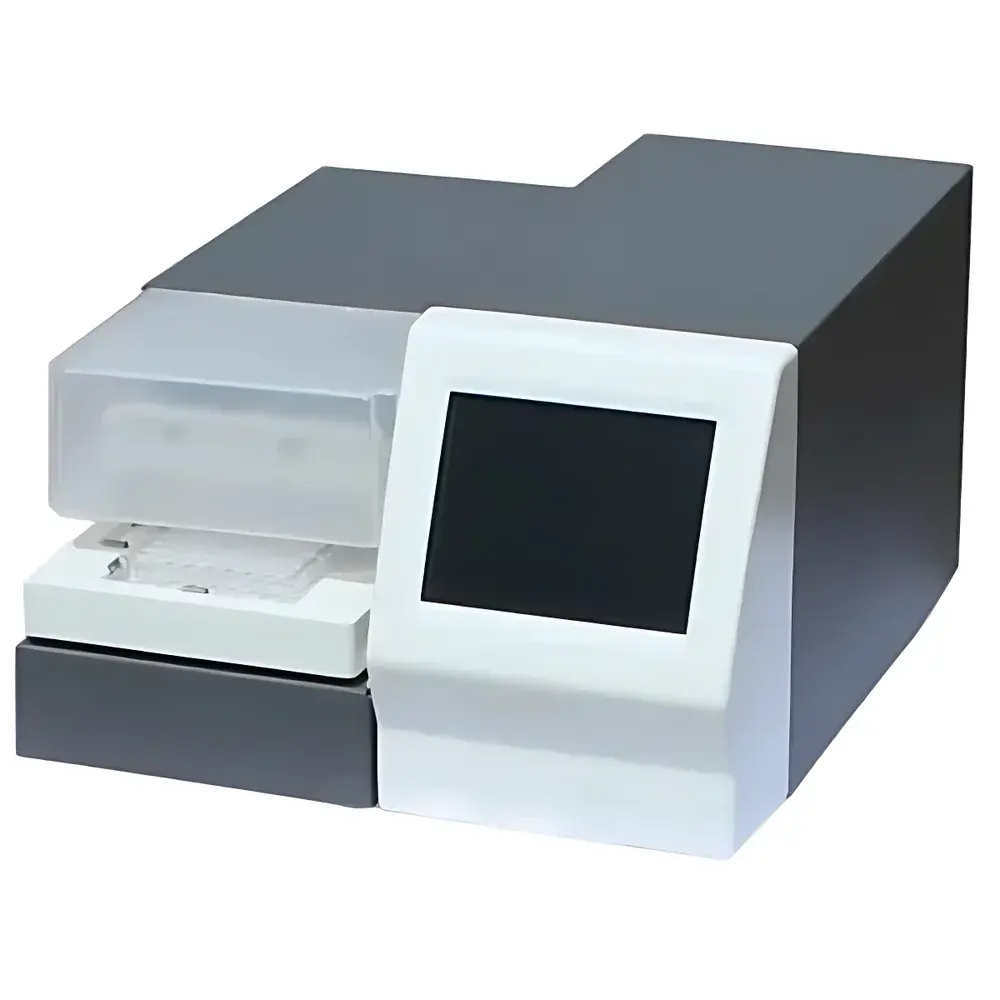
Peiou 318W+ Advanced Microplate Washer
| Brand | Peiou |
|---|---|
| Origin | Shanghai, China |
| Model | 318W+ |
| Instrument Type | Multifunctional Microplate Washer |
| Wash Head Configuration | 8-channel and 12-channel |
| Washing Modes | Strip Wash and Full-Plate Wash |
| Wash Fluid Reservoirs | Three 2-L Bottles (Waste, Deionized Water, Wash Buffer), Each with Liquid-Level Sensors |
| Soaking Time Range | 0–99 min 99 sec (1-sec increments) |
| Wash Cycles | 1–99 |
| Residual Volume per Well | ≤2 µL |
| Orbital Shaking | Adjustable Speed |
| Dispense Volume per Well | 10–300 µL |
| Dispense Accuracy Repeatability | ≤5% |
| Positive Pressure (Dispense Pump) | 200 kPa |
| Negative Pressure (Aspirate Pump) | 60 kPa |
| Fluid Consumption | ~50 mL per full 96-well plate (wash), ~15 mL (pre-wash) |
| Power Input | 150 VA, AC 110–240 V, 50/60 Hz |
| Display | 240 × 128-dot LCD with Touchscreen Interface |
| Aspiration Speed Settings | 6-step adjustable |
| Aspiration Time | 3–99 sec (1-sec increments) |
| Aspiration Modes | Standard, Two-Point Aspiration, Sweep Aspiration |
| Compatible Plate Formats | U-bottom, V-bottom, Flat-bottom microplates |
| Stored Protocols | Up to 99 user-defined methods |
| Programmable Steps | Dispense, Aspirate, Pause, Shake, Loop — freely sequenced |
| Net Weight | 9.6 kg |
| Dimensions (W × D × H) | 300 × 210 × 350 mm |
| Packaging Dimensions | 510 × 450 × 300 mm |
Overview
The Peiou 318W+ Advanced Microplate Washer is an engineered solution for high-fidelity, reproducible washing of ELISA, immunoassay, and cell-based microplates in regulated and non-regulated laboratory environments. It operates on a dual-pump fluidic architecture—employing independent positive-pressure dispensing and vacuum-driven aspiration—to ensure precise volumetric delivery and complete removal of unbound reagents across 96- and 384-well formats. The system supports both strip-wise (1–12 strips) and full-plate washing protocols, enabling flexibility for low-throughput validation studies and high-volume diagnostic workflows. Critical to its reliability is the integrated liquid-level sensing system across all three 2-L reservoirs (waste, deionized water, wash buffer), which actively prevents siphoning, dry-pump operation, and false-wash events—common failure modes that compromise assay integrity and generate non-reproducible optical density (OD) readings.
Key Features
- Dual-channel wash head options: interchangeable 8-channel and 12-channel manifolds for optimal compatibility with standard microplate geometries and edge-effects mitigation.
- Programmable soaking, pre-wash, and pause intervals (0–99 min 99 sec, 1-sec resolution) to accommodate antibody binding kinetics and substrate incubation requirements.
- Adjustable orbital shaking with six-speed settings and configurable duration (3–99 sec) to enhance removal of loosely bound analytes without plate displacement.
- Three aspiration modes—Standard, Two-Point, and Sweep—asymmetrically optimized for U-, V-, and flat-bottom plates to minimize residual volume (≤2 µL/well) and cross-contamination risk.
- Touchscreen interface with 240 × 128-pixel graphical display and intuitive icon-driven navigation; supports multilingual UI (English and Chinese firmware variants).
- Onboard protocol storage: up to 99 customizable washing sequences, including nested loops, conditional pauses, and stepwise parameter overrides.
- Automatic pipeline rinse function during standby mode to prevent crystallization, microbial growth, or buffer salt deposition in fluidic pathways.
Sample Compatibility & Compliance
The 318W+ accommodates ANSI/SLAS-standard microplates (96- and 384-well), including deep-well, half-area, and low-volume formats. Its mechanical design ensures stable plate registration across U-bottom (e.g., for lymphocyte assays), V-bottom (for sedimentation-sensitive applications), and flat-bottom (for adherent cell monolayers) configurations. All fluid-contact surfaces are constructed from chemically inert, autoclavable-grade polymers compliant with ISO 10993-5 cytotoxicity testing. While not certified as IVD medical device under FDA 21 CFR Part 820 or EU MDR, the instrument supports GLP- and GMP-aligned workflows through audit-ready features—including timestamped method execution logs, user-access-controlled protocol editing, and non-volatile memory retention of calibration history. Optional CSV export enables traceability for internal QA review per ISO/IEC 17025 Clause 7.7.
Software & Data Management
Operation is fully managed via embedded firmware with no external PC dependency. All protocols—including dispense volume (10–300 µL/well), aspiration speed, soak time, and cycle count—are stored in non-volatile flash memory with write-cycle protection. Timestamped run logs capture operator ID (via optional PIN login), start/stop time, selected method, and real-time reservoir status (full/low/empty). Data export is supported via USB 2.0 port in comma-separated values (CSV) format for integration into LIMS or statistical analysis platforms (e.g., GraphPad Prism, JMP). Firmware updates are delivered via signed .bin files to ensure integrity verification prior to installation—consistent with NIST SP 800-193 guidelines for firmware resilience.
Applications
The 318W+ serves core workflows in agricultural immunodiagnostics (e.g., detection of foot-and-mouth disease virus antibodies in bovine serum), veterinary pathology labs performing rapid serological screening, and academic research groups conducting cytokine profiling, receptor-ligand binding assays, and high-content screening of kinase inhibitors. Its precision fluid handling supports low-volume ELISA development where inter-assay CVs <5% are required, while programmable multi-step cycles enable complex wash schemes such as detergent-based membrane protein solubilization followed by sequential salt gradient elution. Teaching laboratories benefit from its robust construction, tactile feedback during manual plate loading, and built-in safety interlocks preventing aspiration without plate presence.
FAQ
Does the 318W+ support 384-well plates?
Yes—when equipped with the optional 12-channel wash head and configured for strip-wash mode across two adjacent 192-well halves.
Can wash parameters be locked to prevent unauthorized changes?
Yes—administrator PIN authentication is required to modify stored protocols or system settings.
Is the instrument compatible with common ELISA wash buffers (e.g., PBS-T, Tris-Tween)?
All fluidic components are resistant to aqueous buffers containing ≤0.5% Tween-20, ≤1M NaCl, and pH 4–9; prolonged exposure to organic solvents or strong oxidizers is not recommended.
What maintenance is required beyond daily reservoir replacement?
Monthly inspection of tubing elasticity, quarterly calibration of aspiration pressure using a digital manometer, and annual verification of dispense volume accuracy per CLSI EP10-A3 guidelines.
How is residual volume validated?
Using gravimetric measurement per ASTM E2758-19: 10 µL of dyed water is dispensed into each well, aspirated per user-defined protocol, and residual mass quantified on a 0.01-mg analytical balance.



