
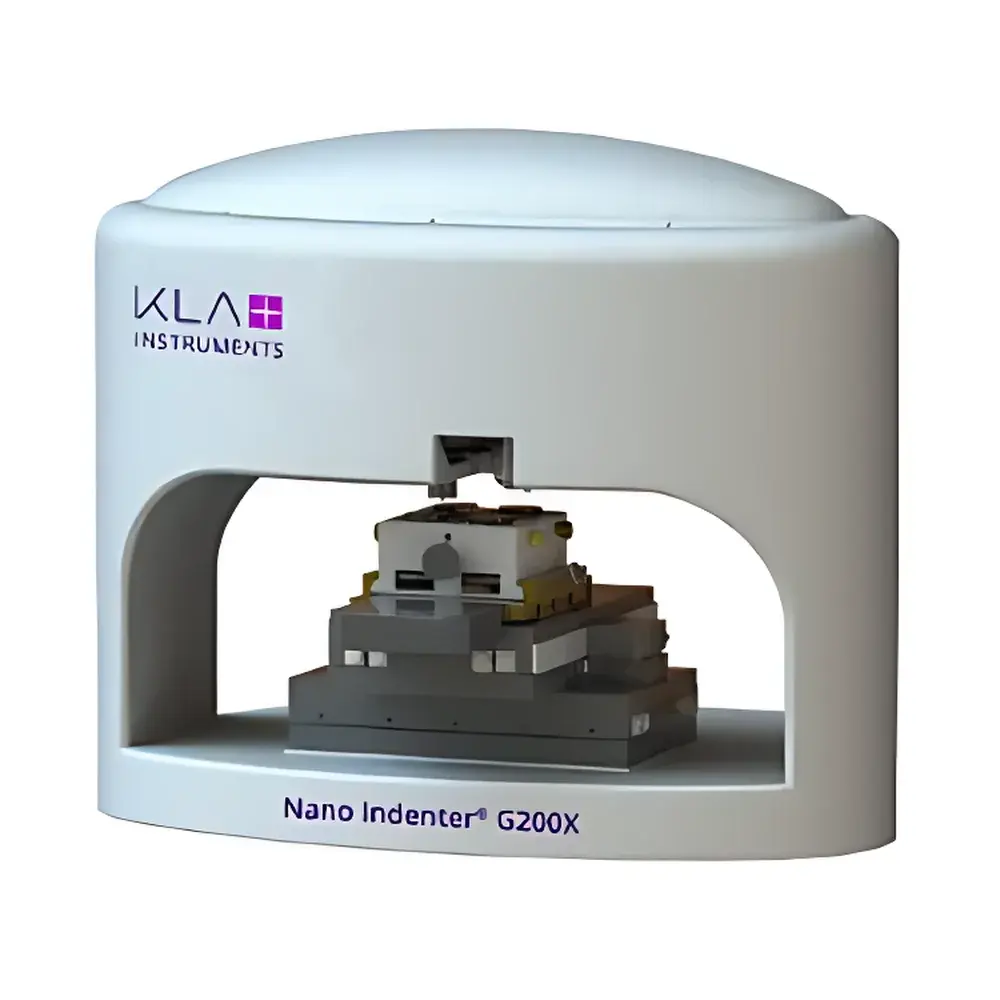
KLA Nano Indenter G200X Advanced Integrated Nanoindentation and Scratch Testing System
| Brand | KLA |
|---|---|
| Origin | USA |
| Model | G200X |
| Instrument Type | Integrated Nanoindentation and Scratch Tester |
| Maximum Load Capacity | 10 N |
| Load Resolution | <1 nN |
| Displacement Range | ±50 µm |
| Displacement Resolution | <0.01 nm |
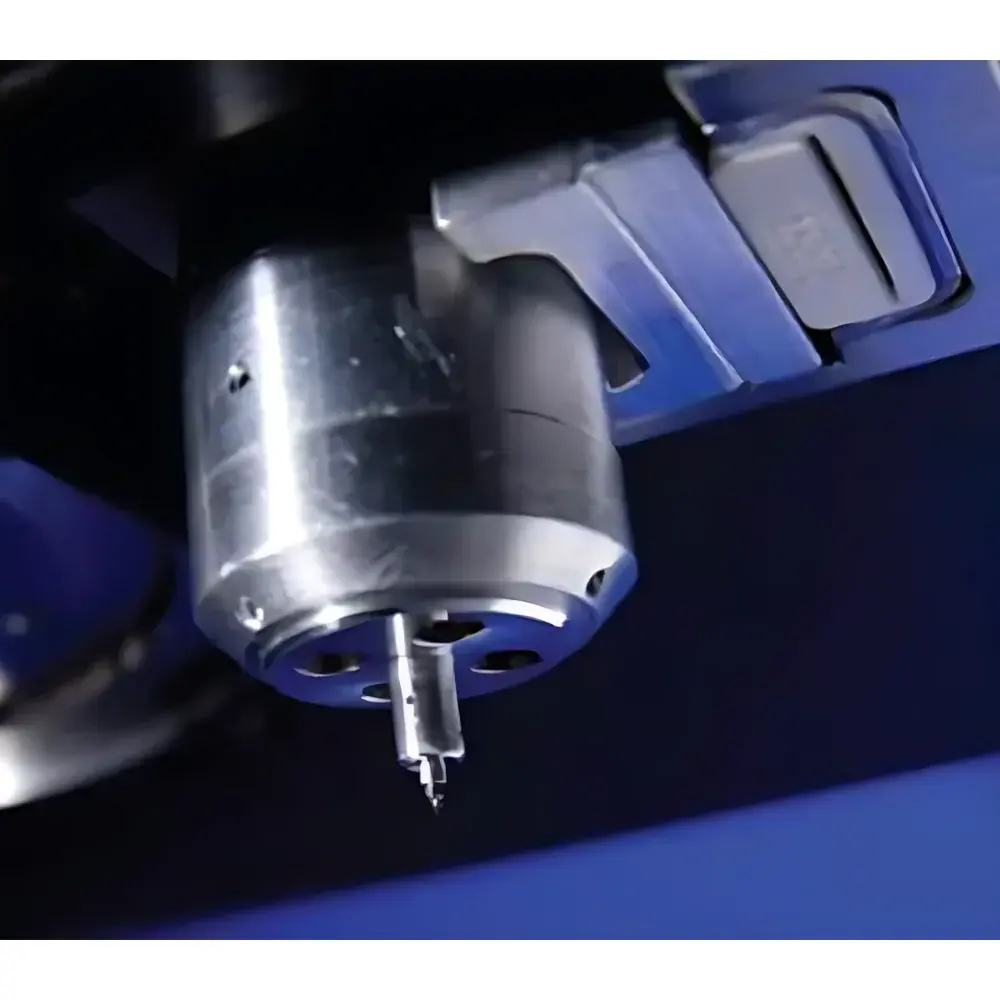
| Indenter Types | Over 30 interchangeable tip geometries (Berkovich, cube-corner, spherical, flat-punch, etc.) |
Overview
The KLA Nano Indenter G200X is a high-precision, modular nanomechanical testing platform engineered for quantitative characterization of mechanical properties at the nanoscale. It operates on the principle of controlled quasi-static and dynamic indentation using electromagnetic actuation, enabling direct measurement of load–displacement response with sub-nanometer displacement resolution and nano-Newton force sensitivity. The system integrates a high-stiffness InForce actuator, closed-loop nanomotorized XYZ stage, and high-magnification optical microscopy to ensure spatial registration accuracy better than 100 nm. Designed for both R&D and production environments, the G200X supports standardized testing per ISO 14577 while delivering advanced capabilities including continuous stiffness measurement (CSM), probe-based imaging, scratch and wear quantification, high-temperature mechanical testing (up to 300 °C), and frequency-dependent viscoelastic analysis. Its architecture complies with GLP/GMP data integrity requirements, including full audit trail logging, electronic signatures, and 21 CFR Part 11–compliant software modules.
Key Features
- Electromagnetic InForce actuator technology ensures exceptional long-term stability, minimal thermal drift, and true single-degree-of-freedom motion—critical for reproducible nanomechanical measurements across load ranges from 10 nN to 10 N.
- High-resolution optical microscope (10×–100× magnification) coupled with a 100 mm × 100 mm × 25 mm motorized sample stage enables rapid region-of-interest navigation and high-throughput multi-site testing.
- InQuest high-speed digital controller acquires data at up to 100 kHz with time constants as low as 20 µs, supporting real-time feedback control during dynamic tests such as CSM, ProbeDMA™, and impact loading.
- Fully modular design allows seamless integration of optional hardware and software packages—including NanoBlitz 3D/4D mapping, AccuFilm™ thin-film analysis, Survey Scanning, NanoVision™ nanoscale positioning, and 300 °C environmental chamber—without system reconfiguration.
- Intuitive InView software suite provides pre-validated test methods (e.g., ISO 14577 hardness, Oliver–Pharr modulus calculation), customizable protocol development, offline simulation mode, and integrated data review (InView ReviewData) and reporting (InFocus) tools.
- Comprehensive indenter library includes Berkovich, cube-corner, spherical (R = 1–100 µm), flat-punch, and custom geometries—all calibrated traceably to NIST standards and compatible across InForce actuator variants.
Sample Compatibility & Compliance
The G200X accommodates diverse sample formats—from polished wafers and thin films (<10 nm) to bulk ceramics, metallic alloys, polymer gels, biological tissues, battery electrodes, and MEMS devices—without requiring specialized mounting fixtures. Its large-stage configuration supports samples up to 200 mm in diameter. All mechanical test protocols adhere to international standards including ISO 14577 (metallic and non-metallic materials), ASTM E2546 (nanoindentation), and USP (mechanical characterization of pharmaceutical coatings). Data management conforms to FDA 21 CFR Part 11 requirements via secure user authentication, immutable audit trails, and electronic signature support within InView software. Environmental options—including inert-gas purged chambers and temperature-controlled stages—are validated for ISO/IEC 17025-compliant calibration laboratories.
Software & Data Management
InView software serves as the unified interface for instrument control, method development, real-time visualization, and post-processing. It includes embedded compliance features: version-controlled test methods, parameter locking, automatic metadata tagging (operator, timestamp, environmental conditions), and export-ready reports compliant with internal QA and external regulatory submissions. The InView ReviewData module enables statistical analysis of property distributions (e.g., modulus/hardness histograms), spatial correlation mapping, and phase identification in multiphase materials. InFocus generates publication-quality figures and customizable PDF/Excel reports with traceable uncertainty propagation. All raw data are stored in vendor-neutral HDF5 format, ensuring long-term accessibility and third-party interoperability. Optional InView Method Development Kit permits scripting of custom test sequences using Python-based syntax—ideal for automated process qualification or AI-driven experimental design.
Applications
The G200X delivers quantitative mechanical data essential for materials development and process validation across industries. In semiconductor manufacturing, it characterizes interlayer dielectric stiffness, copper line fatigue resistance, and low-k film cracking thresholds under thermal cycling. For hard coatings (e.g., TiN, DLC), it isolates intrinsic film properties using AccuFilm™ correction and evaluates adhesion via quantitative scratch testing with acoustic emission monitoring. In battery research, it measures lithiation-induced modulus gradients in NMC cathodes and creep behavior of solid electrolytes under electrochemical stress. Polymer scientists use ProbeDMA™ to extract frequency-dependent storage/loss moduli from microsamples incompatible with macro-DMA instruments. Biomedical researchers apply the BioMaterials Package to quantify shear moduli of hydrogels (1–100 kPa range) and tissue-engineered constructs, bridging the gap between atomic force microscopy and rheometry. Additional validated applications include MEMS stiction analysis, optical coating abrasion resistance, ceramic grain boundary strengthening, and aerospace alloy gradient characterization via depth-resolved CSM.
FAQ
What standards does the G200X support for hardness and modulus measurement?
The system implements pre-validated test methods aligned with ISO 14577, ASTM E2546, and JIS Z 2244, including automatic calculation of reduced modulus, contact depth, and indentation work ratios.
Can the G200X measure viscoelastic properties of soft polymers?
Yes—using the ProbeDMA™ method package with flat-punch indenters and CSM, it quantifies storage modulus (E′), loss modulus (E″), and tan δ over frequencies from 0.1 Hz to 100 Hz, even for samples with moduli below 1 MPa.
Is high-temperature testing possible, and how is thermal drift managed?
The optional 300 °C heating stage incorporates active thermal compensation algorithms and inert gas purge to minimize oxidation; InQuest controller continuously corrects for thermal expansion in real time using reference sensor feedback.
How does the system handle substrate effects when testing thin films?
AccuFilm™ methodology applies Hay–Crawford modeling with CSM-derived depth-dependent stiffness to decouple film and substrate contributions—validated for film-to-substrate modulus ratios from 0.1 to 100.
What level of spatial resolution is achievable for mechanical property mapping?
NanoBlitz 3D achieves 100 nm lateral spacing over 300 × 300 arrays; NanoVision-enabled Survey Scanning extends mapping to 500 µm × 500 µm fields with 10 nm encoder resolution and sub-5 nm positional repeatability.



