
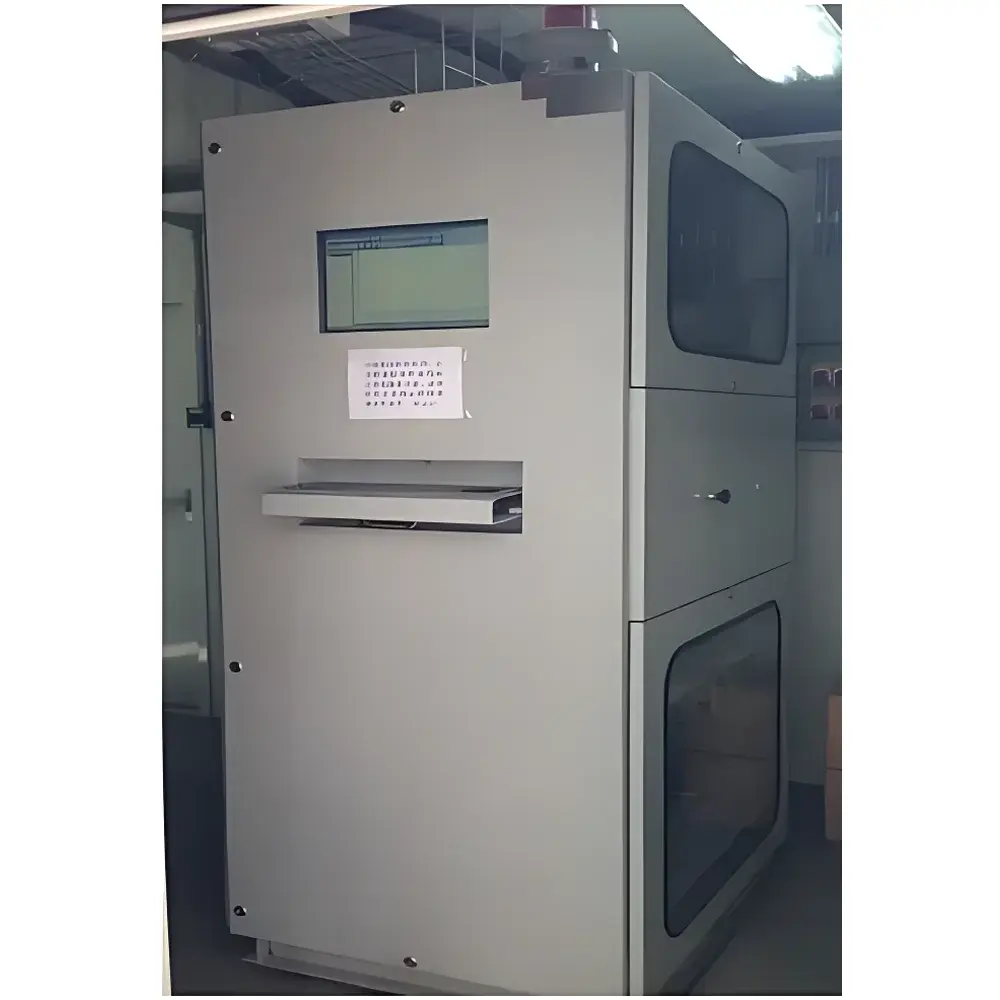
Thermo Fisher TVC-55 Non-Methane Hydrocarbons (NMHC) Continuous Emission Monitoring System
| Brand | Thermo Fisher |
|---|---|
| Origin | USA |
| Manufacturer | Thermo Fisher Scientific |
| Origin Category | Imported |
| Model | TVC-55 |
| Detection Principle | Gas Chromatography with Flame Ionization Detection (GC-FID) |
| Instrument Type | Online Analyzer |
| Configuration | Integrated NMHC/CH₄ Dual-Channel Analyzer |
| Measurement Range | 0–5/50/500 ppm |
| Resolution | 0.025 ppm RMS (300-s averaging) |
| Accuracy | ±2.0% of reading or ±50 ppb (whichever is greater) |
| Response Time | ~70 s |
Overview
The Thermo Fisher TVC-55 Non-Methane Hydrocarbons (NMHC) Continuous Emission Monitoring System is an EPA- and EU-compliant online gas chromatographic analyzer engineered for regulatory-grade measurement of total hydrocarbons (THC), methane (CH₄), and non-methane hydrocarbons (NMHC) in industrial stack emissions and ambient air. It employs dual-channel, sequential GC-FID analysis to quantify CH₄ and NMHC independently—without reliance on subtraction methods—ensuring trace-level accuracy and long-term stability under variable process conditions. The system implements direct hot-wet sampling via a fully heated sample path (up to 200 °C at probe, 80–150 °C in stainless-steel heated line), eliminating condensation, adsorption losses, and thermal degradation of volatile organic compounds (boiling points 50–260 °C). Unlike cold-trap or cryogenic systems, the TVC-55 requires no liquid nitrogen, rapid thermal desorption, or refrigerated dryers—reducing maintenance burden and improving measurement continuity across fluctuating humidity, temperature, and particulate load (≤10 g/m³).
Key Features
- Dual-detection architecture: Simultaneous, independent quantification of CH₄ (peak height) and NMHC (peak area) via backflush GC-FID—eliminating O₂ interference near the CH₄ retention time and removing dependence on oxygen concentration.
- Fully heated sampling train: Electrically heated stainless-steel probe (max 200 °C) with fault-tolerant temperature monitoring and alarm output; constant-power heated transfer line (80–150 °C) to prevent VOC condensation and minimize surface adsorption.
- High-efficiency hot-gas pre-treatment: Particulate filtration at 0.1 µm (99.995% efficiency) and high-boiling tar removal (>250 °C); integrated high-temperature precision filter within the analyzer housing.
- Auto-zero and auto-span capability: On-cycle zero calibration using certified zero air; optional automated span verification with certified CH₄/C₃H₈ standard gas mixtures (1 kg/cm² inlet pressure).
- Robust environmental integration: Compatible with Class I, Division 1 hazardous areas via pressurized “Ex pX” explosion-proof cabinet or fully engineered analyser shelter meeting GB3836.1–2000, IEC 60079-1, and ATEX directives (IIC T4).
- Regulatory-ready outputs: Isolated 4–20 mA analog outputs (configurable), RS232/RS485 serial interface, TCP/IP Ethernet, 10 relay outputs, and 16 digital inputs for external interlocks and status reporting.
Sample Compatibility & Compliance
The TVC-55 is validated for continuous operation in flue gas streams containing moisture, particulates, SO₂, NOₓ, CO₂, and variable O₂ (5–21%). Its hot-wet design preserves sample integrity for C₂–C₁₀ aliphatic and aromatic VOCs—including benzene, toluene, xylene (BTX), ethylene, propylene, and isoprene—without phase change or catalytic loss. The system complies with U.S. EPA Methods 25A and 18, EN 12619:2013, ISO 11890-2, and China’s HJ 1012–2018 for NMHC monitoring. All firmware and data handling routines support audit-ready operation under GLP/GMP frameworks, with full 21 CFR Part 11–compliant electronic signatures, user access control, and immutable audit trails for calibration events, maintenance logs, and raw chromatogram archives.
Software & Data Management
The embedded Thermo Fisher iPort™ software provides real-time chromatogram visualization, peak integration diagnostics, and configurable alarm thresholds (e.g., zero drift >0.1 ppm, span drift >2% over 24 h). Data are timestamped, stored locally (≥30 days of 1-min averages), and exportable in CSV or XML format. Optional integration with centralized SCADA or DCS platforms is supported via Modbus TCP or OPC UA. Remote diagnostics, firmware updates, and method validation reports are accessible via secure HTTPS web interface. All calibration certificates, system suitability tests (SST), and daily performance checks (DPC) are automatically logged with operator ID and electronic signature.
Applications
- Continuous compliance monitoring at VOC abatement units (RTO, RCBO, carbon adsorption beds)—simultaneous inlet/outlet NMHC tracking for destruction efficiency calculation.
- Refinery flare gas composition analysis and methane slip quantification per EPA 40 CFR Part 60 Subpart Ja.
- Chemical manufacturing stack emissions reporting under REACH, LDAR programs, and local air quality permits.
- Landfill and biogas upgrading facilities requiring CH₄/NMHC differentiation for energy recovery and fugitive emission accounting.
- Pharmaceutical cleanroom ambient monitoring where low-level NMHC detection (sub-50 ppb) supports ISO 14644-8 classification.
FAQ
Does the TVC-55 require chilled mirror or Nafion dryers?
No. The system operates in hot-wet mode; sample gas remains above dew point throughout the entire path, eliminating need for drying and associated VOC losses.
Can it measure NMHC in high-humidity exhaust (>80% RH)?
Yes. The heated sampling system maintains vapor-phase integrity up to 100% RH without condensation or water-induced FID quenching.
Is the analyzer compliant with 21 CFR Part 11 for pharmaceutical applications?
Yes—when configured with iPort™ Audit Mode, role-based login, electronic signatures, and tamper-evident data logging.
What is the minimum detectable limit for NMHC under typical operating conditions?
The system achieves a method detection limit (MDL) of 50 ppb NMHC (3σ) with 300-second averaging, verified per EPA 40 CFR Part 136 guidelines.
How often is manual intervention required for routine operation?
Under stable conditions, scheduled maintenance intervals are every 90 days (filter replacement, FID nozzle inspection) and annual GC column reconditioning—no daily operator input needed.
Related Products







