
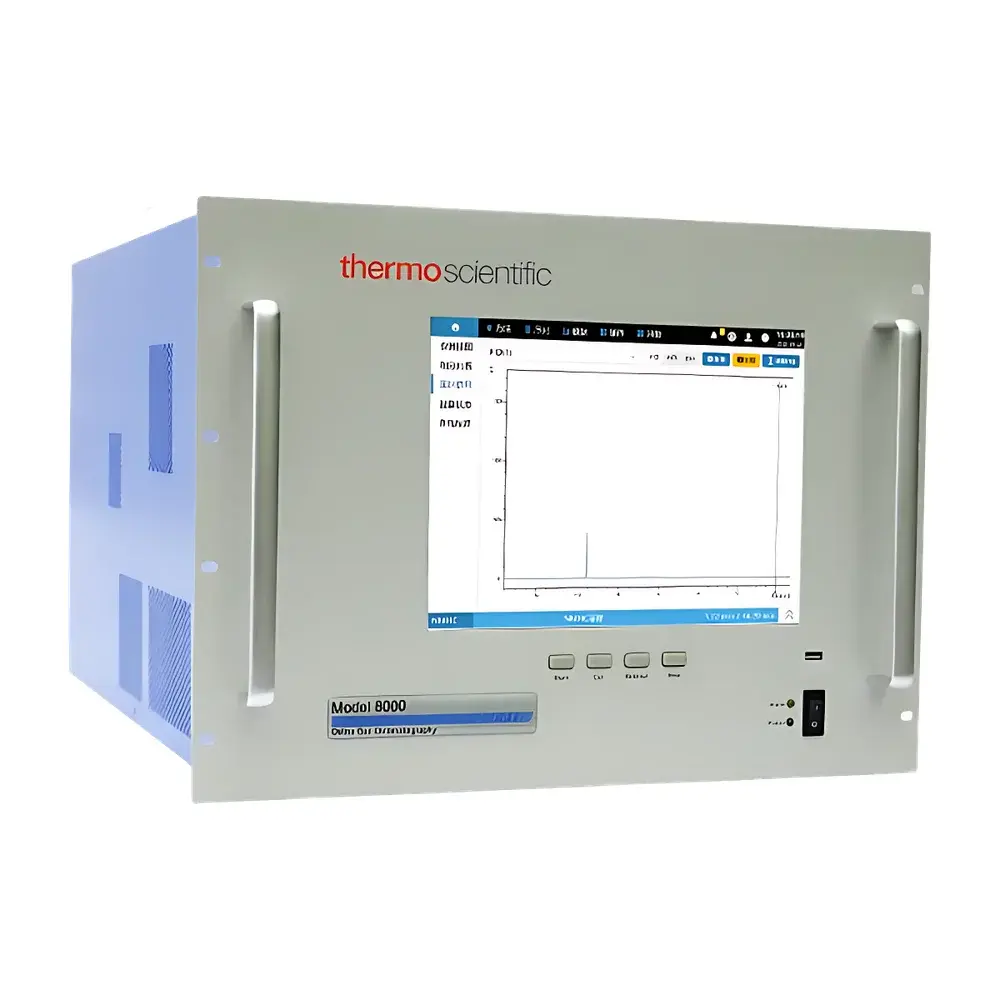
Thermo Fisher 8000 Series Total Organic Carbon Analyzer with Integrated GC-FID/PDHID Detection
| Brand | Thermo Fisher |
|---|---|
| Origin | USA |
| Manufacturer Type | Original Equipment Manufacturer (OEM) |
| Product Category | Imported Instrument |
| Model | Thermo Fisher 8000 Series TOC Analyzer |
| Detection Principle | High-Resolution Gas Chromatography Coupled with Flame Ionization Detector (FID) or Pulsed Discharge Helium Ionization Detector (PDHID) |
| Analyte Range | CH₄, NMHC, Benzene, Toluene, Xylenes (o/m/p), Ethylbenzene, Trimethylbenzenes, Styrene, Ethyl Acetate, Butyl Acetate, Tetrahydrofuran (THF), Isopropanol (IPA), 1-Propanol, Acetone, Hexane, 2-Butanone, Propylene Glycol Monomethyl Ether (PGME), Propylene Glycol Monomethyl Ether Acetate (PGMEA), Cyclopentane, Cyclohexanol, Methylene Chloride, Chloroform, 1,2-Dichloroethane, 1,2-Dichloropropane, and other volatile organic compounds (VOCs) |
| Measurement Cycle | 0–60 min (user-configurable per method) |
| Limit of Detection (LOD) | As low as sub-ppt (≤0.1 pg C) for selected analytes with PDHID |
| Zero Noise | ≤0.04 ppb (as carbon equivalent) |
| Repeatability (RSD) | ≤5% at 10× LOD |
| Computing Platform | Embedded industrial PC — Intel dual-core processor, 4 GB RAM, ≥64 GB SSD (Windows IoT Enterprise) |
| Display | 12-inch full-color industrial capacitive touchscreen |
| Control Software | Onboard system control suite enabling automated sampling, chromatographic analysis, periodic calibration verification, system suitability testing, column conditioning, and unattended 7×24 operation |
| Data Export Formats | MS Excel (.xlsx), CSV, TXT |
| Real-time Status Monitoring | Dynamic graphical interface showing valve positions, oven temperature, detector status, pressure/flow profiles, and alarm history |
| Diagnostics | Comprehensive self-diagnostic routines with event-logged fault codes and predictive maintenance alerts |
| Chromatographic Data Processing | Batch processing support |
| Mechanical Format | 19-inch rack-mountable chassis |
| Dimensions (L×W×H) | 667 mm × 482.5 mm × 355 mm |
| Rack Units | 8U |
| Weight | 32 kg |
| Power Supply | 220 VAC ±10%, 50–60 Hz, max. 500 W |
| Operating Environment | 0 °C to 40 °C, 5–85% RH non-condensing |
| Communication Interfaces | Dual Ethernet (10/100/1000BASE-T), RS-232, RS-485, 3× USB 2.0, VGA output |
| Communication Protocols | Modbus TCP (standard), Modbus RTU over RS-485 (standard), optional analog outputs (0–1 V, 4–20 mA) |
Overview
The Thermo Fisher 8000 Series Total Organic Carbon (TOC) Analyzer is a fully integrated, laboratory-grade gas chromatography (GC) platform engineered for precise quantification of volatile organic compounds (VOCs) in air, stack emissions, ambient monitoring, and cleanroom environments. Unlike conventional standalone TOC analyzers that rely on combustion–NDIR or UV–persulfate oxidation, the 8000 Series employs a high-fidelity GC separation module coupled with either flame ionization detection (FID) or pulsed discharge helium ionization detection (PDHID). This architecture enables compound-specific identification and quantitation—critical for regulatory compliance with EPA Method TO-17, ISO 16017-1, and EN 13649-1. The system operates on the principle of thermal desorption–cold trap–capillary GC–selective detection, delivering robust resolution of complex VOC mixtures—including isomers such as o-, m-, and p-xylene—without spectral overlap or co-elution artifacts. Its modular design supports field-deployable operation while maintaining trace-level sensitivity and long-term stability under continuous duty cycles.
Key Features
- Modular GC architecture with programmable temperature ramping (oven range: 30–250 °C, ramp rate up to 40 °C/min)
- Dual-detector compatibility: FID for hydrocarbon-rich matrices and PDHID for ultra-trace halogenated and non-methane VOCs (e.g., chlorinated solvents, ethers)
- Automated thermal desorption unit with cryogenic focusing (−30 °C trap cooling) and rapid flash-heating (≥400 °C/sec)
- Embedded industrial computing platform running Windows IoT Enterprise with deterministic real-time task scheduling
- 12-inch high-brightness touchscreen HMI with intuitive workflow navigation and context-sensitive help
- Full system automation: unattended 7×24 operation with scheduled calibration checks, blank runs, system suitability tests (SST), and column bake-out protocols
- Comprehensive self-diagnostics including carrier gas leak detection, detector gain drift monitoring, and valve actuation validation
- Rack-mountable 8U chassis compliant with IEC 60297-3-100 mechanical standards and UL 61010-1 safety certification
Sample Compatibility & Compliance
The 8000 Series accepts gaseous samples collected via SUMMA canisters, Tedlar bags, or direct line sampling using heated stainless-steel or SilcoNert®-treated tubing. It accommodates both whole-air and pre-concentrated sample introduction methods. The analyzer meets performance criteria outlined in U.S. EPA Methods TO-14A, TO-15A, and TO-17 for ambient and source testing; it also satisfies ISO 16017-1 (indoor air), ISO 11843-7 (detection capability estimation), and EU Directive 2008/50/EC (ambient air quality assessment). All software functions adhere to FDA 21 CFR Part 11 requirements for electronic records and signatures, including audit trail logging, user role-based access control, and immutable data archiving. System validation documentation supports GLP and GMP-regulated laboratories conducting environmental QC/QA programs.
Software & Data Management
The onboard ChromaControl™ software provides end-to-end method development, instrument control, data acquisition, and reporting. Users define multi-step GC methods—including split/splitless injection, gradient oven programming, and detector parameter tuning—via drag-and-drop interface elements. Raw chromatograms are stored in vendor-neutral .cdf format (NetCDF-compliant), ensuring long-term readability. Batch processing allows alignment, normalization, and comparative analysis across up to 64 chromatograms simultaneously. Integration parameters—including baseline roll-back, peak width constraints, and retention time locking—are adjustable per compound class. Reports export directly to PDF, Excel, or CSV with configurable metadata fields (sample ID, analyst, method version, instrument serial number, calibration date). Audit trails record all user actions, parameter changes, and system events with timestamps and operator IDs—fully traceable for regulatory inspections.
Applications
- Ambient air monitoring networks requiring speciated VOC data for ozone precursor modeling
- Industrial hygiene assessments in semiconductor fabs, pharmaceutical cleanrooms, and paint manufacturing facilities
- Stack emission testing for compliance with NSPS and MACT standards
- Soil vapor intrusion investigations where low-level benzene/toluene/xylene (BTX) detection is critical
- Method development and reference standard verification in certified environmental labs
- Research applications involving kinetic studies of VOC oxidation pathways or atmospheric chemistry simulations
FAQ
Does the 8000 Series support remote monitoring and control?
Yes—via dual Ethernet ports using Modbus TCP or secure HTTPS API endpoints. Remote desktop access is enabled through configured firewall rules and TLS 1.2 encryption.
Can the system be validated per ASTM D6348 or ISO 10156?
Yes—the analyzer includes built-in protocol templates for ASTM D6348 (gas cylinder validation) and ISO 10156 (gas mixture verification), with automated calculation of recovery, precision, and uncertainty budgets.
Is PDHID detector calibration traceable to NIST standards?
All PDHID calibrations utilize NIST-traceable gas standards (SRM 1860, SRM 2559), and certificate-of-analysis files are embedded within the calibration database with digital signature verification.
What maintenance intervals are recommended for routine operation?
Carrier gas filters: every 6 months; GC column: 12–18 months depending on sample matrix load; detector electrodes (PDHID): annual cleaning and reconditioning; system leak check: weekly via built-in pressure decay test.
How is data integrity ensured during power interruption?
The embedded SSD features power-loss protection circuitry and journaling file system (NTFS with write-caching disabled). All active acquisitions are checkpointed every 30 seconds; interrupted runs resume from last valid state upon reboot.







