
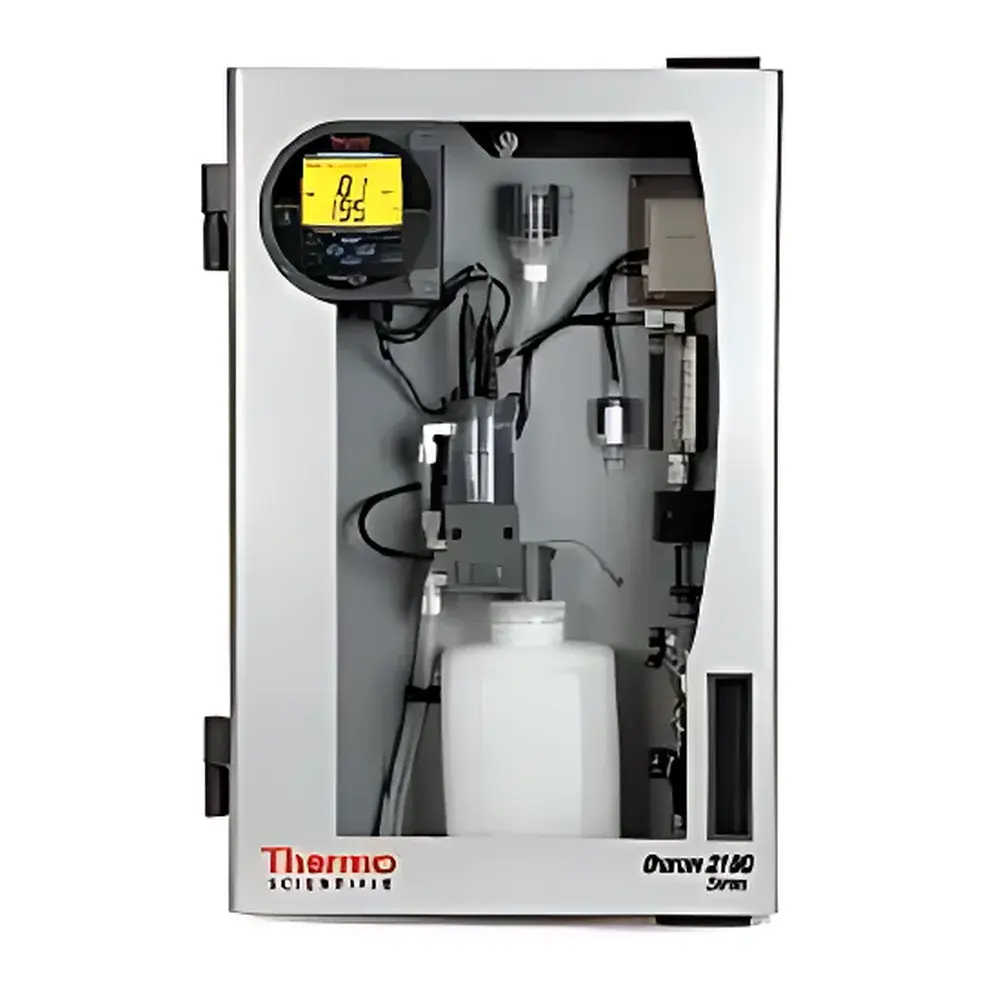
Thermo Scientific 2117XP Chlorine Analyzer
| Brand | Thermo Fisher |
|---|---|
| Origin | USA |
| Manufacturer Type | Original Equipment Manufacturer (OEM) |
| Origin Category | Imported |
| Model | Thermo Scientific 2117XP |
| Pricing | Upon Request |
Overview
The Thermo Scientific 2117XP Chlorine Analyzer is a robust, industrial-grade online analyzer engineered for continuous, real-time measurement of free chlorine concentration in aqueous streams. It operates on the principle of amperometric detection using a membrane-covered, three-electrode sensor system—comprising working, counter, and reference electrodes—optimized for selective and stable chlorine quantification in low-conductivity, low-chlorine environments such as boiler feedwater, ultrapure water loops, and semiconductor process rinse water. Unlike colorimetric or DPD-based methods, the 2117XP eliminates reagent consumption, optical path fouling, and photometric drift, delivering long-term stability and minimal intervention across demanding 24/7 operational cycles. Its design adheres to core requirements for critical water monitoring applications where compliance with ASME B31.1, EPRI guidelines for steam cycle chemistry, and ISO 9001-certified quality assurance protocols is mandatory.
Key Features
- Sub-ppm detection limit: Achieves reliable quantification down to 0.1 ppm free chlorine, suitable for ultra-low-level monitoring in high-purity water systems.
- Chlorine-selective amperometric sensor: Features a proprietary gas-permeable membrane and catalytic electrode architecture that minimizes interference from bromide, ozone, and monochloramine under controlled pH conditions.
- Integrated pH conditioning module: Automatically adjusts sample pH to 6.2–6.8 via inline acid dosing (typically dilute sulfuric or phosphoric acid), ensuring optimal electrochemical response and measurement reproducibility.
- Backlit, high-contrast LCD display: 128 × 64 pixel graphical interface with intuitive navigation; supports multilingual menu options and real-time trend plotting without external software.
- DKA (Dual-Point Known Addition) calibration protocol: Enables rapid, two-point calibration using standard chlorine spikes—no zero-gas or multi-point buffers required—reducing downtime and operator dependency.
- Modular expansion capability: Optional second-channel input supports simultaneous measurement of pH or conductivity, enabling correlated parameter analysis for comprehensive water chemistry assessment.
- Digital communication readiness: Compatible with RS-485 Modbus RTU and optional Ethernet/IP modules for seamless integration into DCS, SCADA, or PLC-based plant-wide monitoring architectures.
- Maintenance-free transducer design: No peristaltic pumps, reagent reservoirs, or moving mechanical parts—only periodic membrane replacement (typical interval: 6–12 months) and electrolyte refill (every 3–6 months).
Sample Compatibility & Compliance
The 2117XP is validated for use with deionized, reverse-osmosis-treated, and demineralized water streams exhibiting conductivity ≤ 5 µS/cm and temperature range of 5–45 °C. It complies with ASTM D1293 (Standard Test Method for pH of Water), ASTM D511 (Standard Test Methods for Chloride Ion in Water), and supports audit-ready data integrity per FDA 21 CFR Part 11 when paired with Thermo Scientific Orion Star™ Connect software. The analyzer meets IP65 enclosure rating for panel-mount installation in NEMA 12-rated control rooms and satisfies IEC 61000-6-2/6-4 electromagnetic compatibility requirements for industrial environments.
Software & Data Management
Local data logging stores up to 30 days of 1-minute interval measurements (chlorine, pH, temperature, sensor status) directly on the instrument’s non-volatile memory. Optional Orion Star Connect software enables remote configuration, diagnostic diagnostics (e.g., membrane integrity check, electrode polarization verification), and automated report generation compliant with GLP/GMP documentation standards. All calibration events, sensor diagnostics, and alarm logs include timestamped user ID attribution and immutable audit trails.
Applications
- Boiler feedwater monitoring in power generation facilities to prevent chloride-induced stress corrosion cracking (SCC) of austenitic stainless steel and Inconel tubing.
- Ultrapure water (UPW) loop surveillance in semiconductor fabrication plants, meeting SEMI F63 purity specifications for chlorine residuals.
- Closed-loop cooling water control in pulp and paper mills to optimize biocide dosing while minimizing corrosion risk.
- Pharmaceutical purified water (PW) and water-for-injection (WFI) distribution system validation per USP and EU GMP Annex 1.
- Agricultural irrigation source water screening to ensure chlorine levels remain below phytotoxic thresholds for sensitive crops.
FAQ
What is the recommended maintenance schedule for the 2117XP sensor module?
Sensor membrane replacement is advised every 6–12 months depending on sample fouling potential; electrolyte replenishment every 3–6 months. No routine cleaning or recalibration is required between intervals if DKA validation confirms performance within ±5% of reference value.
Can the 2117XP measure combined chlorine (chloramines)?
No—it is configured exclusively for free chlorine detection. Combined chlorine requires separate amperometric sensors with different membrane chemistries and redox potentials.
Is third-party certification available for regulatory reporting?
Yes—Thermo Fisher provides factory-issued NIST-traceable calibration certificates and optional IQ/OQ documentation packages aligned with ASTM E2656 and ISO/IEC 17025 laboratory accreditation frameworks.







