
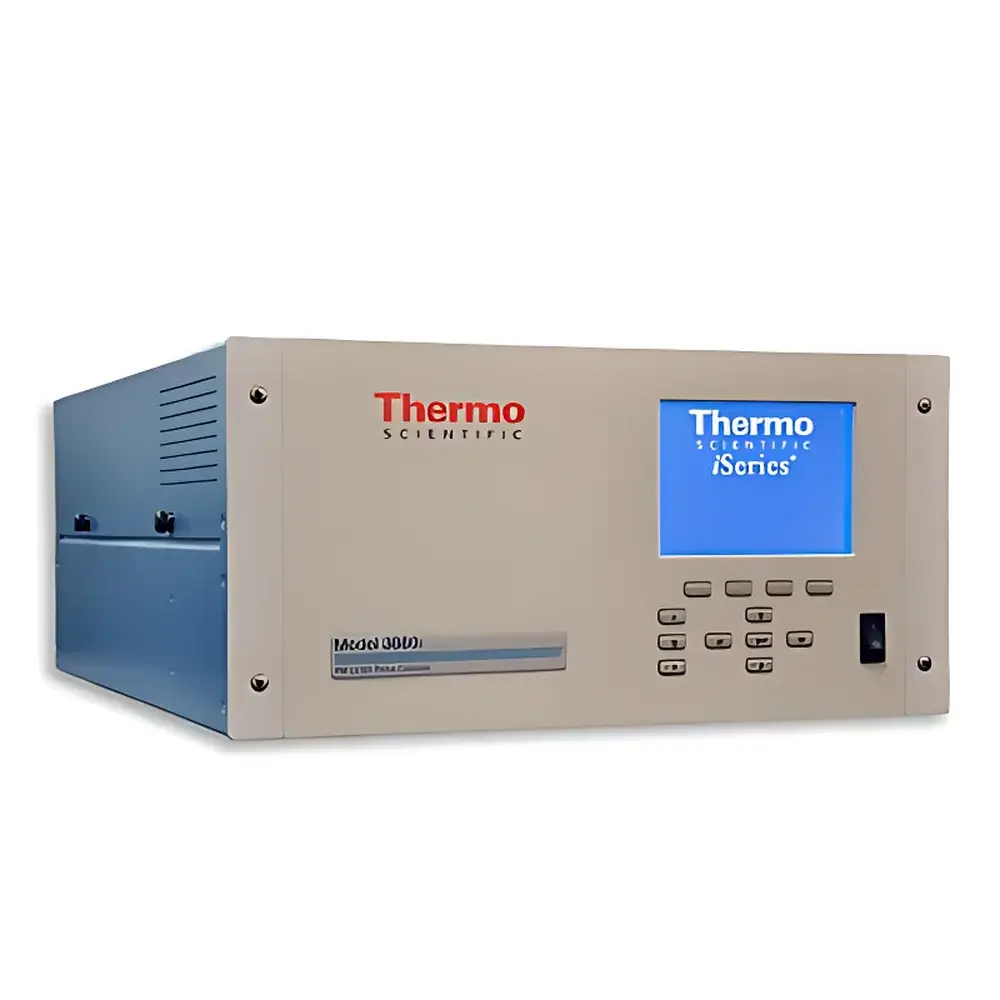
Thermo Scientific Model 3880i PM Continuous Emission Monitoring System (CEMS)
| Brand | Thermo Fisher |
|---|---|
| Origin | USA |
| Manufacturer Type | Original Equipment Manufacturer (OEM) |
| Product Category | Imported |
| Model | 3880i |
| Instrument Type | Flue Gas PM CEMS |
| Measurement Principle | Dual-Method (Beta Attenuation + Tapered Element Oscillating Microbalance, TEOM) |
| Traceability | NIST-traceable mass concentration |
| Compliance | EPA PS-11, QA/QC Procedure 2, Method 5/17 Verified |
| Range | 0–250 mg/m³ (extendable to 0–5 mg/m³ low-range mode) |
| Accuracy | ±20% (uncorrected), ±10% (source-corrected) |
| Detection Limit | 0.25 mg/m³ (15-min integrated) |
| Response Time (T90) | 15 min |
| Power Supply | 200–240 VAC, 50/60 Hz, 30 A |
| Purge Air | 80 slpm at 0.55–0.7 MPa |
| Max Flue Gas Temp | 200 °C |
| Operating Ambient Temp (Controller) | 4–50 °C, non-condensing |
| Analog Outputs | 6 × 0–100 mV / 1/5/10 V, 6 × 0–20 mA / 4–20 mA |
| Digital I/O | 1 power-fail alarm, 10 relay outputs |
| Probe Dimensions | 1117.85 mm (W) × 474.73 mm (H) × 7.09 mm (D), with 914/1524 mm sheath |
| Probe Weight | 59 kg |
| Controller Dimensions | 482.6 mm (19″ W) × 189.5 mm (H) × 655.32 mm (D) |
| Controller Weight | 25 kg |
Overview
The Thermo Scientific Model 3880i PM Continuous Emission Monitoring System (CEMS) is an industrial-grade, dual-principle particulate matter analyzer engineered for regulatory compliance and long-term operational reliability in fossil-fueled power plants, waste incinerators, cement kilns, and other high-temperature combustion sources. It delivers true mass concentration measurements traceable to the National Institute of Standards and Technology (NIST) by integrating two independent, complementary physical measurement techniques: optical scattering (for real-time dynamic response) and tapered element oscillating microbalance (TEOM) gravimetric analysis (for absolute mass calibration). This hybrid architecture eliminates dependence on particle size distribution, refractive index, or chemical composition—factors that introduce systematic bias in single-method systems. The system employs a dilution-extraction sampling configuration, reducing condensate formation and thermal stress on critical components while enabling stable operation across fluctuating flue gas conditions, including variable moisture content, temperature gradients, and transient loading events.
Key Features
- Dual-sensor architecture combining real-time light-scattering detection with periodic TEOM-based gravimetric validation—ensuring continuous accuracy without manual recalibration.
- NIST-traceable mass concentration output certified under U.S. Environmental Protection Agency (EPA) Performance Specification 11 (PS-11) and Quality Assurance Procedure 2.
- Validated per EPA Methods 5 and 17 for stack testing equivalence—supporting audit-ready data submission for Title V permitting and state implementation plans (SIPs).
- Dilution probe design maintains sample temperature above dew point, minimizing filter clogging, corrosion, and maintenance frequency—extending mean time between failures (MTBF) beyond 12 months under typical utility service conditions.
- Modular hardware layout: field-installed heated probe assembly, rack-mounted controller (19″ EIA format), and integrated pneumatic/electrical umbilical bundle—facilitating staged commissioning and retrofit integration into legacy DCS/SCADA infrastructures.
- Configurable analog and digital I/O interfaces—including six voltage/current outputs, ten programmable relays, and discrete fault signaling—enabling seamless integration with plant-level environmental data acquisition systems (EDAS) and regulatory reporting gateways.
Sample Compatibility & Compliance
The Model 3880i is designed for extractive measurement of particulate matter (PM10, PM2.5, total suspended particulates) in hot, humid, and chemically aggressive flue gases. Its dilution ratio is factory-optimized to preserve representative aerosol dynamics while preventing thermophoretic losses and wall deposition in transport lines. The system complies with international regulatory frameworks including EPA PS-11, ISO 12141 (stationary source emissions — determination of PM mass concentration), and EU BREF reference documents for large combustion plants (LCP BREF). All firmware and data handling routines adhere to 21 CFR Part 11 requirements for electronic records and signatures when deployed in GLP/GMP-aligned facilities. Audit trails, user access logs, calibration history, and raw sensor timestamps are retained for ≥18 months onboard and exportable via secure FTP or Modbus TCP.
Software & Data Management
System operation and diagnostics are managed through Thermo’s proprietary CEMS Manager software suite, compatible with Windows 10/11 (64-bit) and deployable on hardened industrial PCs. The software provides real-time visualization of both optical and TEOM channels, automatic drift correction triggers, scheduled validation cycles, and configurable alarm thresholds aligned with 40 CFR Part 60 Appendix B criteria. Data files conform to EPA CDX-compliant CSV and XML formats, supporting direct upload to the Clean Air Markets Division (CAMD) database. All calibration events—including zero/span checks, reference standard deployments, and TEOM baseline verification—are digitally signed and time-stamped with cryptographic integrity checks. Remote diagnostics via TLS-encrypted VNC tunneling allow OEM-certified engineers to perform firmware updates, parameter tuning, and fault isolation without site visitation.
Applications
- Regulatory compliance monitoring for coal-, oil-, and gas-fired power generation units subject to MATS, NSPS Subpart UUUU, or EU IED directives.
- Performance evaluation of electrostatic precipitators (ESPs), fabric filters (FFs), and wet scrubbers under variable load and fuel-switching scenarios.
- Long-term trend analysis of PM emission factors correlated with boiler operating parameters (excess O2, flame temperature, air staging).
- Support for carbon capture readiness assessments where particulate loading impacts downstream amine solvent degradation kinetics.
- Research applications in aerosol science laboratories requiring synchronized optical-gravimetric datasets for model validation (e.g., Mie theory sensitivity studies).
FAQ
Does the Model 3880i require daily manual intervention?
No. Once commissioned and validated, the system operates unattended for up to 30 days between scheduled maintenance intervals. Automated zero/span checks and TEOM reference cycles are programmable via CEMS Manager.
Can it measure ultra-low concentrations below 1 mg/m³?
Yes. With optional low-range configuration (0–5 mg/m³), the system achieves a method detection limit of 0.25 mg/m³ over 15-minute integration periods—meeting stringent requirements for modern combined-cycle gas turbine (CCGT) exhaust monitoring.
Is the TEOM module susceptible to moisture interference?
No. The dilution system maintains sample relative humidity below 40% at the TEOM inlet; additionally, the oscillating element is temperature-controlled to ±0.1 °C to suppress hygroscopic artifact drift.
How is data integrity ensured during network outages?
Onboard non-volatile memory retains ≥720 hours of second-by-second sensor data and event logs. Upon network recovery, buffered data synchronizes automatically without gaps or timestamp corruption.
What certifications does the system hold for hazardous area installation?
The probe assembly is rated Class I, Division 2, Groups B, C, D per NEC Article 500 when equipped with optional explosion-proof enclosures. ATEX and IECEx certifications are available upon request for international deployment.
Related Products







