
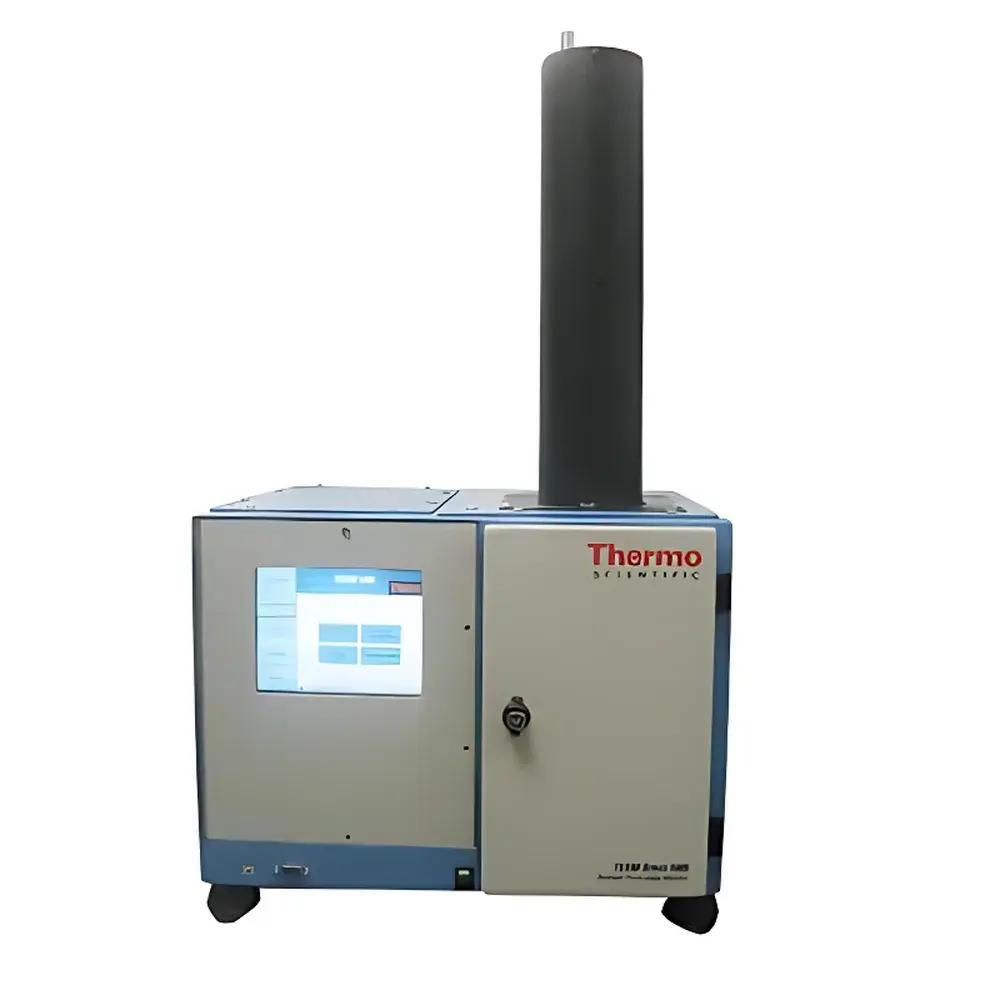
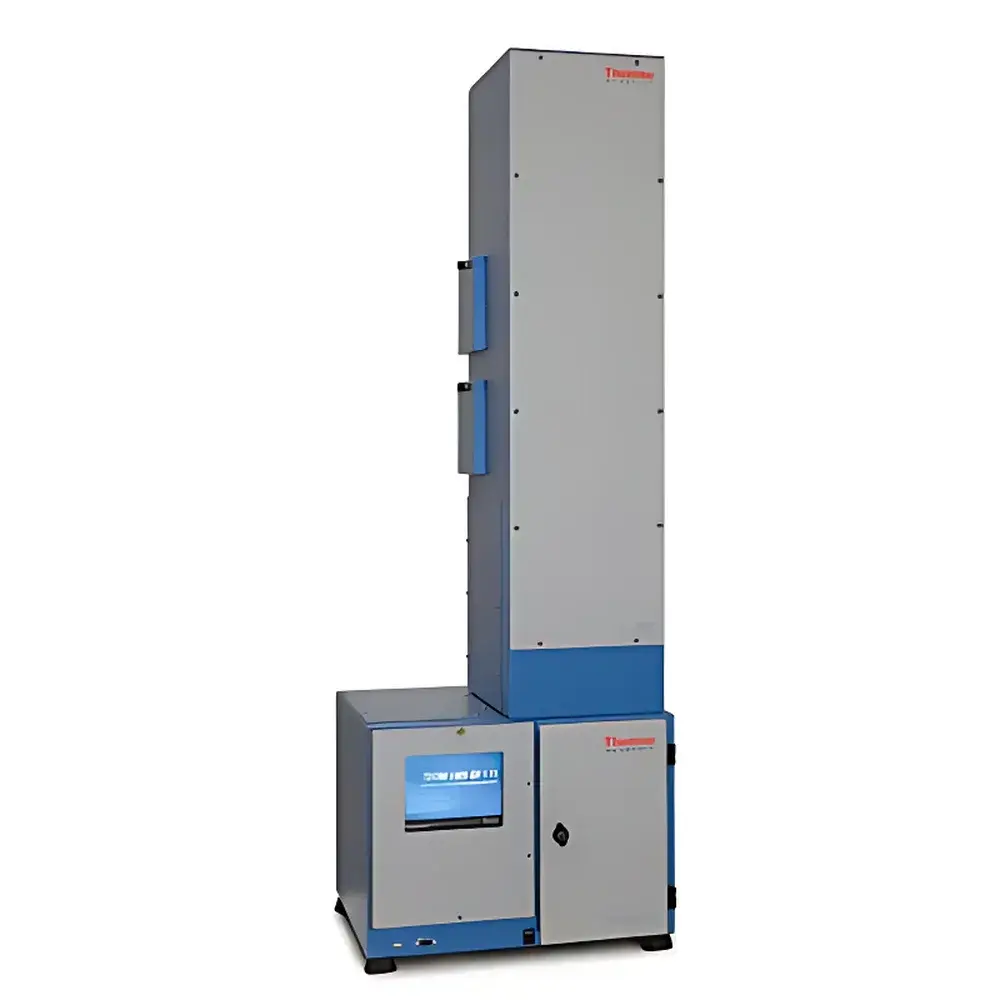
Thermo Scientific TEOM 1405DF/1405F Tapered Element Oscillating Microbalance Particulate Monitor
| Brand | Thermo Fisher |
|---|---|
| Origin | USA |
| Manufacturer Type | Original Equipment Manufacturer (OEM) |
| Product Category | Imported Instrument |
| Model Series | Thermo Scientific TEOM |
| Measurement Principle | Tapered Element Oscillating Microbalance (TEOM) |
| Measured Parameters | PM₁₀, PM₂.₅ |
| Measurement Range | 0–1,000,000 µg/m³ |
| Measurement Interval | Real-time mass measurement with 6-minute data updates and 1-hour rolling averages |
| Sample Flow Rate | 3 L/min (1405F) |
| Fine-mode flow | 3 L/min / Coarse-mode flow: 1.67 L/min (1405DF) |
| Detection Limit | 0.1 µg/m³ |
| Flow Stability | ±75% during mass measurement |
| Data Storage Capacity | 5,000,000 records |
| Accuracy | ±2.0 µg/m³ (1-hr average), ±1.0 µg/m³ (24-hr average for 1405F) |
| Resolution | 0.1 µg/m³ |
| Bypass Flow | 12 L/min (1405DF), 13.67 L/min (1405F) |
Overview
The Thermo Scientific TEOM 1405DF and 1405F are regulatory-grade, continuous ambient particulate matter monitors engineered for high-precision, real-time gravimetric mass concentration measurement of PM10, PM2.5, and optionally PM1.0 or total suspended particulates (TSP). These instruments implement the patented Tapered Element Oscillating Microbalance (TEOM) technology—a dynamic, physics-based method that directly measures particle mass deposited on a vibrating tapered quartz element in real time. Unlike optical or beta attenuation techniques, TEOM provides true gravimetric quantification without empirical correction factors, delivering traceable, NIST-traceable mass data compliant with U.S. EPA Federal Reference Methods (FRM) and Federal Equivalent Methods (FEM) for PM2.5 and PM10. The system operates under controlled temperature and pressure conditions, with integrated thermoelectric cooling and active humidity management to minimize artifact formation from semi-volatile compounds.
Key Features
- Patented TEOM sensor with dual-mode oscillation detection for ultra-stable frequency-to-mass conversion
- Dynamic Filter Measurement (DFM) architecture (1405DF): simultaneous, independent measurement of coarse (PM10–2.5) and fine (PM2.5) fractions using split-flow sampling and dual tapered elements
- Single-channel fine-particle configuration (1405F) optimized for PM2.5-only monitoring with enhanced signal-to-noise ratio
- Active mass flow control via precision thermal mass flow controllers, calibrated against NIST-traceable standards
- Onboard environmental compensation for temperature, pressure, and relative humidity—ensuring metrological consistency across diverse deployment sites
- Real-time data output at 6-minute intervals with configurable 1-hour, 24-hour, and user-defined averaging periods
- Robust industrial-grade enclosure rated for unattended outdoor operation (IP55 equivalent) with internal desiccant and thermal management
Sample Compatibility & Compliance
The TEOM 1405DF/1405F is validated for ambient air, indoor environments, and occupational settings—including industrial hygiene applications requiring OSHA-compliant exposure assessment. It accepts standard 47-mm quartz or Teflon filters and supports both sequential and continuous filter collection modes. The instrument meets U.S. EPA equivalency requirements under 40 CFR Part 53 for PM2.5 and PM10 monitoring and is referenced in ISO 25597:2013 (ambient air—determination of PM mass concentration by gravimetric methods). Its design supports GLP/GMP-aligned audit trails when integrated into validated networked monitoring systems. All calibration protocols—including span, zero, and flow verification—are fully documented and support 21 CFR Part 11-compliant electronic records when used with Thermo’s optional E-Suite software.
Software & Data Management
Instrument control, diagnostics, and data acquisition are managed through Thermo Scientific E-Suite v4.x or higher—a secure, Windows-based platform supporting remote configuration, automated calibration scheduling, and real-time alarm notification. Raw TEOM frequency data, environmental sensor readings (T, P, RH), flow rates, and diagnostic flags are stored locally with timestamped metadata. The system exports ASCII and CSV files compatible with EPA AQS, AirNow, and EU Air Quality Directive reporting formats. Optional MODBUS TCP and RS-485 interfaces enable integration into SCADA and centralized environmental management platforms. Internal flash memory retains up to 5,000,000 records (≥12 months of 6-minute data), with automatic overwrite protection and scheduled backup via USB or Ethernet.
Applications
- Ambient air quality monitoring networks (national, regional, urban)
- Regulatory compliance reporting for EPA, EEA, and local environmental agencies
- Source apportionment studies requiring high-temporal-resolution mass data
- Indoor air quality assessments in schools, hospitals, and commercial buildings
- Occupational exposure monitoring in mining, construction, and manufacturing facilities
- Research applications in aerosol science, atmospheric chemistry, and health effects epidemiology
- Calibration reference for optical particle counters and beta attenuation monitors
FAQ
How does TEOM differ from beta attenuation or optical scattering methods?
TEOM provides direct gravimetric measurement based on resonant frequency shift of a microbalance element—eliminating reliance on Mie theory assumptions or empirical k-factors required by optical or radiometric techniques.
Is the TEOM 1405F suitable for 24-hour compliance monitoring?
Yes. When operated with 24-hour averaging and routine NIST-traceable calibrations, it meets U.S. EPA PM2.5 FRM performance specifications including accuracy (±1.0 µg/m³) and precision (±0.5 µg/m³).
Can the 1405DF measure PM10 and PM2.5 simultaneously?
Yes. Its dual-channel DFM architecture collects and analyzes coarse and fine fractions in parallel using independent flow paths and tapered elements—enabling real-time speciation without time-division multiplexing.
What maintenance is required for long-term field operation?
Recommended quarterly maintenance includes filter tape replacement (if used), flow sensor cleaning, quartz element inspection, and full system calibration using certified reference masses and volumetric flow standards.
Does the instrument support remote diagnostics and firmware updates?
Yes. With Ethernet connectivity and E-Suite, users can perform remote health checks, view real-time sensor diagnostics, and deploy firmware patches without site visits.
Related Products







