
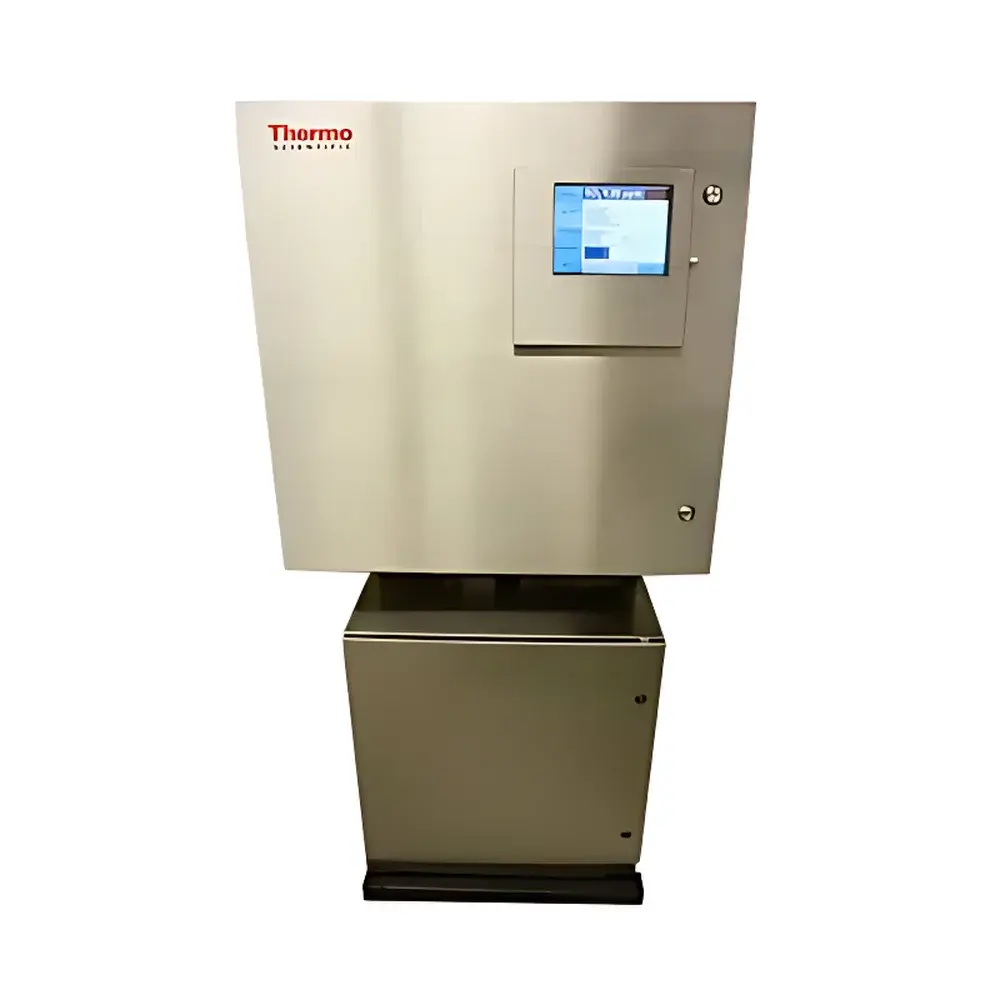
Thermo Fisher Scientific Arke SO3 Continuous Emission Monitoring System
| Brand | Thermo Fisher Scientific |
|---|---|
| Origin | USA |
| Manufacturer Type | Original Equipment Manufacturer (OEM) |
| Product Category | Imported |
| Model | Arke SO3 |
| Instrument Type | Continuous Emission Monitoring System (CEMS) for Sulfur Trioxide |
| Accuracy (Indicated Value Error) | ±0 ppm |
| Repeatability | <0.2 ppm (300-s average) |
| Response Time (T90) | <15 s |
| Long-Term Stability (Zero Drift, 24 h) | <0.5 ppm |
| Span Drift | ≤2% of full scale |
| Linearity | ±1% of full scale |
| H₂O Interference | <1×10⁻⁵ (relative to SO₃ signal) |
| SO₂ Interference | <1×10⁻⁴ (relative to SO₃ signal) |
| Measurement Range | 0–200 ppm |
| Zero Noise (300-s avg) | 0.2 ppm |
| Limit of Detection (LOD, 300-s avg) | 0.4 ppm |
Overview
The Thermo Fisher Scientific Arke SO₃ Continuous Emission Monitoring System is a high-performance, in-situ capable CEMS engineered for the real-time, direct, and selective quantification of sulfur trioxide (SO₃) in hot, high-dust flue gas streams. Unlike conventional extractive analyzers relying on wet chemical or electrochemical detection—methods prone to SO₃ adsorption losses, condensation artifacts, and cross-sensitivity—the Arke SO₃ system employs quantum cascade laser absorption spectroscopy (QCLAS) operating in the mid-infrared region (typically ~7.3 µm), where SO₃ exhibits strong, spectrally isolated rotational-vibrational transitions. This fundamental measurement principle ensures inherent selectivity against SO₂, H₂O, CO₂, NOₓ, and particulate scattering—critical for accurate SO₃ monitoring upstream of air pollution control devices (APCDs). The system is specifically designed to support combustion optimization, APCD performance validation, and corrosion mitigation strategies in coal-, oil-, and biomass-fired power plants, waste-to-energy facilities, and industrial boilers.
Key Features
- Quantum cascade laser absorption spectroscopy (QCLAS) platform delivering parts-per-trillion-level spectral resolution and sub-ppm detection sensitivity.
- Dilution-extraction probe with integrated catalytic SO₂-to-SO₃ converter for on-site span calibration—enabling traceable, matrix-matched verification without external gas standards.
- Inertial particle filter rated for >50 g/Nm³ dust loading, permitting installation pre-electrostatic precipitator (ESP) or pre-fabric filter—eliminating need for hot-wet conditioning systems.
- Minimized sample transport path (<1 m heated line from probe to analyzer cell) to prevent SO₃ wall loss, condensation, or heterogeneous conversion.
- Heated optical cell maintained at >180 °C with active temperature stabilization to ensure vapor-phase integrity and eliminate dew point-related artifacts.
- Robust mechanical architecture compliant with IEC 61000-6-2 (EMC immunity) and NEMA 4X enclosure rating for outdoor deployment in harsh industrial environments.
Sample Compatibility & Compliance
The Arke SO₃ system is validated for continuous operation in flue gases ranging from 80 °C to 200 °C, with moisture content up to 15% v/v and particulate concentrations exceeding 30 g/Nm³ (dry basis). It meets key regulatory and industry requirements including EPA Performance Specification 18 (PS-18) for SO₃ CEMS, ISO 12039:2000 for stationary source emissions—determination of sulfur dioxide and sulfur trioxide, and ASTM D6784-22 for elemental, inorganic, and organic compound determination in stack gas. Its data acquisition architecture supports audit-ready logging per 40 CFR Part 60 Appendix B and enables full compliance with 21 CFR Part 11 when deployed with Thermo Fisher’s optional secure software package (including electronic signatures, audit trails, and role-based access control).
Software & Data Management
The embedded firmware and companion ArkeView™ software provide ISO/IEC 17025-aligned data handling workflows. Real-time concentration outputs (0–20 mA or Modbus TCP) are synchronized with timestamped diagnostics—including laser wavelength stability, cell temperature deviation, and optical density residuals. Raw absorbance spectra are stored at user-configurable intervals (1–60 s) for retrospective interference analysis. Integration with distributed control systems (DCS) and data acquisition systems (DAS) is achieved via native OPC UA, Modbus RTU/TCP, and analog I/O interfaces. All calibration events, maintenance logs, and alarm histories are time-stamped, digitally signed, and exportable in CSV or XML formats compatible with enterprise LIMS and environmental reporting platforms.
Applications
- Optimizing activated carbon injection (ACI) dosing by correlating real-time SO₃ concentration with mercury oxidation state and capture efficiency.
- Diagnosing low-temperature corrosion risks in air preheaters and downstream ductwork through dynamic SO₃/H₂SO₄ dew point modeling.
- Validating SCR catalyst performance and ammonia slip interactions under varying load and fuel sulfur conditions.
- Supporting FGD system tuning by quantifying SO₃ breakthrough across limestone or seawater scrubbers.
- Enabling predictive maintenance of ESPs and fabric filters by detecting SO₃-induced resistivity shifts in fly ash.
- Providing input for regulatory SO₃ mass balance reporting under EU IED Annex V and U.S. Clean Air Act Title IV compliance frameworks.
FAQ
What is the primary measurement principle used in the Arke SO₃ system?
Quantum cascade laser absorption spectroscopy (QCLAS) in the mid-infrared spectral region, targeting fundamental vibrational bands of SO₃.
Can the system operate upstream of an electrostatic precipitator?
Yes—its inertial filtration and heated sampling path enable stable operation at dust loadings >30 g/Nm³.
How is calibration performed without certified SO₃ gas standards?
Via on-probe catalytic conversion of known SO₂ concentrations into SO₃, providing traceable, matrix-matched span calibration.
Does the system meet U.S. EPA PS-18 requirements for SO₃ CEMS?
Yes—the design, test protocol, and performance specifications align with PS-18 criteria for accuracy, drift, and interference rejection.
Is raw spectral data accessible for third-party interference modeling?
Yes—absorbance spectra are logged and exportable for advanced chemometric analysis or custom algorithm development.
Related Products







