
Thermo Fisher Scientific EV-1000 VOCs Continuous Emission Monitoring System (CEMS)
| Brand | Thermo Fisher |
|---|---|
| Origin | USA |
| Manufacturer Type | Original Equipment Manufacturer (OEM) |
| Origin Category | Imported |
| Model | EV-1000 VOCs CEMS |
| Detection Principle | Gas Chromatography with Flame Ionization Detection (GC-FID) |
| Instrument Type | Online Analytical System |
| Typical Configuration | Multi-component VOC Analyzer |
| Detection Range | Volatile Organic Compounds (VOCs), configurable up to 50 ppm, 500 ppm, 5000 ppm, 5% or 50% as methane |
| Resolution | 0.05 ppm |
| Accuracy | ±1 % of full scale or ±0.1 ppm (whichever is tighter) |
| Response Time | ≤60 seconds (average analysis cycle time) |
| Repeatability | ±1 % f.s. or ±0.1 ppm |
| Zero Drift | ±1 % f.s. or ±0.1 ppm |
| Span Drift | ±2 % f.s. or ±0.1 ppm |
| Sample Flow Rate | 600 mL/min (analysis stream) |
| Sample Replacement Rate | 3–10 L/min (max) |
| Calibration Interval | User-configurable (monthly to annual) |
| Operating Temperature | 0–45 °C |
| Ambient Storage Temperature | –20–60 °C |
| Relative Humidity | 0–85 % RH (non-condensing) |
| Power Supply | AC 220 V, 50 Hz, 1.5 kW |
| Dimensions | 650 mm (W) × 580 mm (D) × 1250 mm (H) |
| Weight | 160 kg |
| Carrier Gas | Oil/water-free air or N₂, 60 mL/min at 2 kg/cm², THC < 0.1 ppm |
| FID Fuel Gas | H₂, 30 mL/min at 2 kg/cm², purity >99.999%, THC < 0.1 ppm |
| FID Make-up Gas | Oil/water-free air, 300 mL/min at 2 kg/cm², THC < 0.1 ppm |
| Zero Gas | Oil/water-free air or N₂, 2 kg/cm², THC < 0.1 ppm |
| Span Gas | Hydrocarbon standard in balance gas (air or N₂), 1 kg/cm² inlet pressure |
| Purge Gas | Oil/water-free air, 10 L/min at 2 kg/cm², THC < 1 ppm |
| Standard Output | Modbus TCP |
| Optional Outputs | 4–20 mA, RS232, RS485 |
Overview
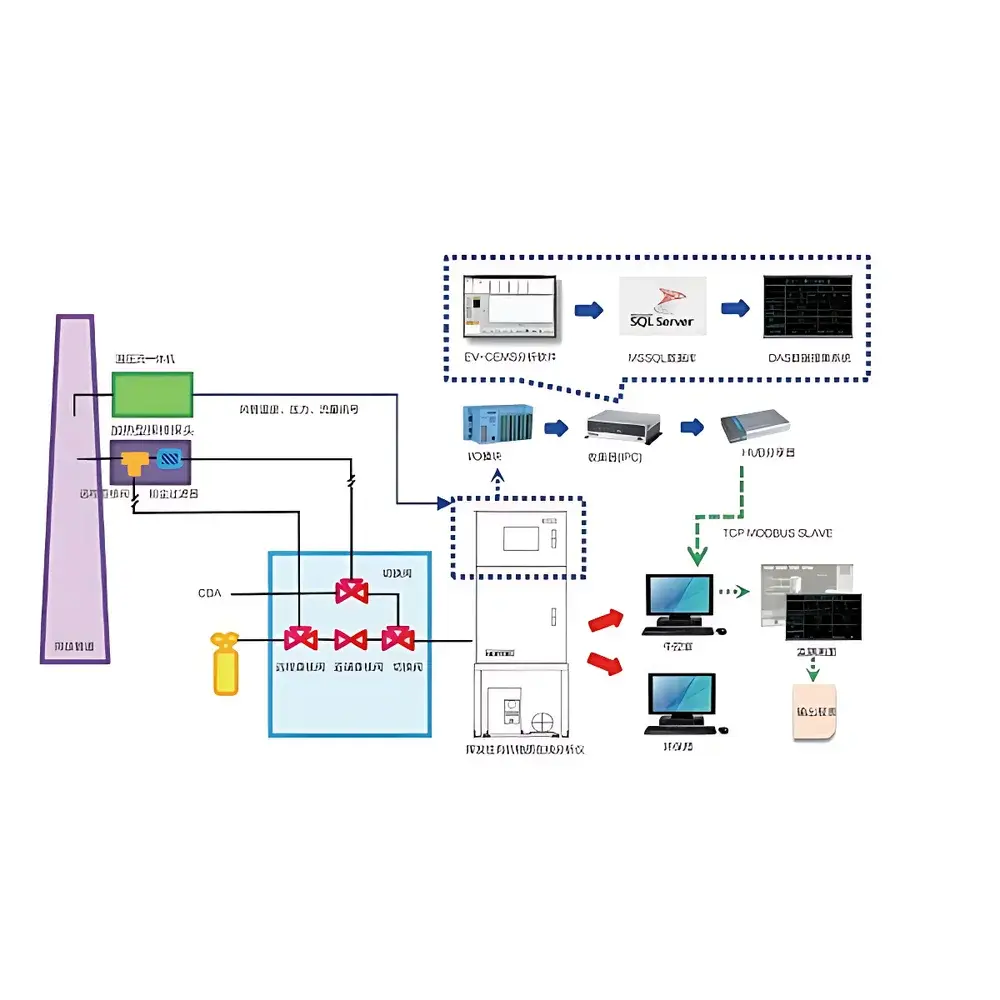
The Thermo Fisher Scientific EV-1000 VOCs Continuous Emission Monitoring System (CEMS) is a fully integrated, GC-FID–based online analyzer engineered for regulatory-grade measurement of volatile organic compounds (VOCs) from stationary emission sources. Designed in strict alignment with U.S. EPA Method 25A, ASTM D6348, and China’s HJ 38–2017 (“Determination of Total Hydrocarbons, Methane, and Non-Methane Hydrocarbons in Exhaust Gases from Stationary Sources by Gas Chromatography”), the system delivers trace-level quantification of total hydrocarbons (THC), methane (CH₄), and non-methane hydrocarbons (NMHC), as well as speciated VOCs—including benzene, toluene, xylene (BTX), alcohols, ketones, alkenes, and high-reactivity VOCs (HRVOCs). Its core architecture employs dual-stage thermal management: a precisely controlled oven housing both the GC column and six-port switching valve, coupled with heated sample lines (up to 180 °C optional) to prevent condensation, adsorption, or carryover—critical for maintaining analytical integrity across humid, particulate-laden, or low-concentration industrial effluent streams.
Key Features
- Multi-point sequential monitoring capability via a robust 6-port rotary valve, enabling time-resolved sampling from up to six independent exhaust ducts without hardware reconfiguration.
- Modular GC column configuration supporting method customization—e.g., dual-column parallel separation or extended-length capillary columns—for enhanced resolution of co-eluting HRVOCs and oxygenated VOCs.
- Integrated thermal management: oven temperature control (±0.1 °C stability) and heated transport lines minimize analyte loss and memory effects, ensuring long-term reproducibility (RSD <1 % f.s. over 7-day operation).
- Dual validation architecture: Remote A-valve diagnostic checks line integrity (leak detection, blockage, contamination); local B-valve self-test verifies detector response, baseline stability, and electronic gain—providing actionable diagnostics for predictive maintenance.
- Full-system automation: Onboard calibration sequence execution, automatic zero/span verification, real-time data processing (including NMHC calculation per HJ 38–2017), and embedded data logging compliant with GLP/GMP audit trail requirements.
- Intuitive 10.1″ capacitive touchscreen HMI with role-based access control (operator, engineer, administrator), supporting guided maintenance workflows, fault tree navigation, and firmware updates over secure HTTPS.
Sample Compatibility & Compliance
The EV-1000 accommodates complex, variable-composition gas matrices typical of industrial stack emissions—including humid flue gases (up to 85 % RH), low-flow ducts (<1 m/s), and high-particulate streams (with optional inline filtration). All wetted materials meet ASTM F2135 standards for hydrocarbon compatibility. The system satisfies performance criteria defined in HJ 38–2017, EU EN 15267-3 (QAL1 certification readiness), and U.S. EPA PS-8 for continuous hydrocarbon monitoring. Data acquisition and storage comply with 21 CFR Part 11 requirements for electronic records and signatures when configured with audit-trail-enabled software. Optional integration with third-party SCADA systems supports ISO 50001 energy management reporting and environmental KPI dashboards.
Software & Data Management
Firmware v3.2+ includes Thermo Fisher’s CEMS-Link™ embedded software suite, featuring real-time chromatogram visualization, peak integration using iterative least-squares deconvolution, and automated retention time locking (RTL) for method robustness. Raw chromatographic data (time-stamped .CDF files) and processed results (CSV/Excel) are stored locally on encrypted 64 GB eMMC with 12-month retention. Remote access enables secure web-based review, alarm acknowledgment, and configuration export/import via TLS 1.2–secured connections. Modbus TCP output supports direct integration into DCS environments; optional OPC UA server module enables IIoT-ready interoperability with cloud platforms (e.g., AWS IoT Core, Azure IoT Hub) for centralized fleet monitoring and AI-driven anomaly detection.
Applications
The EV-1000 is deployed across regulated industrial sectors requiring continuous, legally defensible VOC data: petroleum refining (FCCU, coker off-gas), petrochemical cracking units, pharmaceutical API synthesis vents, printed circuit board (PCB) etching and soldering lines, automotive paint booths, composite manufacturing (resin curing), rubber vulcanization, and surface coating operations (coil, can, wood). It is also utilized by third-party environmental testing laboratories for stack compliance audits, fugitive emission surveys (LDAR support), and ambient air quality reference monitoring where speciated VOC profiles inform ozone precursor modeling.
FAQ
What regulatory methods does the EV-1000 validate against?
The system is factory-verified per HJ 38–2017 and meets the technical specifications of EPA Method 25A and ASTM D6348 for THC/NMHC determination.
Can the system measure individual VOC species—not just total hydrocarbons?
Yes—when equipped with customized GC column sets and calibrated multi-component standards, it quantifies ≥25 target VOCs including benzene, formaldehyde (via derivatization), acetone, isoprene, and 1,3-butadiene.
How frequently must calibration be performed?
Per HJ 38–2017, daily zero/span checks are recommended; full multi-point calibration is required at intervals determined by site-specific QA/QC protocols (typically monthly), programmable within the HMI.
Is the system suitable for high-humidity or corrosive stack gases?
Standard configuration includes Nafion™-based moisture removal and Hastelloy®-lined sample conditioning; optional acid gas scrubbers (SO₂/NOₓ) and heated filter housings extend operational range to aggressive process streams.
Does the EV-1000 support remote diagnostics and firmware updates?
Yes—via embedded cellular (LTE-M) or Ethernet connectivity, with authenticated SSH/TLS access, remote log retrieval, and over-the-air firmware deployment under change-controlled release management.
Related Products







