
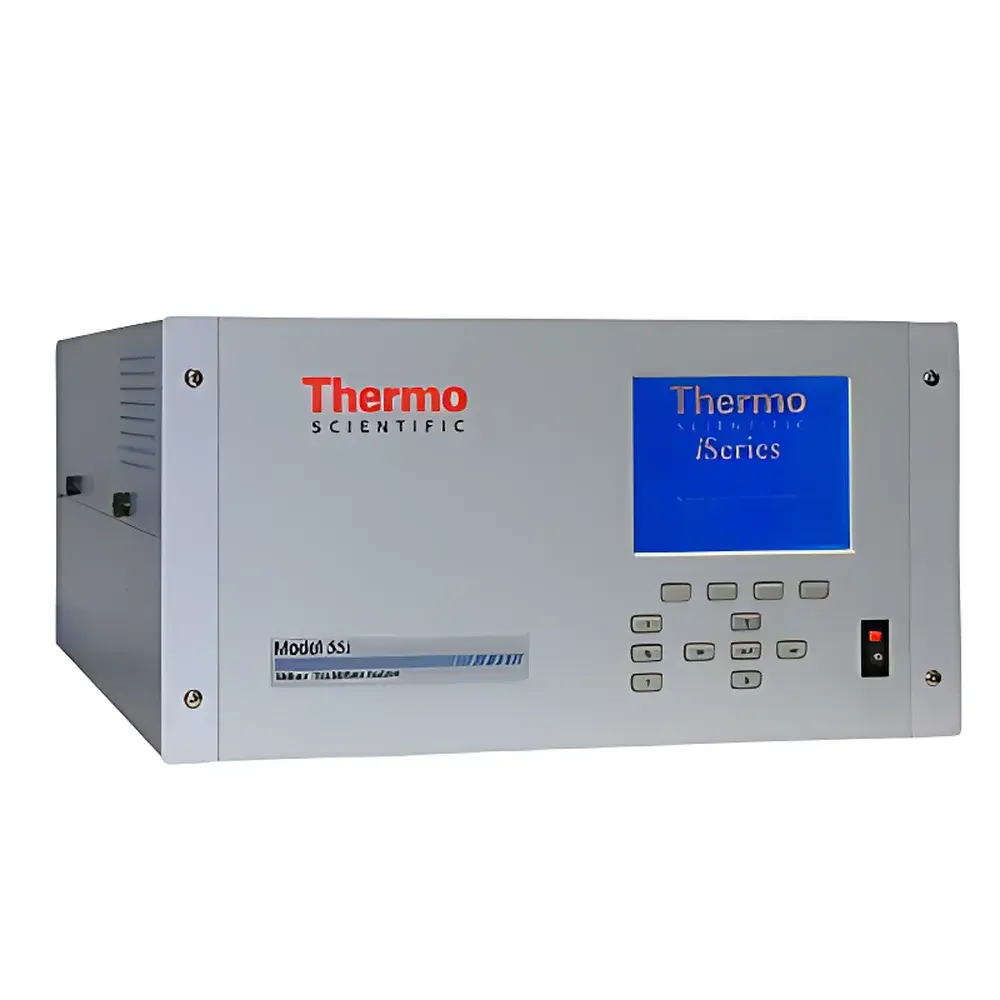
Thermo Scientific 55i Methane and Non-Methane Hydrocarbons Analyzer
| Brand | Thermo Fisher |
|---|---|
| Origin | USA |
| Manufacturer Type | Original Equipment Manufacturer (OEM) |
| Product Origin | Imported |
| Model | Thermo Scientific 55i |
| Detection Principle | Gas Chromatography (GC) with Flame Ionization Detection (FID) |
| Instrument Type | Online Continuous Emission Monitor |
| Configuration | Dual-Channel GC-FID for Simultaneous CH₄ and NMHC Quantification |
| Measurement Ranges | 0–5/50/500 ppm |
| Resolution | 0.050 ppm CH₄ |
| Accuracy | ±2% of reading or ±50 ppb (whichever is greater) |
| Response Time (t₉₀) | 70 s |
| Zero Noise | 0.025 ppm RMS (300-s averaging) |
| MDL | 0.050 ppm CH₄ |
| Span Drift (24 h) | <2% of full scale |
Overview
The Thermo Scientific 55i Methane and Non-Methane Hydrocarbons Analyzer is a certified online gas chromatograph designed for continuous, regulatory-grade measurement of methane (CH₄) and total non-methane hydrocarbons (NMHC) in ambient air, stack emissions, and process streams. Engineered for precision and long-term stability, the 55i employs dual-column gas chromatography coupled with flame ionization detection (GC-FID) to achieve baseline separation of C₁–C₁₂+ hydrocarbons—ensuring that methane is quantified independently from higher alkanes, alkenes, aromatics, and oxygenated VOCs. Unlike catalytic oxidation-based NMHC analyzers, the 55i eliminates reliance on consumable catalysts or high-temperature converters, thereby eliminating risk of catalyst poisoning, calibration drift due to aging, or interference from CO, H₂, or halogenated compounds. Its fully automated thermal management system maintains column oven temperature stability within ±0.1 °C, supporting reproducible retention times and robust peak integration across extended unattended operation.
Key Features
- Dual-channel GC-FID architecture enabling simultaneous, independent quantification of CH₄ and NMHC without mathematical subtraction or correction algorithms
- Auto-ignition FID with real-time flame status monitoring and automatic re-ignition upon flame-out
- Configurable multi-range measurement capability (0–5/50/500 ppm up to 0–50/500/5000 ppm), selectable via software or front-panel interface
- Integrated zero/span validation system compliant with EPA Method 25A and EN 12619 requirements
- Robust industrial enclosure rated IP54, suitable for outdoor cabinet or shelter installation with optional heated sample line support
- Onboard diagnostics including detector voltage, column head pressure, carrier gas flow verification, and GC oven temperature logging
Sample Compatibility & Compliance
The 55i accepts gaseous samples at ambient or elevated temperatures (up to 60 °C inlet), with particulate filtration (≤0.5 µm) and moisture removal (dew point ≤−10 °C) recommended upstream. It complies with U.S. EPA Performance Specification 8 (PS-8) for NMHC analyzers and meets key elements of EN 15267-3 for automated measuring systems. Data integrity protocols align with 21 CFR Part 11 requirements when operated with Thermo’s optional TraceFinder™ or Qtegra™ IS software, supporting electronic signatures, audit trails, and secure user access control. The analyzer is routinely deployed in applications requiring adherence to ISO 11843-7 (detection limit estimation), ASTM D6348 (gaseous emission testing), and EU Industrial Emissions Directive (IED) monitoring mandates.
Software & Data Management
The 55i interfaces seamlessly with Thermo Scientific’s Qtegra Intelligent Scientific Data Solution (ISDS) or TraceFinder™ software for method development, calibration curve generation, and compliance reporting. All chromatographic parameters—including injection volume, oven ramp profiles, detector gain, and peak integration settings—are stored as encrypted method files with version history. Raw GC data (time-stamped chromatograms, detector signals, and system logs) are retained locally for ≥30 days and can be exported in ASTM E1394-compliant .csv or .xml formats. Remote monitoring is supported via Modbus TCP/IP or OPC UA, enabling integration into SCADA, DCS, or centralized environmental data management platforms (EDMPs). Audit trail records capture all operator actions, calibration events, and configuration changes with user ID and timestamp.
Applications
- Ambient air quality monitoring networks (e.g., EPA Photochemical Assessment Monitoring Stations – PAMS)
- Landfill gas and biogas composition analysis for energy recovery optimization
- Fugitive emission detection and quantification at refineries, chemical plants, and natural gas distribution facilities
- Regulatory NMHC compliance reporting under Title V permits and California South Coast AQMD Rule 1148
- Research studies on atmospheric VOC speciation, ozone formation potential, and secondary organic aerosol (SOA) precursors
- Calibration verification of photoionization detectors (PIDs) and portable GC systems using traceable CH₄/NMHC reference standards
FAQ
Does the 55i require external calibration gases for daily operation?
No—while periodic span calibration (typically every 7–14 days) is required per regulatory guidelines, the 55i supports automated zero/span checks using internal solenoid valves and integrated calibration gas manifolds. Certified CH₄-in-air and propane-in-air standards (traceable to NIST SRMs) are used for NMHC equivalent response calibration.
Can the 55i distinguish between ethane and ethylene?
Yes—the dual-column GC configuration resolves C₂H₆ and C₂H₄ with baseline separation under standard EPA Method 25A conditions, enabling compound-specific quantification when configured with appropriate column chemistry and temperature programming.
What maintenance intervals are recommended for the FID and GC columns?
FID jet cleaning is advised every 6 months; capillary column replacement is typically required every 12–18 months depending on sample matrix cleanliness. Full preventive maintenance (PM) kits and service schedules are documented in the OEM Operations Manual (PN: 09100000-001).
Is the 55i compatible with third-party data acquisition systems?
Yes—via analog 4–20 mA outputs, digital RS-232/RS-485 serial communication, or Ethernet-based Modbus TCP, the 55i provides real-time concentration values, system status flags, and diagnostic codes for integration with legacy or modern industrial control infrastructures.







