
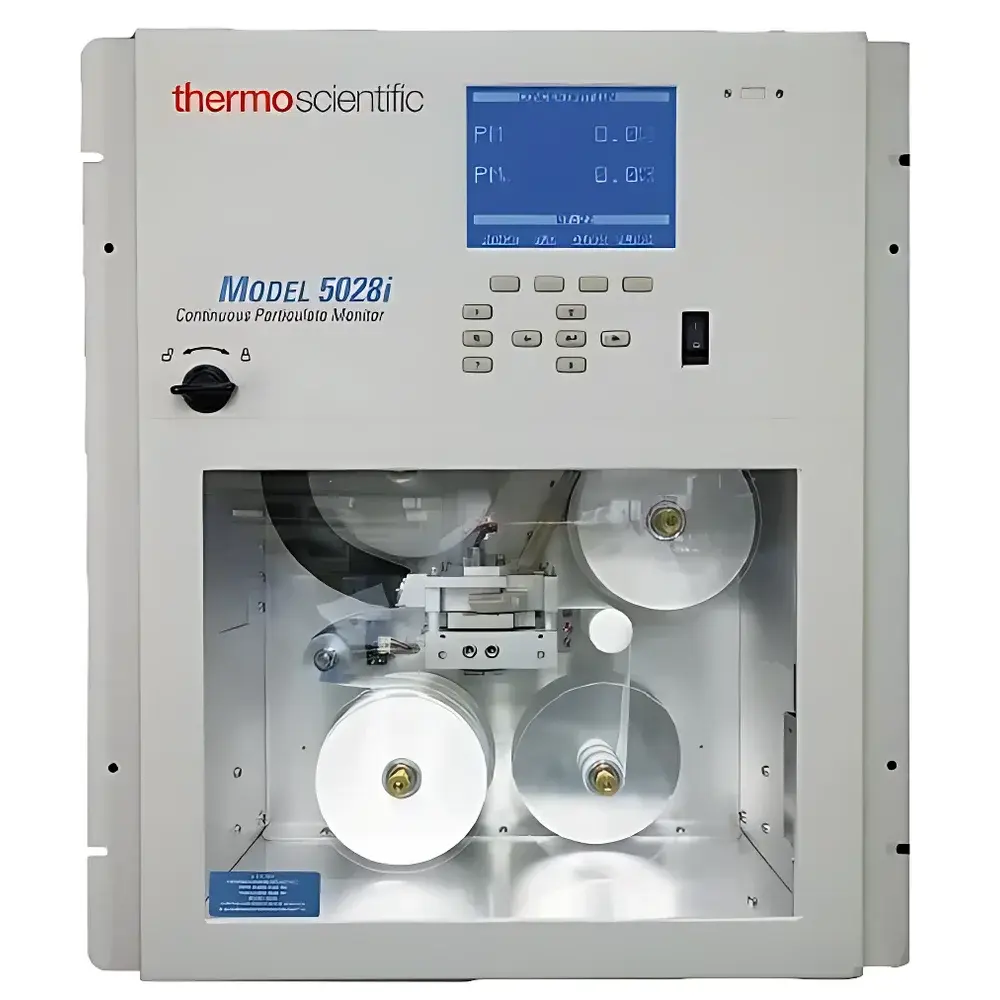
Thermo Scientific 5028i Continuous Particulate Matter Monitor
| Brand | Thermo Fisher |
|---|---|
| Origin | USA |
| Manufacturer | Thermo Fisher Scientific |
| Product Type | Imported Instrument |
| Model | 5028i |
| Measurement Principle | Beta-ray Attenuation |
| Measured Parameters | PM₁₀ and PM₂.₅ |
| Measurement Range | 0–10 mg/m³ (0–10,000 µg/m³) |
| Sampling Flow Rate | 1 m³/h (16.67 L/min) |
| Detection Limit | <1 µg/m³ (24-hr, 2σ) |
| Data Output Interval | 1 s |
| Flow Stability | ±2% accuracy, <5% deviation |
| Regulatory Certification | US EPA EQPM for PM₁₀ (EQPM1102-150) and PM₂.₅ (EQPM0609-183) |
Overview
The Thermo Scientific™ Model 5028i Continuous Particulate Matter Monitor is a dual-channel, real-time ambient air monitoring instrument engineered for regulatory-grade measurement of PM₁₀ and PM₂.₅ mass concentrations. It employs beta-ray attenuation spectroscopy—based on the exponential absorption of beta particles (emitted from a carbon-14 source, activity <3.7 MBq) as they pass through accumulated particulate matter on filter media—to quantify aerosol mass loading with high reproducibility and long-term stability. Unlike stepwise or sequential sampling systems, the 5028i implements true simultaneous, independent measurement across two physically separated sampling trains: one conditioned with a PM₁₀ inlet and cyclone separator, the other with a PM₂.₅ sharp-cut impactor. This architecture eliminates cross-channel interference and enables concurrent, time-synchronized concentration reporting—critical for compliance with U.S. EPA Federal Reference Methods (FRM) and Federal Equivalent Methods (FEM), including certified equivalency under EQPM1102-150 (PM₁₀) and EQPM0609-183 (PM₂.₅).
Key Features
- Dual independent sampling channels with dedicated PM₁₀ and PM₂.₅ inlets, flow controllers, and beta-attenuation detection modules
- Continuous, unidirectional filter tape advancement—minimizing particle re-entrainment and mechanical loss during transport
- Extended-length filter tape cartridge supporting up to 30 days of unattended operation at standard flow (1 m³/h)
- Integrated dynamic heating system enabling user-configurable temperature or relative humidity control of the sample stream to mitigate volatilization and moisture-related bias
- Onboard rechargeable battery maintaining operational continuity during brief power interruptions and reducing post-outage stabilization time
- Real-time flow calibration via thermal mass flow sensor with ±2% full-scale accuracy and traceable NIST-certified validation
- Automated tape advancement triggered by user-defined criteria: cumulative mass loading, elapsed time, or differential pressure across the filter medium
Sample Compatibility & Compliance
The 5028i is validated for ambient outdoor air monitoring in urban, suburban, industrial, and background environments. Its inlet design conforms to ISO 7708:1995 and EPA 40 CFR Part 53 specifications for size-selective sampling. The instrument meets U.S. EPA requirements for FEM designation and supports data integrity protocols aligned with 21 CFR Part 11 (electronic records/signatures) when paired with Thermo’s optional compliance-ready software suite. All mass calibration procedures utilize NIST-traceable polyester membrane filters with certified mass deposition (±5% uncertainty), ensuring metrological traceability across the full 0–10 mg/m³ range. The system is designed for deployment in GLP- and GMP-regulated environmental monitoring networks where audit-ready calibration logs, maintenance histories, and raw attenuation signal archives are required.
Software & Data Management
Data acquisition and instrument control are managed via Thermo’s iSeries Command Center—a Windows-based application supporting local configuration, remote diagnostics, and automated report generation. Raw beta-count data, flow rate, temperature, humidity, and tape position are timestamped at 1-second intervals and stored internally (≥30 days) or streamed via Ethernet/RS-232 to central SCADA or EPA AirNow-compatible platforms. Export formats include CSV, XML, and EPA AQS-compliant ASCII. Audit trails record all parameter changes, calibration events, and maintenance interventions with operator ID and UTC timestamps. Optional firmware upgrades enable enhanced data smoothing algorithms, multi-point flow verification routines, and configurable alarm thresholds for flow deviation, tape exhaustion, or radiation source decay compensation.
Applications
- Regulatory ambient air quality monitoring networks (e.g., U.S. EPA AQS, EU Air Quality Directive stations)
- Industrial fence-line and stack emission verification where co-located PM₁₀/PM₂.₅ differentiation is mandated
- Long-term trend analysis for epidemiological and climate research requiring high temporal resolution and metrological consistency
- Calibration reference for optical scattering monitors (e.g., nephelometers, TEOMs) in field intercomparison studies
- Mobile monitoring deployments using vehicle-mounted or trailer-based configurations with integrated GPS and environmental sensors
FAQ
What regulatory standards does the 5028i meet?
It is certified by the U.S. EPA as an Equivalent Method (EQPM) for both PM₁₀ (EQPM1102-150) and PM₂.₅ (EQPM0609-183), satisfying 40 CFR Part 53 requirements for federal reference and equivalent methods.
How is moisture interference mitigated during sampling?
The integrated dynamic heating system allows users to set target sample line temperature or dew point, reducing adsorbed water mass and minimizing evaporative loss of semi-volatile compounds during filtration.
Is the beta source replaceable in the field?
No—the carbon-14 source is sealed within a stainless-steel capsule and certified for 10+ years of operational life; replacement requires return to an authorized Thermo service center and regulatory notification per national radioactive materials licensing requirements.
Can the 5028i operate without external power for extended periods?
Yes—the internal rechargeable battery sustains critical functions—including flow control, detector operation, and data logging—for up to 4 hours during mains failure, and significantly reduces warm-up and stabilization time upon power restoration.
What is the minimum detectable concentration over a 24-hour averaging period?
The instrument achieves a method detection limit of <1 µg/m³ at 2σ confidence level for 24-hour integrated measurements, consistent with EPA performance targets for network-grade PM monitoring.







