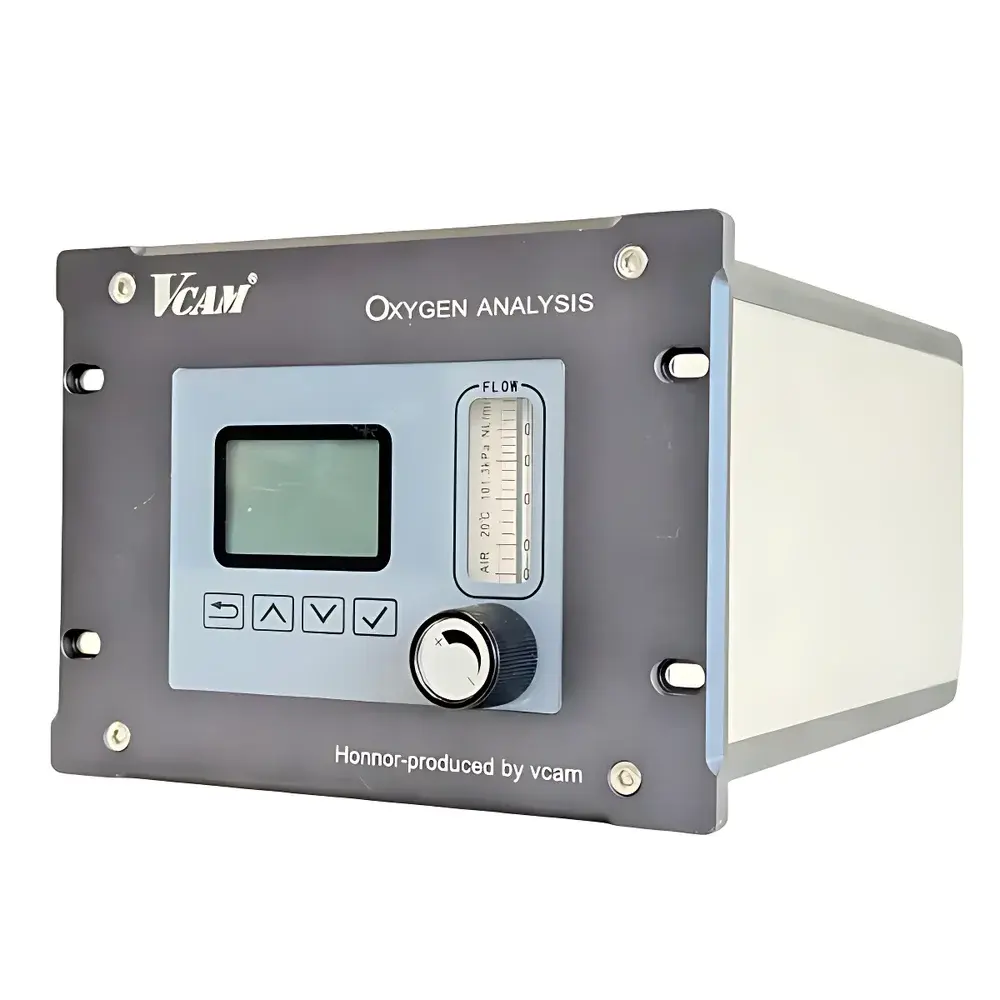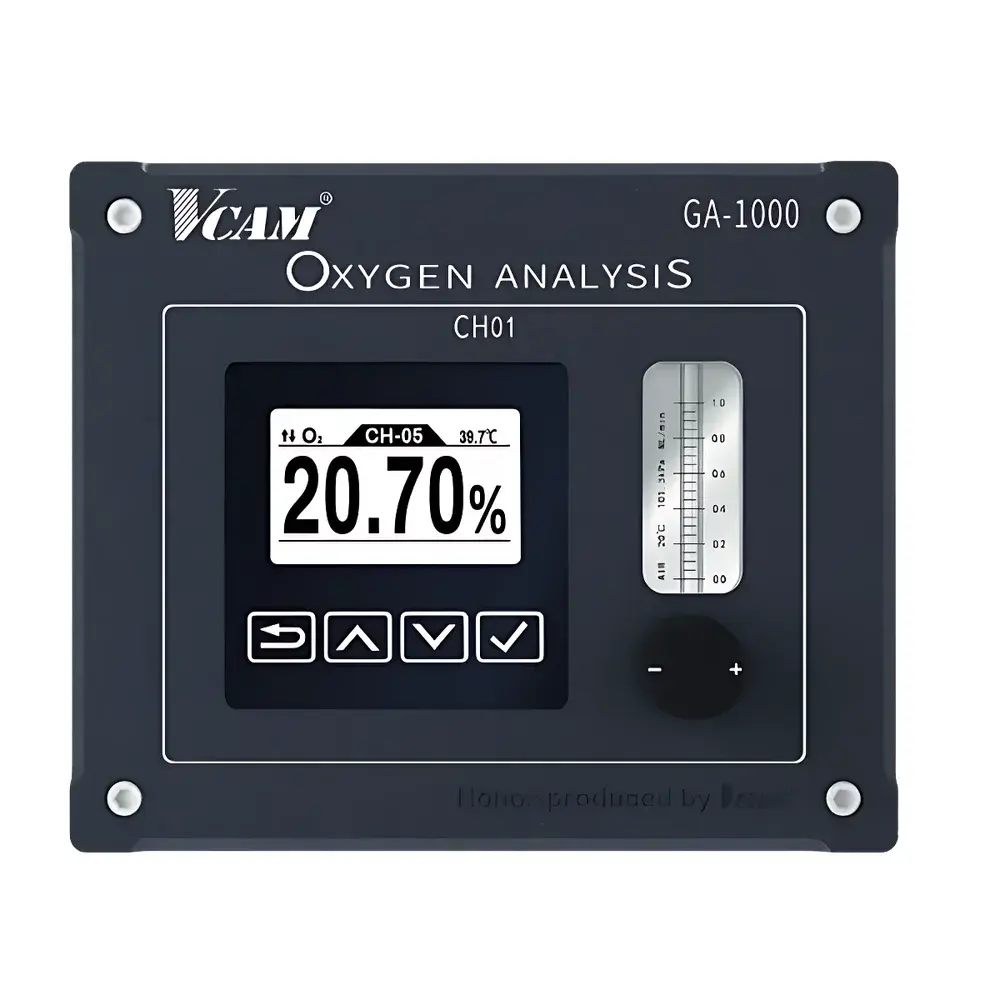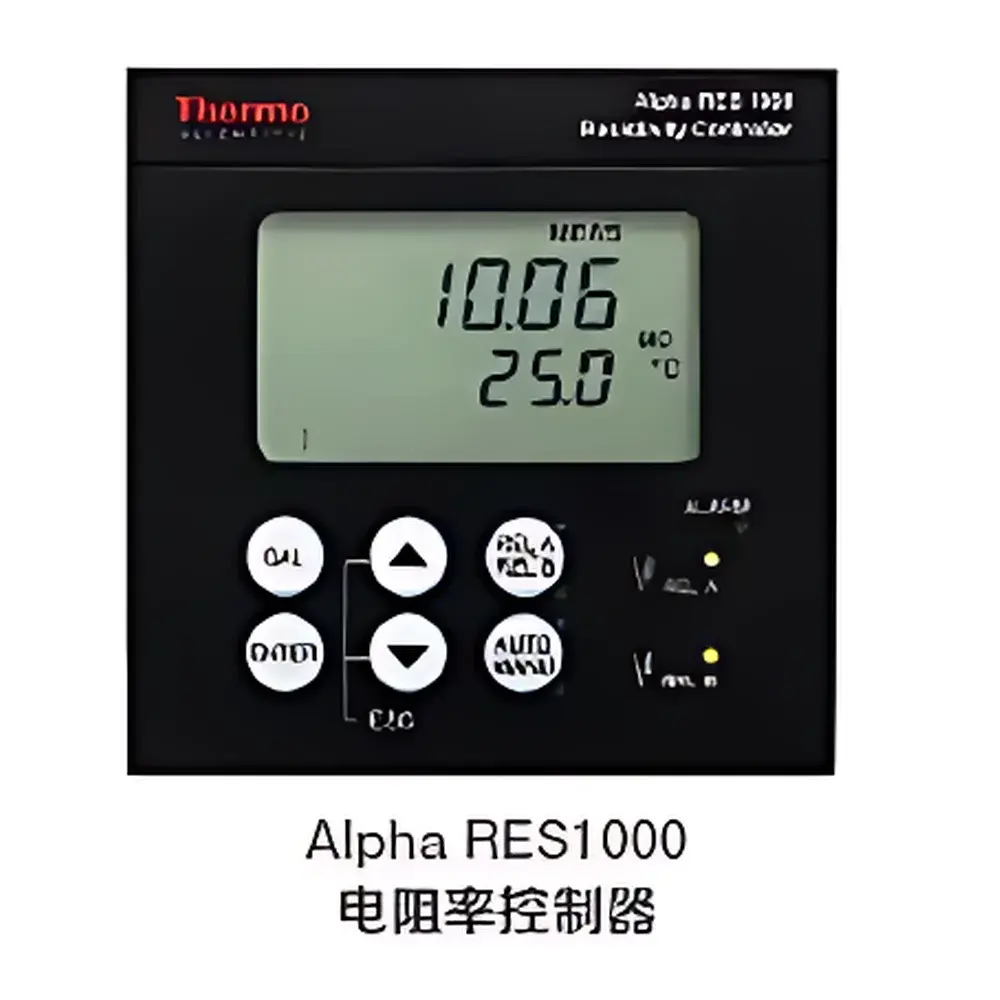
Thermo Scientific Alpha RES1000 Resistivity Controller
| Brand | Thermo Fisher |
|---|---|
| Origin | USA |
| Manufacturer | Thermo Fisher Scientific |
| Product Type | Imported Industrial Online Conductivity/Resistivity Analyzer |
| Model | Thermo Scientific Alpha RES1000 |
| Pricing | Upon Request |
Overview
The Thermo Scientific Alpha RES1000 Resistivity Controller is a high-precision, microprocessor-based online analyzer engineered for continuous monitoring and control of resistivity (or conductivity) in demanding industrial process environments. It operates on the principle of two-electrode or four-electrode conductometric measurement, with automatic temperature compensation (ATC) applied using integrated Pt100/Pt1000 sensors. Designed specifically for applications where ultrapure water quality, chemical concentration stability, or ionic contamination must be tightly regulated — such as semiconductor rinse tanks, pharmaceutical water-for-injection (WFI) loops, and electroplating bath management — the RES1000 delivers stable, drift-free measurements under variable flow, pressure, and ambient conditions. Its robust architecture supports both resistivity (kΩ·cm to MΩ·cm) and conductivity (µS/cm to mS/cm) modes, with full linearization across 10 selectable ranges to accommodate diverse sample chemistries and electrode configurations.
Key Features
- 10 programmable conductivity/resistivity measurement ranges — selected directly via front-panel interface for optimal signal-to-noise ratio and resolution
- Configurable electrode constant (K = 0.01–10.0 cm⁻¹) with automatic K-factor validation during calibration
- Dual independent 4–20 mA analog outputs — fully assignable to primary measurement, temperature, alarm status, or control output signals
- HOLD relay function — enables interlocking with level switches, flow meters, or external safety controllers for fail-safe process shutdown
- Programmable hysteresis (dead band) — adjustable from 0.1% to 10% of span to prevent relay chatter near setpoints
- Relay delay timer — user-defined activation delay (0–2000 s) for alarm and control relays to suppress transient excursions
- Self-cleaning relay output — configurable cycle duration and interval for automated electrode cleaning sequences
- Non-volatile memory — retains calibration coefficients, configuration settings, and system diagnostics through power loss or unexpected shutdown
- Cable resistance compensation — linear correction for lead wire resistance up to 500 Ω, critical for long-distance sensor installations
- Backlit dual-line LCD display — simultaneously shows real-time resistivity/conductivity value and temperature, with icon-driven status indicators for alarms, calibration mode, and relay activity
- Two-wire or three-wire Pt100/Pt1000 temperature input support — compliant with IEC 60751 Class B tolerances
- Two-level password protection — separate access levels for operator and engineer functions to ensure regulatory compliance and configuration integrity
Sample Compatibility & Compliance
The Alpha RES1000 is validated for use with standard industrial conductivity cells (e.g., toroidal, graphite, stainless steel, or platinum electrodes) and compatible with aggressive media including deionized water, caustic etchants (NaOH), acidic baths (H₂SO₄, HCl), and organic solvent blends common in printed circuit board (PCB) manufacturing. It meets electromagnetic compatibility requirements per EN 61326-1 (industrial environment) and carries CE, UL/cULus, and ATEX/IECEx certifications for hazardous area installation (Zone 2 / Class I Div 2). The device supports audit-ready operation under FDA 21 CFR Part 11 when paired with Thermo Scientific Orion Star™ Connect software, enabling electronic signatures, change tracking, and secure data archiving aligned with GLP and GMP practices.
Software & Data Management
While the RES1000 operates autonomously via its front panel, optional integration with Thermo Scientific’s Orion Star™ Connect PC software enables remote configuration, trend logging, and calibration report generation. All calibration events — including date/time stamp, operator ID, reference standard used, and post-calibration deviation — are stored in internal memory and exportable via USB or RS-232. The controller supports Modbus RTU over RS-485 for integration into DCS/SCADA systems, with register mapping documented per ISA-88 and ISA-95 conventions. Firmware updates are performed via secure USB key with cryptographic signature verification to maintain system integrity.
Applications
- Ultrapure water (UPW) monitoring in semiconductor fabrication rinse stations and boiler feedwater systems
- pH-independent ionic purity verification in pharmaceutical purified water (PW) and water-for-injection (WFI) distribution loops
- Real-time control of etchant concentration in PCB manufacturing (e.g., CuCl₂, FeCl₃ baths)
- Electroplating bath management — nickel, copper, gold, and chromium plating solutions
- Chemical dosing feedback in municipal and industrial wastewater neutralization processes
- Monitoring of cleaning solution conductivity in automotive and aerospace component washing lines
- Validation of deionization efficiency in laboratory-grade water purification systems
FAQ
Does the Alpha RES1000 support four-electrode (inductive) conductivity measurement?
No — it is designed exclusively for two-electrode contact-type sensors. Four-electrode cells require the Thermo Scientific Orion 5-Star or AquaMate platforms.
Can the 4–20 mA outputs be scaled independently for different parameters?
Yes — each output can be assigned and scaled separately to resistivity, temperature, % saturation, or control error signal.
Is NIST-traceable calibration supported out of the box?
Yes — the unit accepts certified KCl standards (e.g., 84 µS/cm, 1413 µS/cm, 12.88 mS/cm) and stores calibration history with uncertainty values per ISO/IEC 17025 guidelines.
What is the maximum allowable cable length between the controller and sensor?
Up to 100 meters with shielded twisted-pair cable (AWG 22), provided cable resistance compensation is enabled and Pt1000 temperature sensing is used.
Does the device comply with USP for purified water testing?
It meets the instrumental performance criteria specified in USP , but final system qualification (including sensor validation and installation qualification) remains the responsibility of the end user per GAMP 5 guidance.
Related Products